
Renting a boat in Croatia can mean anything from hiring a small motorboat for a day of swimming to chartering a sailing yacht or catamaran for a week between the islands. The right option depends on your boating experience, licence, group size, route and how much responsibility you want to take for navigation and weather decisions.
Croatia has a large charter industry and excellent boating areas around Istria, Zadar, Šibenik, Split and Dubrovnik. You can rent bareboat if your qualifications are accepted, add a professional skipper, or choose a fully crewed yacht.
This guide explains how boat rental in Croatia works, which licences may be required, what costs to expect beyond the advertised rental price, what to check before signing the contract and the main Croatian navigation, anchoring and safety rules visitors should understand.
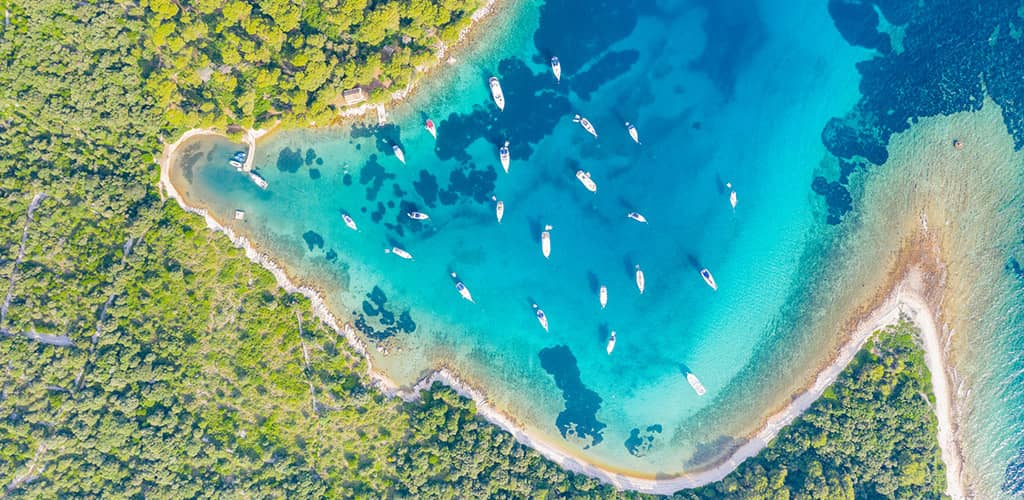
Boat rental options in Croatia
The phrase “boat rental in Croatia” covers several different types of trip. Before comparing prices, decide whether you want a simple day on the water or a boat that will also be your accommodation for several nights.
| Rental type | Best for | Typical use | Main consideration |
|---|---|---|---|
| Small motorboat or RIB | Couples, families and small groups | Beaches, coves and nearby islands | Licence/skipper and fuel |
| Sailing yacht | Sailors and multi-day trips | Island hopping and overnight cruising | Experience, weather and berths |
| Catamaran | Families and larger groups | Comfortable multi-day cruising | Higher rental and berth costs |
| Motor yacht | Groups prioritizing speed and comfort | Longer distances and premium trips | Fuel consumption |
| Skippered charter | Visitors without suitable qualifications or experience | Day trips or multi-day cruises | Skipper fee and accommodation arrangements |
| Fully crewed yacht | Service-focused groups | Luxury multi-day cruising | Highest overall cost |
Day boat rental or multi-day yacht charter?
Day boat rental
A half-day or full-day motorboat or RIB is the simplest way to explore nearby bays, beaches and islands. These rentals are widely available in coastal destinations and may be offered either bareboat or with a skipper.
A day rental normally requires less planning than a yacht charter, but you should still confirm the licence requirements, fuel policy, security deposit, permitted navigation area and what time the boat must be returned.
Multi-day yacht charter
A multi-day sailing yacht, catamaran or motor-yacht charter involves more than hiring transport. The boat becomes your accommodation, and you need to plan provisioning, overnight berths, water and fuel, weather, route changes and return procedures.
Weekly yacht charters also commonly involve formal check-in and technical handover, a larger security deposit and mandatory charter packages or cleaning charges.
Which type of boat should you rent?
RIB or small motorboat
A RIB or small motorboat is one of the best choices for a single-day trip. It is useful for reaching nearby beaches and coves quickly and can cover more distance than a slow displacement boat.
Fuel consumption can vary substantially with engine size and speed, so clarify how fuel is charged before booking.
Sailing yacht
Sailing yachts suit travelers who want the journey itself to be part of the holiday. They are generally more economical on fuel than fast motorboats, but a bareboat sailing charter requires genuine sailing and manoeuvring experience.
Catamaran
Catamarans offer more deck and interior space and are particularly popular with families and larger groups. Their shallow draft can be useful in some anchorages, but they generally cost more to charter and often pay higher marina and quay fees because of their width.
Motor yacht
A motor yacht provides speed, range and comfort, but fuel can become one of the largest variable costs of the trip. Ask for realistic consumption information rather than judging the holiday only by the headline charter price.
Croatia Boat Rentals: See availability and prices
Do you need a boat licence to rent a boat in Croatia?
If you rent with a professional skipper, guests do not need to qualify as the vessel's skipper. If you want to operate a bareboat yourself, the situation is different.
Your skipper qualification must be accepted by the Croatian authorities for the type and size of vessel and the navigation area involved. Do not assume that every recreational boating or sailing certificate issued abroad is automatically valid for chartering in Croatia.
Croatia's Ministry of the Sea maintains an official list of recognized foreign certificates, including the conditions and limitations attached to individual qualifications.
Check Croatia's official list of recognized skipper certificates
Before paying the final balance for a bareboat charter, send a copy of your qualification to the charter company and obtain confirmation that it is accepted for the vessel you intend to rent.
A licence alone may not be enough for every operator. Charter companies can also consider whether the skipper has sufficient practical experience for the size and type of boat.
Do you need a VHF or radio licence?
Many charter boats carry VHF or GMDSS-VHF radio equipment. Depending on the skipper qualification and vessel, an appropriate radio certificate may also be required.
The safest approach is to check the exact entry for your skipper qualification in Croatia's recognized-certificate list and ask the charter company to confirm which documents they require.
Do not arrive at the charter base assuming a sailing certificate alone automatically covers the vessel's radio equipment.
Bareboat, skippered or fully crewed charter?
Bareboat charter
Bareboat gives you the most freedom. Your group chooses the route and daily schedule, but the skipper is responsible for navigation, weather interpretation, manoeuvring, anchoring and the safe operation of the vessel.
Choose bareboat because the nominated skipper is genuinely comfortable handling the boat, not simply because removing the skipper fee makes the advertised price lower.
Skippered charter
A professional skipper is often the best choice when nobody has an accepted licence, when your practical experience is limited, or when you simply do not want responsibility for docking, navigation and weather decisions during the holiday.
A local skipper can also help with route choices, anchoring and overnight stops, but the final itinerary still needs to respond to weather and sea conditions.
For multi-day charters, check whether the skipper requires a dedicated cabin and whether your group is expected to provide the skipper's meals. This can affect how many guest berths are realistically available.
Fully crewed yacht
A fully crewed charter can add a host, chef, deck crew or other services depending on the vessel. This is the least hands-on option and is particularly suitable for groups who want a private yacht holiday without managing daily boat operations.
Best places to rent a boat in Croatia
Pula and Istria
Pula and the Istrian coast are good starting points for the northern Adriatic, including Brijuni and routes towards Kvarner. This region is particularly suitable for travelers who want something different from the classic central-Dalmatian island circuit.
Zadar, Sukošan and Biograd
Zadar, nearby Sukošan and Biograd are major bases for exploring Dugi Otok, the Zadar archipelago and the northern approach to Kornati.
The large number of islands and comparatively short distances between many stops make this region particularly attractive for multi-day cruising.
Šibenik and Murter
Šibenik and Murter are well positioned for the Kornati archipelago and surrounding islands. Routes can combine protected areas, smaller settlements and historic Šibenik without requiring long passages every day.
Split, Trogir and Kaštela
Split, Trogir and the surrounding marinas form one of Croatia's most important charter regions. Popular routes include Šolta, Brač, Hvar and Vis.
This is a strong first choice if you want the classic central-Dalmatian island-hopping experience and a large selection of sailing yachts, catamarans and motorboats.
Dubrovnik and southern Dalmatia
Dubrovnik is the natural starting point for the Elaphiti Islands, Mljet, Pelješac and Korčula.
A one-week Dubrovnik charter does not need to race north towards Split. Southern Dalmatia has enough islands, coves and historic towns for a complete route of its own.
For detailed local information, see our guide to renting a boat in Dubrovnik.
For route and sailing-region ideas, see our Sailing in Croatia guide.
How much does boat rental in Croatia cost?
There is no useful single average price for renting a boat in Croatia. A small day boat in May and a large catamaran in August are completely different products.
The final price depends on the boat type, size, age, charter base, season, duration, whether a skipper or crew is required and which mandatory extras are added to the advertised rental rate.
When comparing offers, calculate the total trip cost rather than comparing only the headline rental price.
| Cost | Why it matters |
|---|---|
| Base charter/rental price | The advertised price for the boat itself |
| Mandatory charter package | Can include cleaning, linen, handling or other base services |
| Skipper or crew | Usually charged separately unless explicitly included |
| Security deposit | Refundable if the vessel is returned according to the contract |
| Fuel | Can be modest on sailing yachts but substantial on fast motorboats |
| Marina, quay and buoy fees | Usually paid during the trip and vary by boat size and location |
| Provisioning | Food, drinks and supplies for the crew |
| Protected-area fees | Can apply in national parks and other managed areas |
| Transfers and optional equipment | Airport transfers, SUPs, extra towels, early check-in and similar extras |
What is normally included and what costs extra?
There is no universal Croatia charter package. Two boats with similar advertised weekly prices can have quite different mandatory extras.
Before booking, check whether the price includes final cleaning, bed linen, towels, dinghy, outboard motor, gas, marina berth at the charter base, WiFi and any mandatory handling or transit package.
Fuel is commonly charged according to use. For many rentals the boat is supplied with fuel and expected to be returned according to a specified fuel policy, but the exact arrangement should be confirmed in the contract.
Skipper fees, crew meals, overnight marina fees, tourist charges and national-park entry are commonly separate unless the offer explicitly says otherwise.
Security deposits and damage waivers
Bareboat and day-boat rentals commonly require a security deposit. The amount depends on the vessel and operator and can be substantially higher for larger or more valuable yachts.
The deposit may be taken as a card payment, pre-authorisation or another form specified by the rental company.
Some companies offer a damage or security-deposit waiver for an additional fee. Read the conditions carefully: paying for a waiver does not necessarily mean that every type of damage or loss is covered without further liability.
Before booking, check the rules for sails, propellers, dinghies, outboard motors, lost equipment, blocked toilets, negligence and underwater damage. These can be treated differently under individual contracts.
What to check before booking a boat
- Exact boat: Confirm the model, year, layout and permitted passenger capacity.
- Licence acceptance: Get written confirmation before a bareboat charter.
- Practical experience: Make sure the nominated skipper is comfortable with the boat size and type.
- Mandatory extras: Ask for the complete list rather than comparing only the advertised rate.
- Security deposit: Confirm the amount and payment method.
- Cancellation conditions: Pay attention to weather provisions as well as ordinary cancellation terms.
- Fuel policy: Confirm whether fuel is included and how the boat must be returned.
- Skipper arrangements: Check cabin and food requirements on multi-day charters.
- Check-in and return time: A seven-night charter does not always mean seven complete days of sailing.
- Included equipment: Check dinghy, outboard motor, bedding, towels and optional water-sports equipment.
- Technical assistance: Ask who to contact if a mechanical problem occurs during the rental.
- Navigation limits: Confirm where the contract allows the boat to be taken.
Boat check-in and technical handover
For a multi-day charter, allow enough time for the check-in process rather than planning to sail away immediately after reaching the marina.
The base may need to review identification and licences, collect fees and the security deposit, and complete a technical handover of the vessel.
Inspect the boat carefully before accepting it. Check the engine, electronics, sails where applicable, steering, fuel and water levels, toilets, refrigerator, dinghy, outboard motor, safety equipment and inventory.
Photograph existing damage before departure and make sure important defects are recorded on the handover documentation.
Also ask the base to demonstrate systems you have not used before. Ten minutes spent understanding batteries, water tanks, toilets or anchor controls can prevent significant problems later.
Croatian boating rules every renter should know
Rental-company instructions do not replace Croatian maritime regulations. The skipper is responsible for knowing the rules that apply to the vessel and area of navigation.
Distance from shore
Under Croatia's current navigation regulations, boats under 15 metres generally navigate at least 50 metres from shore. Larger vessels have greater minimum distances.
Exceptions apply when entering or leaving a harbour, approaching an anchorage or berth and in other situations where navigation closer to shore is necessary and permitted. In these situations, speed and manoeuvring must be appropriate to the circumstances.
Swimming areas
Do not drive through marked swimming areas. Boats under 15 metres must generally remain at least 50 metres from the boundary of an organized bathing area.
Extra caution is required around unmarked swimmers outside buoyed areas.
Divers
Keep at least 50 metres from the prescribed diver marker and maintain a proper lookout for divers and swimmers.
Speed near the coast
Within 300 metres of shore, in narrow channels and in approaches to ports and anchorages, a general maximum of 8 knots applies unless a lower local restriction or another specific rule applies.
Fast planing should take place only where and when it is legally permitted. Jet-powered and planing craft are subject to additional distance restrictions close to shore.
Anchoring near beaches
Anchoring is restricted around bathing areas and in other specifically protected or prohibited zones. As a general rule, anchoring is not permitted within 50 metres of the boundary of an organized bathing area or within 150 metres of the shore of a natural bathing area.
Local signs, harbour-master instructions, protected-area rules and organized mooring fields can impose additional restrictions.
National parks and protected areas
Some of Croatia's most attractive boating destinations lie within national parks and other protected areas. These can have separate vessel-entry fees, anchoring restrictions and designated moorings.
Kornati National Park is one of the most important examples. Boaters should check current vessel tickets and permitted navigation, anchoring and overnight arrangements before entering.
Mljet National Park also has specific visitor and boating arrangements.
Do not assume that because a bay is geographically accessible it is legal to anchor there. Rules inside protected areas take precedence over normal cruising habits.
Marinas, town quays, mooring buoys and anchoring
If you are chartering for several days, the choice of overnight stop affects both your route and your budget.
Marina
Marinas generally provide the widest range of services, including shore power, water, toilets and showers. They are convenient but are often the most expensive way to spend the night.
Town quay
A town quay places you directly beside restaurants and sightseeing. Facilities, reservation systems and charges vary considerably from one destination to another.
Mooring buoy
Organized mooring fields are common in Croatian bays. A buoy can provide a convenient alternative to a marina, but it is not necessarily free. Check who operates the field and what the fee includes.
Anchoring
Anchoring gives the greatest independence but requires suitable depth, holding ground, swing room and weather conditions. It must also be legal at that location.
Never choose an anchorage only because another boat is already there. Check the chart, local restrictions and forecast yourself.
Weather and marine forecasts
The Adriatic should not be described as automatically calm or easy. Conditions can change rapidly, and a competent bareboat skipper needs to understand both the forecast and the local effects of Croatia's main winds.
Bura is a northeasterly wind that can produce strong and highly variable gusts, particularly near mountain-backed parts of the coast and through channels.
Jugo is a southeasterly wind often associated with increasing swell, cloud and unsettled weather.
Maestral is a common summer northwesterly sea breeze and can provide enjoyable afternoon sailing during settled conditions.
For current conditions, use the Croatian Meteorological and Hydrological Service marine forecast rather than relying solely on a general weather app.
DHMZ Marine Forecast for Small Crafts
If the forecast is unsuitable, change the route or stay in harbour. A berth reservation or holiday itinerary should never pressure the skipper into making an unsafe passage.
For more detail on Croatian sailing regions and winds, see our complete Sailing in Croatia guide.
Best time to rent a boat in Croatia
The main recreational boating and charter season runs from spring into autumn, but the experience changes significantly by month.
| Period | What to expect |
|---|---|
| May | Quieter harbours and good availability, but cooler water and more variable weather than midsummer |
| June | Long days, increasingly warm sea and generally less pressure than July and August |
| July–August | Highest demand, hottest weather and greatest competition for popular boats and berths |
| September | Warm sea and usually less pressure than peak summer; one of the strongest shoulder-season options |
| April and October | Possible for experienced crews, but weather and seasonal services require more flexibility |
If a specific catamaran, newer yacht, particular base or exact travel week matters, book earlier for July and August. For an ordinary day boat, there may be more flexibility, but the most popular summer dates can still sell out.
Avoid relying on universal booking percentages or promises of guaranteed early-booking discounts. Availability changes by destination, vessel type and individual operator.
What to bring on a boat rental
For a day rental, pack light. Sunscreen, a hat, swimwear, drinking water, a towel and non-slip footwear cover most basic needs. A dry bag or waterproof phone case is useful for electronics and documents.
For a multi-day charter, soft-sided bags are much easier to store than rigid suitcases. Add personal medication, chargers, suitable deck shoes, warmer layers for evenings and a windproof jacket for unsettled weather.
Before buying or bringing bulky boating equipment, check what the charter already provides.
Who should hire a skipper?
Hire a skipper if you have any uncertainty about your licence being accepted, your experience with the vessel size, docking in busy marinas or your ability to make independent weather and navigation decisions.
A skipper is also a good choice if the qualified sailor in your group wants a holiday rather than spending the entire week responsible for the boat.
Bareboat is most suitable when the skipper's documents have already been confirmed and they are genuinely comfortable managing the vessel in changing conditions.
Frequently asked questions about renting a boat in Croatia
Can I rent a boat in Croatia without a licence?
Will my foreign boat licence be accepted in Croatia?
Do I need a VHF licence in Croatia?
Can I rent a boat in Croatia for one day?
Is fuel included in Croatian boat rentals?
Do I need to pay a security deposit?
Can a charter company refuse a bareboat rental even if I have a licence?
When is the best time to rent a boat in Croatia?
What should I do if bad weather is forecast?
For route ideas, sailing regions, winds and longer-trip planning, continue with our Sailing in Croatia guide. If you are renting locally in southern Dalmatia, see our detailed Dubrovnik boat rental guide.