
Croatia has one of the most extensive ferry networks in the Mediterranean, connecting the mainland with more than 40 inhabited islands and dozens of seasonal routes. Ferries are an essential part of travel planning, especially if you are visiting popular islands such as Hvar, Brač, Korčula, Mljet, or Vis.
Ferry booking in Croatia is generally straightforward, but it works differently from air or train travel. Ticket availability depends on the type of ferry, the route, the season, and whether you are travelling as a foot passenger or with a vehicle. Some routes require advance planning in summer, while others can be booked easily on the day of travel.
This guide explains how ferry booking in Croatia works, which ferry types and operators you will encounter, when you should book in advance, and what to expect when travelling between Croatian islands. It is designed to help you choose the right booking method and avoid common mistakes, whether you are planning island hopping or a single ferry crossing.
Types of Ferries You Can Book in Croatia
Before booking a ferry in Croatia, it is important to understand that not all ferries operate in the same way. The Croatian ferry system includes several distinct types of vessels, each serving different routes and travel needs. Choosing the right type affects ticket availability, travel time, and whether advance booking is necessary.
Car ferries (vehicles and passengers)
Car ferries are the backbone of island transport in Croatia. They carry vehicles and foot passengers and operate year-round on major island routes. These ferries are slower than catamarans but are essential if you plan to travel with a car, motorcycle, or camper.
Vehicle space is limited and allocated on a first-come, first-served basis for many routes. During the summer season, popular car ferry routes can sell out days in advance, making early booking or early arrival at the port important.
Passenger-only catamarans
Catamarans are fast passenger-only ferries that connect major coastal cities and islands. They are significantly quicker than car ferries and are commonly used for island hopping or day trips. Catamarans do not carry vehicles.
Seats on catamarans are limited, and tickets often sell out quickly in peak season. For popular summer routes, advance booking is strongly recommended, especially for morning departures.
International ferries
International ferry routes connect Croatia with neighboring countries, most commonly Italy. These ferries usually operate seasonally and function more like long-distance passenger services, often with assigned seating and stricter boarding procedures.
International ferry tickets should always be booked in advance, as availability is limited and schedules vary by season.
Book Your Ferry Tickets in Croatia
If you already know your travel dates or want to compare ferry options quickly, the booking tool below lets you search Croatian ferry routes, check availability, and see official schedules in one place.
The search includes major Croatian ferry operators and shows both car ferries and passenger-only catamarans where available. It is especially useful in summer, when popular routes can sell out and departure times matter.
For flexible travel outside peak season, you can also buy tickets directly at the port. However, if you need a specific departure, are travelling with a vehicle, or are planning island hopping, booking in advance is usually the safer option.
Tip: Morning departures and fast catamarans are the first to sell out in summer.
Main Ferry Operators in Croatia
Ferry services in Croatia are operated by a small number of companies, each covering specific routes and vessel types. Understanding who operates which routes helps you know where to book tickets, what level of service to expect, and how reliable schedules are throughout the year.
Jadrolinija
Jadrolinija is Croatia’s national ferry operator and the backbone of island transport. It operates the majority of car ferry routes and many passenger-only services, connecting the mainland with nearly all major inhabited islands.
Jadrolinija ferries run year-round, with increased frequency during the summer season. Because it carries vehicles, Jadrolinija is the primary option for travellers planning road trips that include islands.
Krilo (Kapetan Luka)
Krilo is a major operator of high-speed passenger catamarans. Its routes focus on popular island connections from Split and Dubrovnik, making it a common choice for island hopping and day trips.
Krilo services are seasonal on many routes and are especially busy in summer. Tickets often sell out in advance, particularly on morning departures.
TP Line
TP Line operates modern passenger catamarans on selected coastal and island routes. Its services are primarily seasonal and aimed at travellers looking for fast connections without vehicles.
TP Line routes often complement those operated by Krilo, offering additional departure times on high-demand island crossings.
Other regional operators
In addition to the main national and private operators, several smaller regional companies run short ferry or boat connections, especially in northern Adriatic regions and on less busy island routes.
These services are usually simple, locally oriented, and may have limited online booking options, particularly outside the main tourist season.
How to Book Ferries in Croatia
Ferry booking in Croatia can be done in several ways, depending on the route, ferry type, and season. Some travellers book everything in advance, while others buy tickets at the port. The right approach depends on whether you are travelling with a vehicle, using fast catamarans, or visiting during peak summer months.
Booking ferry tickets online in advance
Many ferry tickets in Croatia can be booked online before your trip. Advance booking is especially important for fast passenger catamarans and for car ferries on popular island routes during the summer season.
Online booking allows you to secure a seat or vehicle space and avoid long queues at the port. For some routes, tickets may be available weeks or even months ahead, while others open closer to the travel date.
Buying ferry tickets at the port
Tickets for many ferry routes can still be purchased directly at the ferry port on the day of travel. This is common for foot passengers on less busy routes and outside the peak summer period.
When buying tickets at the port, it is advisable to arrive early, particularly for morning departures or if you are travelling with a vehicle. Availability is limited once a ferry reaches capacity.
Using ferry booking platforms
In addition to official operator websites, several ferry booking platforms allow you to search routes, compare schedules, and purchase tickets in one place. These platforms are useful for planning multi-leg island trips and checking alternative departures.
While convenient, booking platforms may charge service fees and do not always show the full range of local or seasonal services.
Booking ferries with a car
Travelling with a car requires special attention when booking ferries in Croatia. Vehicle spaces are limited and are the first to sell out on busy routes.
On popular summer routes, it is often necessary to book vehicle tickets in advance. Even with a reservation, arriving early at the port is recommended, as loading order and space allocation can affect boarding.
Do You Need to Book Ferries in Advance in Croatia?
Sometimes yes, but not always. Whether you should book in advance depends on the season, the route, and the ferry type. In practice, the biggest pressure points are summer travel, fast passenger catamarans, and car ferries on the most popular island crossings.
Peak season (June to September)
In peak season, advance booking is strongly recommended for high-demand routes, especially for passenger-only catamarans and any trip that involves a vehicle. Catamarans can sell out because seats are limited, and car ferries can reach vehicle capacity quickly on busy days.
If you already know your travel dates in summer, booking ahead reduces stress and helps you build a realistic island-hopping plan around departure times.
Shoulder and off-season (roughly October to May)
Outside peak season, booking is often less urgent for many routes, particularly for foot passengers on frequent connections. However, schedules are usually reduced, some routes become seasonal only, and late changes are more common - so it is still smart to check the latest timetables before committing to a travel day.
Car ferries vs catamarans
Car ferries are essential if you are bringing a vehicle, but availability is tied to vehicle space. On routes where reservations are offered, an advance purchase can be the difference between boarding at your preferred time or waiting for a later departure.
Catamarans are fast and convenient for island hopping, but they do not carry vehicles and they can sell out quickly on popular summer routes. If a catamaran departure is important to your plan, treat it like a flight seat - book it early rather than hoping for last-minute availability.
Routes that sell out fastest
The routes most likely to sell out are those linking major hubs (Split and Dubrovnik) with the most visited islands and day-trip destinations, as well as popular weekend departures. Capacity pressure is usually highest on morning sailings, on weekends, and around local holidays.
A practical rule of thumb
If you are travelling with a car in summer, or relying on a specific catamaran departure, book in advance. If you are a foot passenger travelling outside peak season on a frequent route, you can often buy tickets close to departure - but you should still confirm the schedule and arrive early enough to avoid queues.
Most Popular Ferry Routes in Croatia
Croatia’s ferry network is easy to use once you know the main hubs. In simple terms, most island routes radiate from a few key mainland ports, with Split and Dubrovnik being the most important for visitors exploring Dalmatia.
If you are planning island hopping, look for passenger-only catamarans (fast connections). If you are travelling with a car, you will usually rely on car ferries. Below are the most popular route patterns travellers use, with practical examples.
Split region routes (Central Dalmatia)
Split is the main mainland gateway for islands like Hvar, Brač, Vis, and Šolta. In summer, this is also one of the busiest ferry zones in Croatia, so it helps to plan around peak departure times.
- Split to Brač and Hvar (catamaran) is one of the most popular passenger-only routes for island hopping and short stays.
- Split to Stari Grad (Hvar) car ferry is the standard choice if you need to bring a vehicle to Hvar.
- Split to Supetar (Brač) car ferry is one of the most frequent and practical crossings for day trips and multi-stop itineraries.
- Split to Vis car ferry is the main vehicle route to Vis, which is a popular base for quieter island travel.
Dubrovnik region routes (Southern Dalmatia)
Dubrovnik is a major hub for passenger catamarans along the southern islands and the Dubrovnik Riviera. It is also the main jumping-off point for trips to Mljet and for island hopping that continues toward Korčula and beyond.
- Dubrovnik to Mljet, Korčula and Lastovo (catamaran) is a key route for travellers who want to move between islands without a car.
- Dubrovnik to the Elaphiti Islands ferry is a classic option for easy island escapes close to the city.
Pelješac and Korčula connections
Korčula is often reached via Pelješac Peninsula, especially for travellers arriving by car from Split, Dubrovnik, or inland Croatia. These crossings are short but can become very busy in summer.
- Orebić to Korčula car ferry is the most common quick crossing for reaching Korčula from Pelješac.
- Ploče to Trpanj car ferry is frequently used as part of road-trip routes toward Pelješac and Korčula.
Longer island-hopping links (seasonal)
In summer, additional seasonal catamarans connect multiple islands in one trip. These routes are useful for island hopping, but they are also more sensitive to seasonality and capacity, so it is smart to check schedules and book early when a specific departure matters.
- Dubrovnik to Korčula, Brač, Hvar and Split is a well-known seasonal link for travellers moving between major islands and hubs.
- Split to Hvar and Korčula (catamaran) is a strong option for island hopping without a car.
Ferry Prices in Croatia - What to Expect
Ferry prices in Croatia are regulated on many domestic routes and are generally affordable compared to similar island countries. The exact price you pay depends on the ferry type, route length, season, and whether you are travelling on foot or with a vehicle.
Passenger ticket prices
Foot passenger tickets are the simplest and cheapest option. Prices vary mainly by distance and ferry type, with fast catamarans usually costing more than slower car ferries.
On short routes, passenger tickets are typically inexpensive, while longer island-hopping catamaran routes cost more due to speed and onboard comfort. In high season, popular departures may sell out, but the base ticket price usually remains the same.
Vehicle prices on car ferries
If you are travelling with a car, motorcycle, or camper, the vehicle ticket is charged separately from the passenger ticket. Vehicle prices depend on the length and category of the vehicle and the route distance.
Because vehicle space is limited, availability is often more important than price. On busy summer routes, securing a vehicle spot can matter more than finding the lowest fare.
Seasonal differences
Many domestic ferry routes in Croatia have stable prices throughout the year, especially those operated by the national ferry company. However, seasonal catamarans and international ferries may have different price levels depending on demand and travel dates.
Summer schedules usually offer more departures, while off-season travel may be cheaper on some routes but comes with reduced frequency.
Why ferry prices vary
Price differences are mainly driven by distance, vessel type, and operating costs. Fast catamarans cost more to operate than traditional ferries, and longer routes naturally result in higher ticket prices.
When comparing prices, always check whether the ticket includes reserved seating, luggage allowances, or flexible change options, as these details can differ by operator.
Checking current prices safely
Because ferry prices and schedules can change, it is best to treat published prices as indicative. Always confirm current fares directly through official ferry operators or reputable booking platforms shortly before travel.
Common Ferry Booking Mistakes to Avoid in Croatia
Most ferry problems in Croatia come down to timing, assumptions, or booking the wrong type of service. The tips below focus on the mistakes that most often cause missed departures, unnecessary stress, or unexpected extra costs - especially in peak summer travel.
Arriving too late at the port
One of the most common mistakes is treating ferries like a casual walk-on service in peak season. Even if you have a ticket or reservation, you still need time for queuing, boarding procedures, and finding the correct lane or boarding point.
- For vehicle lines with reservations, arriving early is essential in summer, when port traffic is heavy and loading queues can be long.
- For passenger catamarans, boarding usually starts shortly before departure and late arrivals may be refused.
Mixing up car ferries and passenger-only catamarans
Many travellers assume all ferries work the same way. They do not. A car ferry can take foot passengers and vehicles, while a catamaran is typically passenger-only. Booking the wrong type can force a major itinerary change, especially if you planned to travel with a car.
Assuming you can easily change tickets later
Ticket flexibility varies by operator and route. Some tickets and booking types have limited change options and may require cancellation and rebooking instead. If your schedule might change, check the change and cancellation rules before you buy.
Not checking luggage rules for catamarans
Fast catamarans have limited storage space. Operators typically set luggage weight limits per passenger, and excess luggage may be allowed only if there is space on board. If you are travelling with large suitcases, multiple bags, or special items, confirm the operator’s policy before your travel day.
Relying on weak mobile signal at small ports
On smaller islands and ferry ports, mobile signal and data speeds can be unreliable. A simple prevention step is to keep your ticket saved offline (for example as a screenshot or downloaded PDF) so you can show it quickly when boarding.
Underestimating weather and schedule changes
In the Adriatic, fast services can be more sensitive to weather conditions than larger ferries. If your plan depends on a specific sailing - especially a catamaran - build in a buffer and have a fallback option (earlier departure, later departure, or an alternative route) during shoulder season and winter.
Ferry Booking in Croatia - FAQs
Can I buy ferry tickets last minute in Croatia?
Often yes, especially as a foot passenger on frequent routes and outside peak summer. The biggest last-minute risk is on passenger-only catamarans and on car ferries for popular islands in July and August, when departures can sell out. For summer travel, buying in advance is the safer option if you need a specific sailing time.
How early should I arrive at the ferry port?
It depends on the operator and season, but arriving early is important in Croatia, especially in summer when port traffic and queues increase. Jadrolinija specifically advises arriving 60 minutes before departure in summer for lines with reservations, and 30 minutes in winter when heavy traffic is not expected.
As a general safety rule for busy routes, aim to be at the port well before departure so you have time for ticket checks, queues, and finding the correct boarding lane or gate.
Do catamarans in Croatia carry cars?
In most cases, no. Catamarans are typically passenger-only fast services and do not take vehicles. If you are travelling with a car, you will usually need a car ferry instead of a catamaran.
How much luggage can I bring on Croatian catamarans?
Luggage rules depend on the operator. Krilo (Kapetan Luka) allows up to 23 kg of luggage per passenger, and additional luggage may be allowed only if there is space on board.
TP Line allows 20 kg of luggage per passenger, and notes that extra luggage is not guaranteed because storage space is limited, although it may be permitted if there is room.
Do I need to print ferry tickets?
Usually no. Many operators accept a digital ticket shown on your phone, which can make boarding faster. It is still smart to save your ticket offline (for example as a screenshot or downloaded PDF) in case mobile signal is weak at smaller ports.
Are ferries in Croatia reliable in bad weather?
Ferries are generally reliable, but sailings can be delayed or cancelled in poor sea conditions. Fast passenger services can be more sensitive to weather than larger ferries. If your schedule is tight, plan a buffer and avoid relying on the last sailing of the day when weather risk is higher.
Do ferry schedules change by season?
Yes. Croatia has year-round ferry services on key island routes, but frequency increases in summer and some routes are seasonal only. Always check the latest timetable close to your travel date, especially outside peak season.
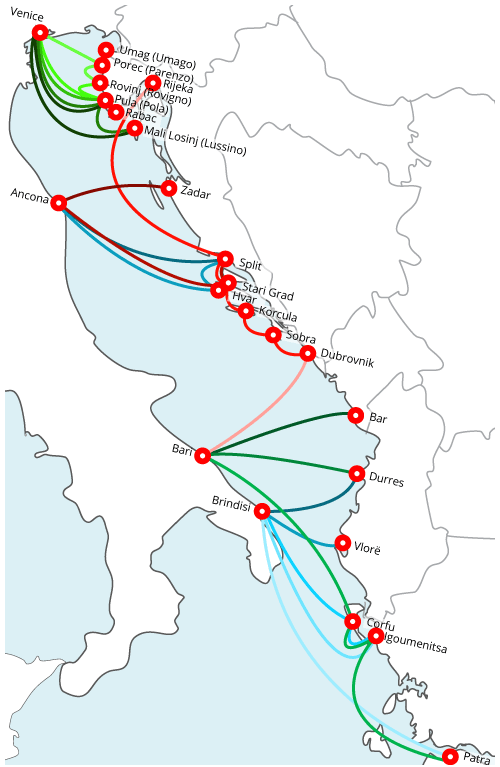
Ferries From Croatia
- Dubrovnik - Bari, Korcula, Rijeka, Sobra (Mljet Is.), Split, Stari Grad (Hvar Is.)
- Hvar (Hvar Is.) - Ancona
- Korcula - Dubrovnik, Rijeka, Sobra (Mljet Is.), Split, Stari Grad (Hvar Is.)
- Mali Losinj (Lussino) - Venice
- Pula (Pola) - Venice
- Porec - Venice
- Rabac - Venice
- Rijeka - Dubrovnik, Korcula, Sobra, Split, Stari Grad (Hvar Is.)
- Rovinj (Rovigno) - Venice
- Sobra (Mljet Is.) - Dubrovnik, Korcula, Rijeka, Split, Stari Grad (Hvar Is.)
- Split - Ancona, Dubrovnik, Korcula, Rijeka, Sobra (Mljet Is.)
- Stari Grad - Ancona, Dubrovnik, Korcula (Korcula Is.), Rijeka, Sobra (Mljet Is.)
- Umag (Umago) - Venice
- Zadar - Ancona
Ferries From Italy
- Ancona - Hvar (Hvar Is.), Split, Ancona, Stari Grad (Hvar Is.), Zadar
- Bari - Bar, Corfu, Dubrovnik, Durres, Igoumenitsa, Patras
- Venice - Mali Losinj (Lussino), Pula (Pola), Porec, Rabac, Rovinj (Rovigno), Umag (Umago)
Ferries From Greece
- Brindisi - Corfu, Durres, Igoumenitsa, Patras, Vlore
- Corfu - Bari, Brindisi
- Igoumenitsa - Bari, Brindisi
- Patras - Bari, Brindisi
Ferries From Montenegro
- Bar - Bari
Ferry Booking in Croatia: Quick Final Advice
Ferry travel is a normal part of getting around Croatia, and booking is usually simple once you know whether you need a car ferry or a passenger-only catamaran. The main planning pressure comes in peak summer, when popular routes can sell out, especially for vehicles and fast services.
If you are travelling in July or August, or you need a specific departure time, booking online in advance is the most reliable approach. For quieter travel periods and less busy routes, buying tickets close to departure is often possible, but it is still worth checking the latest timetables before you go.