
Easter in Croatia combines Christian Holy Week traditions with regional customs that vary considerably from the Adriatic coast to continental Croatia. Decorated Easter eggs, blessed food and Palm Sunday greenery are found across the country, but Dubrovnik's woven palm branches, Dalmatian sirnica, Istrian pinca and the Easter fires of northern Croatia give each region its own character.
Easter, or Uskrs in Croatian, is the most important Christian holiday for many Croatian families. The religious celebration is centred on Holy Week, beginning with Palm Sunday and continuing through Holy Thursday, Good Friday and Holy Saturday to Easter Sunday.
Alongside church services and processions, generations of local customs have developed around spring greenery, decorated eggs, traditional food and family gatherings. Some traditions are shared across Croatia, while others are closely associated with individual regions and even particular villages.
Common Easter traditions in Croatia
Although the details differ from region to region, several customs appear throughout Croatia.
- Palm Sunday greenery: branches and spring plants are taken to church for blessing, with the type of greenery varying according to local climate and tradition.
- Pisanice: decorated Easter eggs symbolising new life are painted, dyed, etched or decorated with wax using techniques that differ between regions.
- Holy Week processions: many towns and villages hold processions and devotions during the days before Easter.
- Blessing Easter food: families traditionally take baskets of food to church, particularly on Holy Saturday or early Easter morning.
- Easter breakfast: blessed eggs, bread, ham and other regional foods are eaten with the family on Easter morning.
- Egg tapping: in many areas, children and adults knock decorated eggs against one another to see whose shell remains unbroken.
Older Croatian Easter traditions also preserve traces of customs associated with spring and the renewal of nature. Green branches, flowers, water and fire all appear in regional practices that became intertwined with Christian observance over the centuries.
Palm Sunday in Croatia
Palm Sunday is known as Cvjetnica, with other regional names also in use. Churches commemorate Christ's entry into Jerusalem by blessing greenery brought by worshippers.
The plants used historically depended strongly on geography. In coastal Croatia, olive and palm branches are common, while continental traditions have included willow, dogwood, hazel, ivy and other spring greenery.
After blessing, branches were traditionally taken home and placed behind a crucifix or religious picture, carried to fields and vineyards, or kept in barns and other farm buildings. They were regarded both as a Christian blessing and, in older folk tradition, as protection for the household, livestock and crops.
One particularly widespread older custom involved washing the face in water containing spring flowers or young greenery on Palm Sunday morning. Variations were recorded in several parts of Croatia, reflecting an older belief in the renewing power of spring plants and water.
Dubrovnik Easter traditions: pome and pengana eggs
The Dubrovnik region has some of Croatia's most distinctive Easter traditions, particularly the weaving of palm branches and the decoration of Easter eggs using wax.
Dubrovačka poma
On Palm Sunday in Dubrovnik and the surrounding area, beautifully woven palm branches called pome or palmice are traditionally taken to church for blessing.
The practice is especially characteristic of southern Dalmatia. Young palm leaves are divided into narrow strips and carefully braided into decorative patterns. Making an elaborate poma requires considerable skill because the woven leaves must remain tight and hold their shape as the branch dries.
Larger branches may be made for churches, while smaller pome are carried by individuals. Traditionally, the blessed branch could later be placed near a crucifix or holy image in the home, taken to a field or vineyard, or kept elsewhere on the property as a symbol of blessing and protection.
An old poma was not simply thrown away when replaced the following year. Traditionally it could be burned or buried, reflecting the respect given to an object that had been blessed.
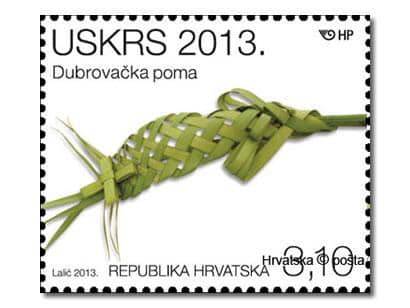
The poma became such a recognisable symbol of Dubrovnik's Easter heritage that Croatian Post featured it on a special Easter postage stamp issued in 2013.
Pengana Easter eggs
Another particularly important Dubrovnik tradition is the pengano jaje, an Easter egg decorated using a wax-resist technique known locally as penganje.
Patterns are drawn onto the shell using beeswax before the egg is dyed. The wax prevents colour from reaching the covered areas, leaving the ornament visible when the wax is removed. Onion skins were among the traditional natural dyes used to create rich reddish and brown tones.
Decorations can include flowers, branches, stars, hearts and geometric ornaments. Written messages and dedications also became part of the tradition, particularly during the 20th century.
Decorated eggs were traditionally exchanged among family members, friends and visitors as Easter gifts. The symbolism of the egg fits naturally with Easter: in Christian tradition it represents new life and resurrection.
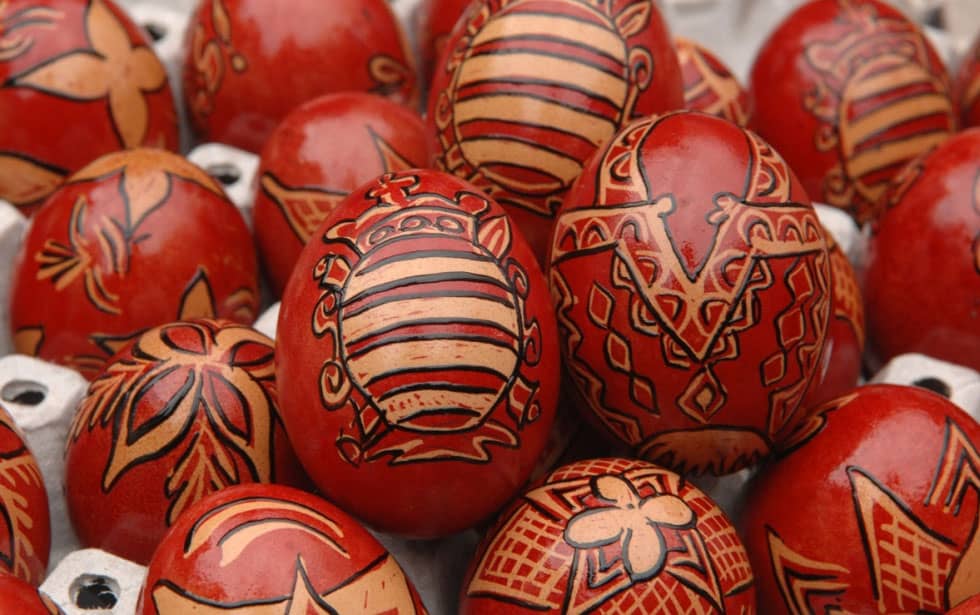
The traditions of pome and pengana eggs are documented and preserved by Dubrovnik Museums. The collection of the Ethnographic Museum in Dubrovnik includes hundreds of traditional Easter eggs as well as woven palm and olive branches from the Dubrovnik area.
Dubrovnik Museums also organises the PENGA Festival of Easter Traditions, bringing together traditional egg-decorating techniques and other Easter customs from Dubrovnik and different parts of Croatia.
Easter traditions in Dalmatia
Across Dalmatia, Easter combines church processions, the blessing of food, family meals and distinctive seasonal dishes.
Sirnica: Dalmatian Easter bread
One of the foods most strongly associated with Easter in Dalmatia is sirnica, a fragrant sweet bread prepared with eggs, sugar and citrus zest.
Despite its name, traditional Dalmatian sirnica does not normally contain cheese. Old family recipes differ, and preparing the dough can begin well before Easter because it traditionally requires careful kneading and a long rise.
For many Dalmatian families, Easter without sirnica would be difficult to imagine. Bakeries also produce large quantities during Holy Week for those who do not make it at home.
Blessing the Easter meal
On Holy Saturday, families traditionally prepare baskets containing food for blessing at church. Depending on the household, the basket may include eggs, bread or sirnica, ham, salt and other foods intended for Easter breakfast.
The blessed food is then shared with the family on Easter morning. In some Dalmatian towns, public Easter breakfasts have also become part of contemporary holiday celebrations.
Za Križen on the island of Hvar
One of Croatia's most remarkable Holy Week traditions takes place on the island of Hvar. The centuries-old Za Križen, or Following the Cross, procession begins after services on Maundy Thursday.
Six processions leave simultaneously from six villages and travel through the night in a circular route of about 25 kilometres. Each procession is led by a cross-bearer followed by worshippers carrying candles and lanterns and singing traditional religious chants.
The journey lasts around eight hours and has been performed for centuries. UNESCO added the Procession Za Križen to the Representative List of the Intangible Cultural Heritage of Humanity in 2009.
For visitors, this is not primarily a tourist performance but a living act of religious devotion. Anyone attending should respect the solemn nature of the procession and the communities that maintain it.
Easter traditions in Istria
Istria has its own distinctive Easter foods and family customs, several of which remain visible at seasonal events throughout the peninsula.
Istrian pinca
Pinca is the traditional Istrian Easter sweet bread. It is generally round, enriched with ingredients such as eggs, sugar and raisins, and traditionally marked with a cross on top before baking.
Historically, pinca was one of the relatively rare sweet foods on a modest rural Easter table. Families prepared it before the holiday and served it as part of Easter breakfast together with decorated eggs and other blessed foods.
Jajarice for children
A particularly charming Istrian Easter tradition is the jajarica. These are small braided breads made especially for children, with a boiled or decorated egg incorporated into the dough.
Children traditionally received them as Easter gifts, making the bread and egg part of the same symbolic celebration.
Easter breakfast in Istria
Alongside pinca and pisanice, a traditional Istrian Easter breakfast may include ham, spring onions, salt and radishes. Easter lunch can be more substantial, with lamb and other festive dishes accompanied by local wines.
Easter eggs in Slavonia and Baranja
Decorated eggs are also an important part of Easter traditions in Slavonia and Baranja. Regional techniques form part of a much wider Croatian tradition of creating pisanice, or decorated Easter eggs.
Across Croatia, eggs have historically been decorated using an impressive variety of methods. Natural dyes were produced from materials such as onion skins, plants and tree bark. Wax could be applied before colouring, designs could be scratched into dyed shells, while some traditions involved embroidery, wrapping or other highly specialised techniques.
Several traditional egg-decorating techniques from eastern Slavonia and other continental regions are now recognised as elements of Croatia's protected intangible cultural heritage. At Dubrovnik's PENGA festival in 2026, craftspeople demonstrated techniques from eastern Slavonia, Podravina and Međimurje alongside Dubrovnik penganje.
The terminology also varies regionally. Pisanice is widely understood throughout Croatia, while terms equivalent to coloured or decorated eggs have traditionally been used in Slavonia, Baranja, Lika and elsewhere.
Easter in Zagreb and northern Croatia
In Zagreb, Central Croatia and the northwest, spring greenery, decorated eggs and the blessing of Easter food are also central traditions, but the plants and some of the rituals differ from those of the Adriatic coast.
Willow, dogwood and spring greenery
Instead of the woven palm branches characteristic of Dubrovnik, Palm Sunday traditions in continental Croatia historically used plants such as willow, dogwood, hazel and other greenery available at the beginning of spring.
As elsewhere in Croatia, blessed branches could be kept in the home or taken to fields and farm buildings. These Christian customs became intertwined with older beliefs about spring plants as symbols of health, fertility and protection.
Vuzmenka: the Easter fire
One of the most distinctive older traditions of northwestern Croatia is the Easter bonfire, known by regional names including vuzmenka.
Traditionally, large piles of wood and branches were prepared and lit around Holy Saturday or Easter, sometimes before dawn. The custom belongs to a broader Central European tradition of ritual Easter fires and survives in some communities today as part of local Easter celebrations.
The meaning of these fires combines Christian symbolism with much older traditions surrounding light, spring and renewal.
Croatian pisanice: more than painted eggs
Although modern Easter eggs are often simply coloured with commercial dyes, traditional Croatian pisanice display remarkable regional variety.
Natural colouring materials historically included onion skins, nettles, grasses and bark. Wax-resist decoration was common in several areas, while other techniques included scratching designs into the coloured shell, using acid to remove colour or wrapping and decorating eggs with thread and other materials.
Common motifs included flowers, leaves, branches, stars, spirals and geometric patterns. Some eggs also carried names, greetings, romantic messages or dedications to the person receiving them.
Eggs were not only decorative. They were exchanged as gifts and used in games, particularly the familiar Easter custom of tapping one egg against another. The owner of the egg whose shell remained intact was the winner.
What travellers should know about Easter in Croatia
Easter can be a rewarding time to visit Croatia, but it is primarily a family and religious holiday rather than a festival staged for visitors.
- Good Friday is quieter. Religious processions and services take place throughout the country, particularly in traditionally Catholic communities.
- Holy Saturday can be busy around churches. Families may bring baskets of Easter food for blessing.
- Easter Sunday is family-focused. Some shops, attractions and services may close or operate reduced hours.
- Easter Monday is also a public holiday. Transport and business hours may differ from normal weekday schedules.
- Regional events change each year. Tourist boards often organise Easter fairs, public breakfasts, workshops and cultural programmes, but dates should be checked for the year of travel.
- Respect religious processions. Traditions such as Hvar's Za Križen remain acts of faith rather than entertainment.
Regional Easter traditions overview
| Region | Traditions to look for |
|---|---|
| Dubrovnik region | Woven pome, pengana eggs, Palm Sunday traditions |
| Dalmatia | Sirnica, food blessing, Holy Week processions, Za Križen |
| Istria | Pinca, jajarice, pisanice and Easter breakfast |
| Slavonia and Baranja | Decorated eggs, regional pisanice techniques, festive family meals |
| Zagreb and Central Croatia | Spring branches, pisanice, blessed food and Easter fires |
A living tradition
Croatian Easter customs are not identical from one end of the country to the other. Geography, local agriculture, historical influences and family traditions have all shaped the way the holiday is celebrated.
A woven palm branch in Dubrovnik, a piece of sirnica in Dalmatia, an Istrian jajarica and a northwestern vuzmenka may look very different, but they share the same themes of faith, family, spring and renewal.
That regional variety is what makes Easter traditions particularly interesting for travellers exploring different regions of Croatia.