
The Croatian Maritime Museum in Split explores the maritime history of the Croatian Adriatic, from ancient seafaring and traditional wooden boats to merchant shipping, naval warfare and modern shipbuilding. The museum is housed inside the 17th-century Gripe Fortress, with historic vessels and naval equipment displayed both indoors and in the fortress courtyard.
Among its most distinctive exhibits is a major torpedo collection that includes a torpedo head dating from 1866, part of what the museum describes as the oldest surviving torpedo example in the world.
Croatian Maritime Museum Split quick overview
| Best for | Ships, naval history, maritime technology and Adriatic heritage |
|---|---|
| Time needed | About 1-1.5 hours |
| Adult ticket | €3.50 |
| Reduced ticket | €1.80 |
| Family ticket | €10 |
| Location | Gripe Fortress, east of Split Old Town |
| Top highlights | Torpedo collection, historic vessels, ship models and naval exhibits |
Is the Croatian Maritime Museum worth visiting?
Yes, especially if you are interested in ships, naval history or the maritime culture of the Adriatic. The museum is quieter than Split's main Old Town attractions and offers a good mix of large physical objects, ship models, weapons, machinery and historical documents.
The fortress setting and outdoor vessel collection also make it more varied than a conventional indoor museum.
Allow around 1-1.5 hours for a normal visit. Maritime enthusiasts can easily spend longer exploring the ship models, torpedo collection and military history displays.
What to see at the Croatian Maritime Museum
The permanent exhibition covers both civilian and military maritime history, following the development of ships, navigation, trade, shipbuilding and naval warfare along the Croatian Adriatic.
The torpedo collection
The torpedo collection is one of the museum's most important holdings. It originated from the former Whitehead torpedo factory museum in Rijeka and later became part of the Military and Naval Museum collection inherited by the Croatian Maritime Museum.
The display follows the development of the torpedo from the idea proposed by Ivan Lupis to the engineering work of Robert Whitehead in Rijeka.
Among the most important surviving objects are a torpedo head from 1866 and a torpedo tail from 1868. The museum presents the 1866 example as the oldest surviving torpedo specimen in the world.
Historic boats in the courtyard
Several large vessels are displayed in and around the courtyard of Gripe Fortress.
The most important include:
- Perina - a traditional Dalmatian gajeta built in Trogir in 1857 and one of the oldest preserved vessels on the Adriatic
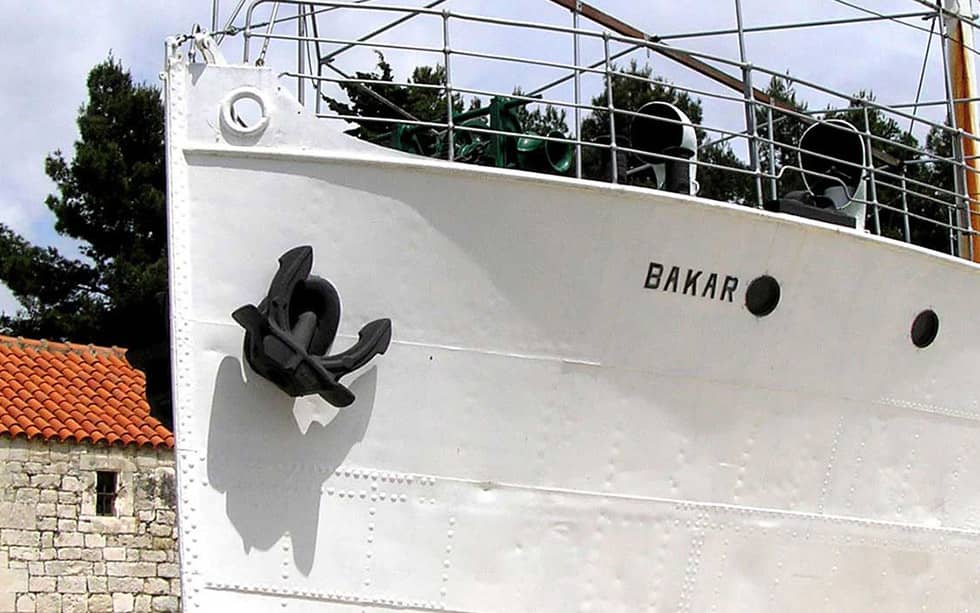
- Bakar - the preserved bow section of a steamship built in England in 1938
- Streljko - a fishing boat converted into a patrol vessel during World War II and today the only surviving vessel of the Partisan Navy
- A traditional Neretva lađa from 1934
- A Neretva trupica from 1954
- The Split-built batana Tonči from 1950
These vessels give the museum a much stronger connection with real Adriatic seafaring than ship models alone could provide.
Merchant shipping and traditional seafaring
The civilian maritime section follows the development of ships from ancient times through sailing vessels, steamships and motor-powered ships.
Ancient anchors, amphorae and underwater archaeological finds introduce the earliest periods of maritime trade, while later displays use paintings, photographs and models to explain the sailing traditions of Dalmatia, Dubrovnik and Boka Kotorska.
The museum also preserves an important collection of ship machinery, including early Croatian marine engines made in Split at the beginning of the 20th century.
Ship models
The museum has developed a large collection of detailed ship models.
Models represent different periods of Adriatic maritime history, including ancient vessels, medieval and early modern ships, sailing vessels, naval ships, seaplanes and other maritime technology.
The collection contains more than 100 ship and vessel models, with some of the oldest examples dating back to the Adriatic Exhibition held in Split in 1925.
Naval and military history
The military section follows naval conflict in the Adriatic from antiquity to the modern period.
Displays include weapons, uniforms, naval equipment, flags, ship models and material connected with major periods of Adriatic warfare.
The Battle of Vis in 1866 is represented through original objects, while later sections cover the Austro-Hungarian Navy, World War I, World War II and the Croatian War of Independence.
The museum's weapons collection ranges from historic swords and shipboard firearms to naval guns and more modern military equipment.
Gripe Fortress
The Croatian Maritime Museum occupies Gripe Fortress, a 17th-century defensive complex built east of the historic centre of Split.
The fortress was constructed during a period of increasing military pressure on Dalmatia and became an important part of Split's defensive system.
Today it is the only completely preserved fortification complex of its type in the city, making the building itself part of the museum experience.
The large courtyard also provides enough space to display boats, cannons and other objects that could not realistically be exhibited inside conventional museum rooms.
Split's maritime museum history
Maritime museum collections in Split have a longer history than the present institution.
The first Maritime Museum in Split was founded in 1925. Its collections later developed alongside the Military and Naval Museum, underwater archaeology collections and maritime material preserved by Split's shipbuilding industry.
The present Croatian Maritime Museum Split was formally established as an independent institution in 1997 and inherited material from these earlier museums and collections.
Its mission today covers the maritime heritage of the Croatian Adriatic from prehistory to the present.
Croatian Maritime Museum tickets
| Ticket | Current published price |
|---|---|
| Adult | €3.50 |
| Schoolchildren, students and pensioners | €1.80 |
| Children aged 5-7 | €0.70 |
| Family ticket | €10 |
| First Sunday of each month | €0.70 |
| SplitCard | 50% discount |
Children under 4 and persons with disabilities currently receive free admission. ICOM members, journalists and licensed tourist guides also qualify for free entry.
Opening hours
Monday-Friday
09:00-19:00
Saturday
09:00-17:00
Sunday
10:00-17:00
The museum has separate schedules for public holidays. Some holidays are open from 10:00-17:00, while others are closed.
How to get to the Croatian Maritime Museum
The museum is at Glagoljaša 18 inside Gripe Fortress, east of Split Old Town.
It is within walking distance of the historic centre, but the final approach to Gripe is uphill. In hot weather or for visitors with limited mobility, a taxi may be more comfortable.
For more cultural attractions around the city, see our guide to museums in Split.
Split - "Emperor's City for History Lovers"
Private Walking Tour+Cellars Museum
Guided tour of Old Town Split, including the famous Diocletian's Palace (UNESCO World Heritage Site) and the basement cellars.
Accessibility
Persons with disabilities currently receive free admission. Because the museum occupies a historic fortress and includes both indoor and outdoor areas, accessibility can differ between parts of the complex.
Contact the museum directly if step-free access to a particular exhibition or courtyard area is important to your visit.
Address and official information
Croatian Maritime Museum Split
Glagoljaša 18
21000 Split
Croatia
Phone: +385 21 347 346 / +385 21 348 092
Official website: Croatian Maritime Museum Split