
The Ethnographic Museum Split combines traditional Dalmatian culture with one of the most unusual museum settings in the city. Located beside the Peristyle, the museum occupies part of the former imperial residential quarters of Diocletian's Palace and presents costumes, jewellery, handicrafts and everyday objects from the Dalmatian coast, islands and hinterland.
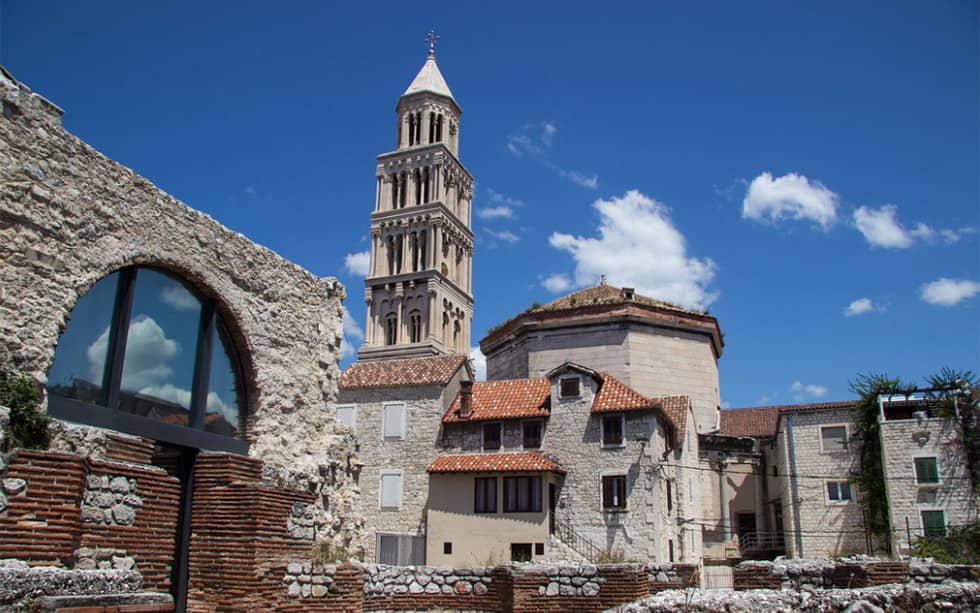
A visit also gives access to historic architectural remains inside the museum complex and a route up to the roof of the Vestibule, with views over the old town, St Domnius bell tower, the sea and nearby islands.
Ethnographic Museum Split quick overview
| Best for | Traditional Dalmatian culture, costumes and historic Palace interiors |
|---|---|
| Time needed | About 45-75 minutes |
| Adult ticket | €7 |
| Reduced ticket | €4 |
| Family ticket | €15 |
| Split Card | Free admission |
| Top highlight | Vestibule rooftop viewpoint |
| Location | Inside Diocletian's Palace, beside the Peristyle |
Is the Ethnographic Museum Split worth visiting?
Yes, especially if you want to understand Dalmatian life beyond Roman emperors, palaces and archaeological ruins. The museum explains how people along the coast, on the islands and in the Dalmatian hinterland dressed, worked, furnished their homes and maintained local traditions.
It is also unusually rewarding for a relatively small museum because the building itself forms part of the visit. Roman architectural remains, a small early medieval church and the Vestibule rooftop add another layer to the ethnographic collections.
Allow around 45-75 minutes, unless you are interested in traditional textiles or the architecture of Diocletian's Palace.
What to see inside the Ethnographic Museum
The permanent exhibition focuses primarily on the traditional culture of Dalmatia, where two different cultural zones meet.
The Adriatic cultural zone represents the islands and coastal communities, while the Dinaric cultural zone reflects life in the Dalmatian hinterland. The differences can be seen particularly clearly in clothing, jewellery, household objects and traditional crafts.
Traditional Dalmatian costumes and jewellery
Traditional clothing is one of the museum's strongest areas. Costumes from different parts of Dalmatia show how dress varied between coastal towns, islands and inland communities.
Clothing and jewellery could communicate where a person came from, social position, age and whether an outfit was intended for daily life, work or a special occasion.
The museum also preserves collections of silver and gold jewellery, embroidery, lace and other textile work.
Traditional crafts, weapons and household objects
Displays include traditional handicrafts, weapons, furniture and objects associated with domestic life and work. A reconstructed traditional room furnished with authentic objects from the beginning of the 20th century gives visitors a more complete impression of how a Dalmatian household could look.
Inside Diocletian's imperial residential quarters
Part of what makes the Ethnographic Museum unusual is its location within the southern residential section of Diocletian's Palace.
These spaces formed part of the emperor's private and residential quarters in the 4th century. It is therefore more accurate to describe the museum as occupying part of the imperial residential area rather than identifying a particular room as Diocletian's bedroom.
The museum is only steps from the Peristyle and Vestibule, making it easy to combine with the main sights of Diocletian's Palace.
Church of St Andrew de Fenestris
The museum complex also contains the remains of the Church of St Andrew de Fenestris, dating from the 7th century and considered one of the oldest churches in Split.
Its presence illustrates how the Roman imperial palace was gradually transformed during the centuries after Diocletian, as residential buildings and Christian spaces developed within the ancient structure.
The Vestibule rooftop view
One of the best reasons to visit the Ethnographic Museum is the route to the roof of the Vestibule, passing through the courtyard of the medieval Božičević-Natalis Palace and climb a Roman staircase leading to the elevated terrace above the former imperial Vestibule.
From here there are excellent views of:
- St Domnius Cathedral bell tower
- The stone roofs and streets of Split Old Town
- The structure of Diocletian's Palace
- The Adriatic Sea
- Dalmatian islands on the horizon
The viewpoint is particularly useful for understanding how the Roman palace was absorbed into the medieval and modern city around it.
A separate €2 Vestibule ticket is also currently available for visitors who only want access to the Vestibule area rather than the full museum.
Split - "Emperor's City for History Lovers"
Private Walking Tour+Cellars Museum
Guided tour of Old Town Split, including the famous Diocletian's Palace (UNESCO World Heritage Site) and the basement cellars.
History of the Ethnographic Museum Split
The Ethnographic Museum was founded in 1910, making it one of Croatia's oldest ethnographic museums.
Its founder, architect Kamilo Tončić, had begun collecting folk costumes, embroidery and traditional handicrafts several years earlier and organised exhibitions of this material in Split from 1907.
The museum moved between several locations during the 20th century before relocating to its present setting within the former imperial quarter of Diocletian's Palace in 2005.
Ethnographic Museum Split tickets
| Ticket | 2026 price |
|---|---|
| Adult | €7 |
| Schoolchildren, students and seniors | €4 |
| Groups of 10 or more - per person | €4 |
| Family ticket | €15 |
| Vestibule only | €2 |
| Split Card | Free |
Opening hours
| Period | Monday-Friday | Saturday |
|---|---|---|
| November 1-May 31 | 09:00-16:00 | 10:00-14:00 |
| June 1-August 31 | 09:00-19:00 | 10:00-17:00 |
| September 1-30 | 09:00-18:00 | 10:00-17:00 |
| October 1-31 | 09:00-17:00 | 10:00-14:00 |
Sunday: 10:00-14:00 from June 15 to September 15. Other Sundays are closed. The museum is closed on public holidays.
Pet-friendly museum
Since July 2026, the Ethnographic Museum has been the first museum in Split to introduce regular pet-friendly visiting hours. Dogs may currently enter during the last three opening hours of each working day. They must be kept on a lead, and additional rules apply to potentially dangerous breeds. The museum does not charge admission for pets.
How to find the Ethnographic Museum
The museum is at Iza Vestibula 4, immediately beside the Vestibule and Peristyle in the heart of Diocletian's Palace.
From the Peristyle, walk through the Vestibule toward the southern residential section of the Palace and follow the signs for the Ethnographic Museum.
For more cultural attractions around the city, see our guide to museums in Split.
Address and official information
Ethnographic Museum Split
Iza Vestibula 4
21000 Split
Croatia
Phone: +385 21 344 164
Official website: Ethnographic Museum Split