
Diocletian’s Palace is the historic heart of Split, but it is not a conventional palace museum. The Roman complex forms part of the living Old Town, with homes, shops, cafés, churches and streets built into structures first laid out for Emperor Diocletian around the turn of the 4th century.
The palace later became the foundation of medieval Split and today forms part of the UNESCO-listed Historical Complex of Split with the Palace of Diocletian. Most streets and squares are free to explore, while individual monuments such as the Cellars, Cathedral of St. Domnius and Temple of Jupiter have separate admission.
For more sightseeing ideas, see our Split attractions guide.
Diocletian’s Palace: quick overview
- What is it? A Roman imperial residence and fortified complex that gradually evolved into Split’s historic centre.
- UNESCO status: Part of the Historical Complex of Split with the Palace of Diocletian, inscribed on the UNESCO World Heritage List in 1979.
- Cost: Walking through the palace streets, gates, Peristyle and most outdoor spaces is free; individual monuments charge separate admission.
- Main sights: Peristyle, Vestibule, Cathedral of St. Domnius, Temple of Jupiter, Palace Cellars and the Roman gates.
- Time needed: Around 1 hour for the main outdoor highlights, 2-3 hours with ticketed interiors, or half a day at a relaxed pace.
- Best time: Early morning for quieter streets or late afternoon and evening for atmosphere.
- Location: Directly behind Split’s Riva waterfront and a short walk from the ferry port and main bus station.
Best tours of Diocletian’s Palace
Diocletian’s Palace can easily be explored independently, but much of its original Roman layout is hidden within later buildings. A knowledgeable guide can explain which spaces belonged to the imperial residence, how the main Roman streets were arranged and how the palace gradually became the medieval city of Split.
A tour is particularly useful if you want to understand the relationship between the Peristyle, imperial apartments, mausoleum, Temple of Jupiter and underground substructures rather than simply walking between individual landmarks.
Split - "Emperor's City for History Lovers"
Private Walking Tour + Cellars Museum
This guided walking tour focuses on the highlights of Split’s Old Town, with special attention to Diocletian’s Palace, the Peristyle, and the impressive underground substructures. It is well suited to visitors who want historical context without rushing and prefer a more personal, in-depth experience.
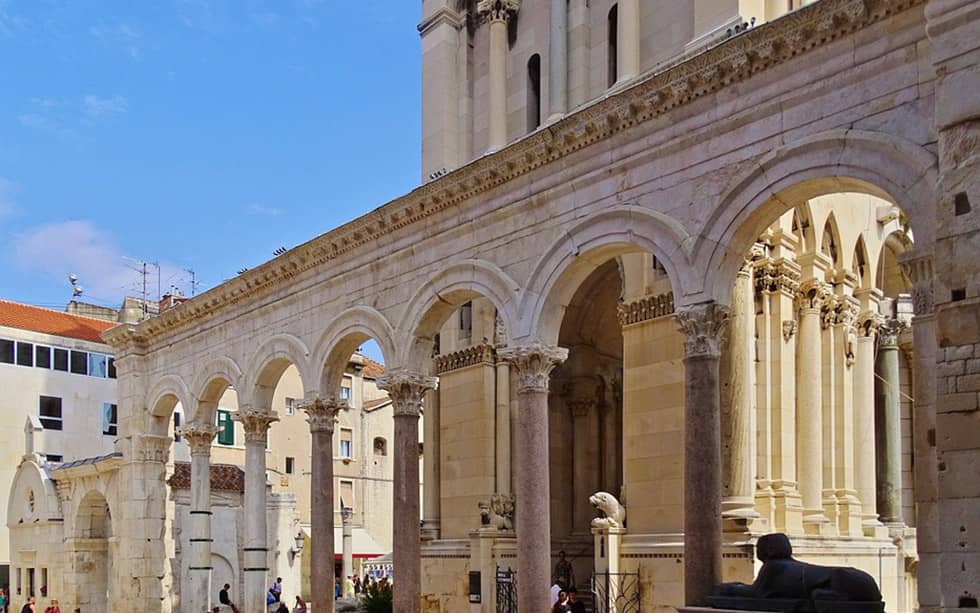
Table of Contents
What is Diocletian’s Palace?
Diocletian’s Palace was built in the late 3rd and early 4th centuries AD for the Roman emperor Diocletian, who retired to the Dalmatian coast after ruling the empire.
The original complex combined elements of a luxurious imperial villa with the ordered layout and fortifications of a Roman military camp. Two principal streets divided the palace into four sections: the Cardo ran north to south and the Decumanus crossed it from east to west.
The southern half facing the sea contained the emperor’s ceremonial and residential apartments. The northern section had a more practical role and accommodated soldiers, servants, storage and other functions necessary to operate the complex.
At the ceremonial centre stood the Peristyle, Diocletian’s mausoleum and religious buildings such as the Temple of Jupiter.
After antiquity the palace was never simply abandoned. New residents moved into its surviving structures, and Roman halls and walls were gradually adapted into houses, churches, workshops and streets. Medieval, Renaissance and Baroque buildings were inserted into the Roman fabric, creating the historic centre visitors walk through today.
This layering is why the UNESCO property is officially called the Historical Complex of Split with the Palace of Diocletian, rather than simply Diocletian’s Palace.
What is free and what needs a ticket?
There is no general admission ticket to enter Diocletian’s Palace. The palace streets are public streets forming part of Split’s city centre.
| Free to explore | Usually ticketed separately |
|---|---|
| Peristyle | Palace Cellars / Substructures |
| Vestibule passage | Cathedral of St. Domnius interior |
| Golden, Silver, Iron and Bronze Gates | Cathedral bell tower and related church spaces |
| Main palace streets and alleys | Temple of Jupiter / Baptistery |
| Most outdoor Roman remains | Individual museums and exhibitions |
Restaurants, cafés, shops and accommodation inside the palace operate as normal independent businesses and have their own opening hours.
What to see inside Diocletian’s Palace
1. Peristyle
The Peristyle was the ceremonial centre of Diocletian’s residence and remains the most recognizable space inside the palace.
The emperor would have appeared here during official ceremonies, framed by the monumental architecture linking his apartments with the mausoleum and religious precinct.
Today it is one of Split’s busiest gathering places and the easiest location from which to orient yourself inside the palace.
2. Cathedral of St. Domnius
The Cathedral of St. Domnius occupies what was originally Diocletian’s mausoleum. Its conversion into a Christian cathedral is one of the clearest examples of how the Roman palace was reused after antiquity.
The cathedral interior, treasury and bell tower are managed as ticketed attractions. The bell tower gives wide views over the palace roofs, Riva and harbour.
3. Vestibule
The circular Vestibule stood on the ceremonial route between the Peristyle and the emperor’s private apartments. Its open roof and tall stone walls make it one of the palace’s most distinctive surviving Roman spaces.
The main passage is quick to visit and free to enter.
4. Temple of Jupiter
The Temple of Jupiter is one of the best-preserved Roman religious spaces within the palace. It was later converted into a Christian baptistery.
Its compact interior makes it an easy addition to a Cathedral and Peristyle visit.
5. Palace Cellars and Substructures
The underground Palace Cellars are among the most important surviving parts of Diocletian’s original complex.
The vaulted rooms supported the emperor’s apartments above and preserve their basic footprint, which helps archaeologists and visitors understand how the lost residential spaces were arranged.
The central passage linking the Riva with the Peristyle is freely accessible, while the museum sections of the substructures require admission.
6. The four Roman gates
The palace originally had four principal gates, and they remain useful landmarks for navigating central Split.
- Golden Gate: monumental northern entrance and the most impressive surviving gate
- Silver Gate: eastern entrance beside the Green Market
- Iron Gate: western entrance opening toward the later medieval city
- Bronze Gate: southern sea-facing entrance leading through the Cellars toward the Riva
7. Egyptian sphinx
An ancient Egyptian sphinx still stands beside the Peristyle, reflecting Diocletian’s use of imported Egyptian monuments within the ceremonial complex. See our Sphinx in Split guide for more background.
8. The palace streets
Some of the most interesting parts of the palace are simply the streets themselves. Roman walls appear inside later houses, medieval arches cross ancient routes and cafés occupy spaces that have been continuously reused for centuries.
This is what makes Diocletian’s Palace different from a conventional archaeological park: the monument is still part of everyday Split.
Self-guided walking route
About 1 hour
- Start at the Golden Gate.
- Follow the original north-south route toward the Peristyle.
- See the Cathedral exterior and Egyptian sphinx.
- Walk through the Vestibule.
- Continue through the Cellars passage to the Bronze Gate and Riva.
2-3 hours
Follow the same route but add the Cathedral complex, Temple of Jupiter and paid sections of the Palace Cellars.
Half day
Add the bell tower, museums, lunch or coffee inside the historic centre and more time exploring the lanes beyond the main Roman axes.
The Best of Split Private Tour
Exploring Split on your own can be rewarding, but without context it’s easy to walk past important landmarks without understanding their significance.
A private walking tour of Split turns the city into an open-air museum, where Roman foundations, medieval streets, Venetian influences, and modern life are all connected into one clear story. With a knowledgeable local guide, Diocletian’s Palace, the historic gates, bustling markets, and the Riva Promenade become more than just photo stops, they become part of a living narrative that explains how Split evolved over nearly two thousand years.
Tickets and opening hours
The palace itself has no opening or closing time because its streets form part of central Split. You can walk through the gates, Peristyle, Vestibule and public lanes at any time.
Individual attractions have their own opening hours and admission arrangements. These can change by season, religious services, exhibitions and restoration work.
Rather than relying on old prices, check the current ticket information at each attraction when you visit. Cathedral-related sites may offer combined tickets, while the Palace Cellars are managed separately.
For detailed information about the underground complex, see Diocletian’s Palace Cellars.
Best time of day to visit
Early morning
The quietest period for the Peristyle, gates and narrow streets. It is also one of the best times for photography before larger tour groups arrive.
Late afternoon and evening
The historic centre becomes busier with restaurants and cafés, but softer light and evening activity make this one of the most atmospheric times to walk through the palace.
Midday in summer
July and August can be very hot and crowded around the Peristyle and main streets. Use the hottest part of the day for the Cellars, museums, lunch or other shaded stops.
How to get there and where to enter
Diocletian’s Palace is directly behind the Riva waterfront in central Split. There is no single official visitor entrance.
- From the ferry port: walk along the Riva from Split Ferry Port toward the Bronze Gate and Cellars.
- From the bus station: the Split Main Bus Station is beside the ferry terminal and within easy walking distance.
- From northern central Split: Golden Gate is a convenient starting point.
- From the Green Market: use Silver Gate.
Which gate is best?
There is no best entrance overall. Use the gate that fits your walking route:
- Golden Gate: best for a north-to-south historical route
- Silver Gate: useful from the market and eastern Old Town
- Iron Gate: convenient from the western historic centre
- Bronze Gate: easiest from the Riva, ferry port and waterfront
Accessibility
Diocletian’s Palace is a historic city centre rather than a purpose-built visitor attraction, so accessibility varies significantly.
- Main outdoor areas: many principal streets and the Peristyle area can be reached with limited mobility, although surfaces are uneven.
- Stone paving: polished limestone can become slippery in rain.
- Ticketed monuments: some interiors involve stairs and narrow passages.
- Bell tower: the climb is steep and unsuitable for visitors with limited mobility.
- Cellars: accessibility differs between the central passage and ticketed underground rooms.
If mobility is a major consideration, concentrate on the principal street level and check accessibility with individual ticketed attractions before purchasing admission.
Practical tips
- Wear good shoes: the polished stone can be slippery, especially after rain.
- Visit early in summer: the central spaces become crowded and hot later in the day.
- Dress appropriately for churches: modest clothing is expected inside the Cathedral and other religious spaces.
- Keep valuables secure: the busiest streets can become very crowded during peak season.
- Respect residents: people still live inside the palace, so private doorways and residential spaces should be treated accordingly.
- Do not rush: many Roman fragments and later architectural details are easiest to notice away from the busiest central route.
Eating and shopping inside the palace
Restaurants, cafés, shops and accommodation operate throughout the palace. Prices and styles vary widely, so there is no need to leave the historic centre simply because you want lunch or a coffee.
If value is your priority, compare places inside the walls with restaurants a few streets farther from the main Peristyle-Riva route.
Nearby attractions and what to do next
- Riva Promenade: directly outside the southern palace wall
- Split Green Market: beside Silver Gate
- Marjan Hill: walking trails and viewpoints west of the Old Town
- Museums in Split: archaeology, art and local history
- Day trips from Split: islands, coastal towns and inland excursions
Access
Public palace streets and squares are accessible 24 hours. Individual ticketed monuments have their own opening hours.
Why visit?
A rare Roman imperial complex that evolved into the living historic centre of a modern city.
Address
Dioklecijanova 1
21000 Split
Croatia
Diocletian’s Palace FAQ
Is Diocletian’s Palace free to enter?
Yes. The palace streets, gates, squares and most outdoor areas are part of Split’s public Old Town and are free to explore. Individual sites such as the Palace Cellars, Cathedral complex and Temple of Jupiter charge admission.
How long do you need to visit Diocletian’s Palace?
Allow around one hour for the principal outdoor highlights. Two to three hours is better if you plan to visit the Cellars, Cathedral and Temple of Jupiter, while half a day allows time for the bell tower, museums and a relaxed meal.
Is Diocletian’s Palace actually a palace?
Yes, although not in the modern sense of a single residence. It was a large fortified Roman complex combining imperial apartments, ceremonial spaces, religious buildings and military or service areas.
What are the main things to see?
The key sights are Peristyle, the Cathedral of St. Domnius, Vestibule, Temple of Jupiter, Palace Cellars, Golden Gate and the historic streets within the Roman walls.
Are Diocletian’s Palace Cellars worth visiting?
Yes, particularly if you are interested in Roman architecture. The underground rooms preserve the footprint of the imperial apartments that once stood above them and make the original palace layout easier to understand.
Is Diocletian’s Palace UNESCO-listed?
Yes. The Historical Complex of Split with the Palace of Diocletian has been on the UNESCO World Heritage List since 1979.
Can you visit Diocletian’s Palace at night?
Yes. The palace streets are part of central Split and remain accessible at night. Evening is one of the most atmospheric times to visit, particularly around the Peristyle and nearby squares.
What is the best entrance to Diocletian’s Palace?
There is no single best entrance. Golden Gate is useful for a classic north-to-south route, while Bronze Gate is most convenient from the Riva and ferry port.
Is Diocletian’s Palace wheelchair accessible?
Partially. Some main outdoor streets can be explored with limited mobility, but uneven paving, steps and inaccessible levels make several interior attractions difficult or impossible for wheelchair users.
Are there restaurants and shops inside Diocletian’s Palace?
Yes. The palace is a living neighbourhood containing restaurants, cafés, shops, accommodation and private homes.
Was Game of Thrones filmed in Diocletian’s Palace?
Yes, parts of the Palace Cellars were used as filming locations. The Roman and UNESCO history of the site, however, is the main reason to visit.
What is the best time of day to visit?
Early morning is best for quieter streets and photographs. Late afternoon and evening offer the strongest atmosphere, while midday in July and August is usually the hottest and busiest period.
Other things to do in Split
If you’re spending more time in the city after visiting Diocletian’s Palace, these guides will help you plan the rest of your stay.
- Day trips from Split – islands, coastal towns and inland attractions
- Events in Split – concerts, festivals and seasonal events
- Museums in Split – archaeology, art, maritime history and local culture
- Shopping in Split – markets, local products and shopping areas
- Parks and beaches in Split – swimming and green spaces near the Old Town
Where to stay in Split
- Split travel guide – neighborhoods, transport, beaches and main attractions
- Hotels in Split – hotels and apartments near the Old Town and beaches
- Luxury villas in Split – larger private stays suited to families and groups
- Hostels in Split – budget-friendly accommodation, often within walking distance of the palace