
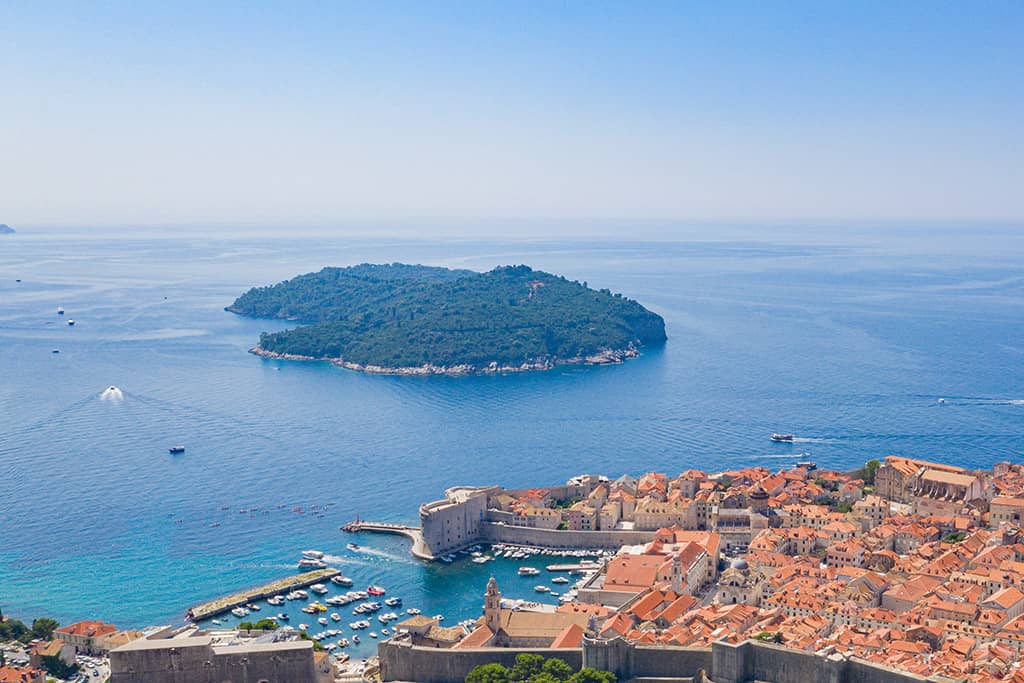
The legend of Lokrum Island says that Benedictine monks placed a curse on Lokrum when they were forced to leave their monastery at the end of the 18th century. According to the story, the monks walked around the island at night carrying candles upside down and condemned anyone who tried to possess Lokrum for personal pleasure.
What turned the Lokrum curse into one of Dubrovnik's best-known legends was what happened afterwards. A series of genuine tragedies became associated with later owners and members of the Habsburg dynasty, including Emperor Maximilian of Mexico, Crown Prince Rudolf and Empress Elisabeth of Austria. The deaths are historical; their connection to the monks' curse belongs to folklore.
The Benedictine monks of Lokrum
The story begins with the Benedictines. A monastery was founded on Lokrum Island in 1023, only a short distance across the sea from Dubrovnik. For centuries the Benedictine community was closely connected with the island and with the development of the Dubrovnik area.
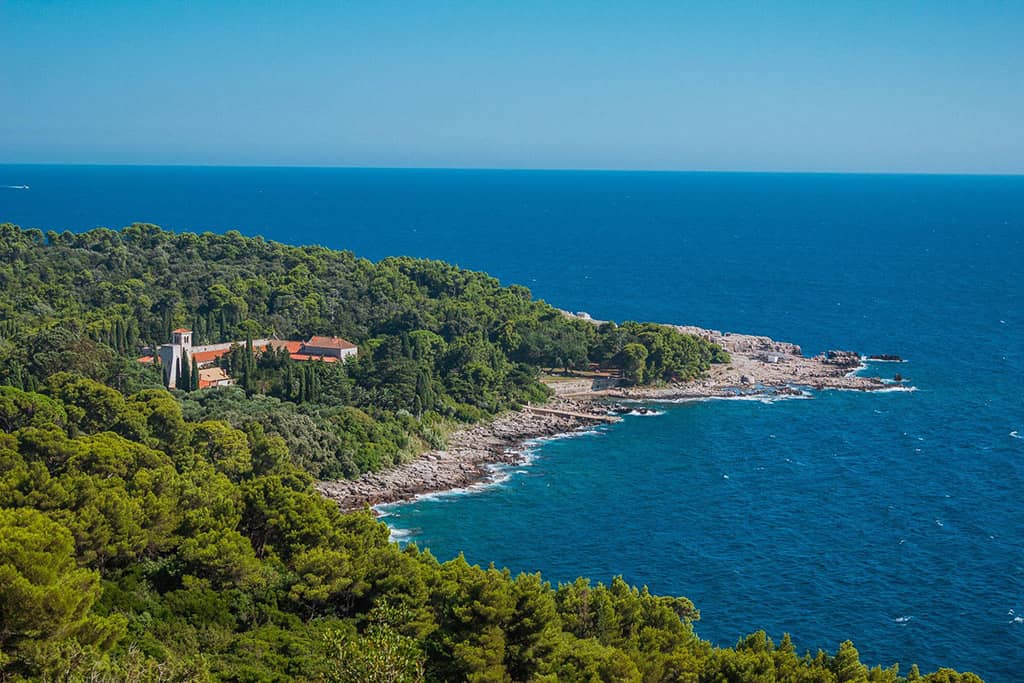
The surviving monastic complex still includes Romanesque remains together with a Gothic-Renaissance cloister added during later centuries. The monastery was damaged in the catastrophic Dubrovnik earthquake of 1667 but remained part of Lokrum's history long afterwards.
By the end of the 18th century, however, the Benedictine presence on Lokrum was coming to an end. In 1798 the monastic community was dissolved and the monks had to leave the island that had been their home for centuries.
How the curse of Lokrum began
According to the traditional legend, the Benedictines did not accept their departure quietly. Before leaving Lokrum for the last time, they gathered for a final act that would become the foundation of the island's curse.
The monks are said to have celebrated their final mass and then, after darkness fell, dressed in their hooded black robes and began a solemn procession around the island.
Each monk carried a candle turned upside down so that the hot wax fell onto the ground. As they walked, they pronounced a curse on anyone who had helped drive them from Lokrum and on anyone who would try to claim the island for personal pleasure.
The monks' final procession
The procession is the most memorable part of the Lokrum legend. In some versions of the story the monks walked around the island three times; in others the emphasis is simply on the long nocturnal procession and the trail of wax left behind them.
At dawn, the story says, they boarded a boat and left Lokrum without looking back. They never returned.
Whether such a ceremony really took place cannot be established from the legend itself. What is certain is that the story became deeply attached to Lokrum, and later generations began interpreting misfortunes involving the island's owners as evidence that the Benedictine curse had followed them.
Did the Lokrum curse come true?
The legend became more powerful because Lokrum's later history contains enough genuine tragedy to make a supernatural explanation tempting. Over time, storytellers connected an increasingly long list of deaths, illnesses and family disasters with the monks' curse.
Not every tale repeated about the curse can be reliably verified. Three famous Habsburg tragedies, however, are well documented and became central to later versions of the Lokrum story.
Maximilian of Habsburg and Lokrum
Archduke Ferdinand Maximilian of Habsburg first visited Lokrum in May 1859 after a terrible explosion aboard the Austrian warship Triton near the island. The disaster killed dozens of sailors, and Maximilian came to Dubrovnik in connection with the tragedy.
He was captivated by Lokrum. Later in 1859 he acquired the island and began transforming it into an imperial country residence. Parts of the old Benedictine monastery were incorporated into the residence, while gardens, paths and landscaped areas were created around the island.
For several years Lokrum became closely associated with Maximilian and his wife Charlotte. But in 1864 Maximilian accepted the Mexican crown and left Europe to become Emperor of Mexico.
His reign ended disastrously. Republican forces captured him in 1867, and on 19 June of that year Maximilian was executed by firing squad at Querétaro alongside generals Miguel Miramón and Tomás Mejía.
To believers in the Lokrum curse, the dramatic death of one of the island's most famous owners seemed like powerful evidence. Historically, of course, Maximilian's execution resulted from the political and military collapse of the Second Mexican Empire, not from events on Lokrum.
Crown Prince Rudolf and the Mayerling tragedy
The curse story later expanded beyond Lokrum's direct owners to other members of the Habsburg dynasty associated with the island and its inheritance.
One of the most famous was Crown Prince Rudolf, the only son of Emperor Franz Joseph I and Empress Elisabeth and heir to the Austro-Hungarian throne.
On 30 January 1889, Rudolf and his young mistress, Baroness Mary Vetsera, were found dead at his hunting lodge at Mayerling in the Vienna Woods. The deaths became known as the Mayerling Incident and are generally understood as a murder-suicide pact, although the circumstances generated speculation for decades.
Rudolf's death shocked the monarchy and altered the Habsburg line of succession. In Lokrum folklore, it became another major tragedy attributed to the curse.
Empress Elisabeth of Austria
Rudolf's mother, Empress Elisabeth of Austria—better known as Sisi—was herself the victim of another famous Habsburg tragedy.
On 10 September 1898, while visiting Geneva, Elisabeth was attacked by Italian anarchist Luigi Lucheni. He stabbed her with a sharpened file as she was walking toward a steamer on Lake Geneva, and she died from her injuries shortly afterwards.
Her assassination had no historical connection with a supernatural curse, but it was another extraordinary death within the family whose name had become so closely linked with Lokrum. Unsurprisingly, it was soon incorporated into the island's growing legend.
Why did the Lokrum curse become so famous?
The Lokrum legend has survived particularly well because it combines real places, genuine historical upheaval and memorable folklore.
- The monastery is real. Benedictines lived on Lokrum for centuries, and visitors can still walk through the surviving monastic complex.
- The monks really left. Their community disappeared from the island at the end of the 18th century.
- The curse has a powerful image. Black-robed monks carrying inverted candles through the darkness is unusually vivid folklore.
- Maximilian really owned Lokrum. His residence and landscaping transformed the island in the 19th century.
- The later tragedies really happened. Maximilian's execution, the Mayerling Incident and Elisabeth's assassination all provided later storytellers with dramatic material.
The result is a legend in which documented history and supernatural storytelling became increasingly difficult to separate. Each new tragedy gave the older story another chapter.
Is Lokrum really cursed?
There is no historical evidence that a supernatural curse caused the misfortunes associated with Lokrum's owners. The curse belongs to local legend rather than established history.
That does not make the story unimportant. Legends often survive because they give people a memorable way to explain complicated events, and Lokrum offered ideal material: an ancient monastery, displaced monks, aristocratic owners, imperial ambition and a remarkable sequence of genuine tragedies.
Later retellings greatly expanded the list of supposed victims. Some stories describe Dubrovnik nobles dying soon after acquiring the island, bankrupt owners desperate to sell it and various members of European royal families suffering disaster after becoming connected with Lokrum. Details vary considerably between versions, which is another reason to treat them as folklore rather than a literal historical record.
One final detail gives the story an appropriately mysterious ending. According to tradition, the curse will remain in force until every last drop of wax from the Benedictines' upside-down candles has been collected from Lokrum.
Lokrum Island today
Today Lokrum is a protected nature reserve and one of the easiest island trips from Dubrovnik. Visitors can walk through the Benedictine monastery where the legend began, explore Maximilian's former residence and gardens, swim along the rocky coast and spend time among the island's dense Mediterranean vegetation.
The island is for daytime visits rather than overnight stays. Current reserve rules require visitors to leave by the final official boat.
For current boat information, tickets, swimming spots, attractions and practical advice, see our complete guide to visiting Lokrum Island from Dubrovnik.
Dubrovnik Kayaking Tour + Gourmet Lunch On Lokrum Island
See Dubrovnik and Lokrum from the water on a kayaking experience combining paddling, swimming and a meal.
The tour offers a different perspective on the coastline around Dubrovnik and Lokrum. Check the current itinerary before booking, as stops, inclusions and access to Lokrum can change.
Official information: Public Institution Lokrum Reserve