
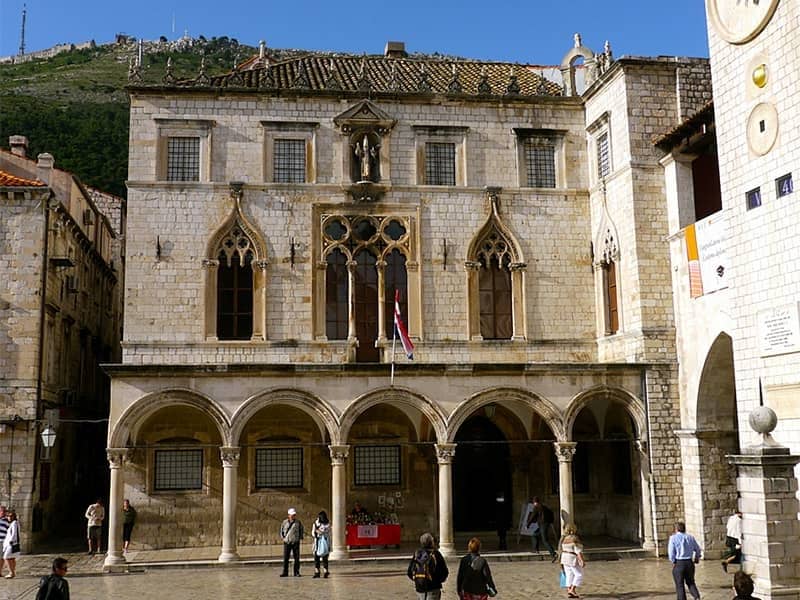
At the eastern end of Stradun (Placa), beside Luža Square and the City Bell Tower, Sponza Palace (also known as Divona) is one of the finest secular buildings in Dubrovnik Old Town.
Built in the early 16th century in Dubrovnik’s distinctive Gothic-Renaissance style, it was created as a commercial and administrative hub of the Republic, serving roles such as a customs house, bonded warehouse, mint, and an office for weights and measures. Today, it houses the Dubrovnik State Archives, and visitors still come to admire its elegant stonework and the calm, shaded atrium.
Quick facts
- Also known as: Divona (historic customs house)
- Location: Dubrovnik Old Town, Luža Square area (eastern end of Stradun/Placa), next to the City Bell Tower
- Built: 1516–1522 (early 16th century)
- Designer: Paskoje Miličević (municipal engineer)
- Architectural style: Dubrovnik Gothic–Renaissance
- Original purpose: Commercial and state services (customs house, warehouses, mint, weights and measures office)
- Today: Home of the Dubrovnik State Archives
Tickets and opening hours
Sponza Palace is not a typical museum - it is a working institution that houses the Dubrovnik State Archives. Visitor access focuses on the atrium (often used for exhibitions in the peak season) and the Memorial Room. In the summer months, entry to the atrium is regulated by ticketing to preserve a calm atmosphere, especially since the archives reading room is located above.
Atrium ticket policy (seasonal)
- Summer months - entry to the atrium is possible with a ticket.
- Individual ticket - 5 EUR.
- Group ticket - 3 EUR.
- Outside the summer months - atrium access is free.
- Not included with the Dubrovnik Card.
- Dubrovnik residents - free atrium entry year-round.
Memorial Room of the Dubrovnik Defenders opening hours
- Winter: 10:00 - 15:00
- Summer (1 May - 31 October): 09:00 - 21:00
Tip: Hours and access can change for exhibitions or special circumstances - double-check the official sources or the entrance notice on the day you visit. If you want the stories behind Sponza Palace, the Bell Tower, and nearby landmarks to really click, consider joining a guided Dubrovnik Old Town walking tour - it is an easy way to cover the highlights efficiently, get local context, and avoid missing the small details you would otherwise walk past.
Dubrovnik Super Saver:
Cable Car Ride and Old Town Walking Tour plus City Walls
Embark on an unforgettable journey through the stunning city of Dubrovnik, renowned for its breathtaking architecture and rich history. Stroll along the narrow and winding streets of the UNESCO World Heritage Site of Dubrovnik Old Town. Be awe-inspired by the mesmerising views from the 16th-century city walls, and take your experience to the next level by taking a cable car ride to Mt. Srd for panoramic views of the city.
Book your tour now and discover Dubrovnik with a knowledgeable tour expert.
Where is Sponza Palace?
Sponza Palace sits in the heart of Dubrovnik Old Town on Luža Square, right at the eastern end of Stradun (Placa). It stands immediately beside the City Bell Tower and is part of the main landmark cluster most visitors reach as they walk Stradun from one end to the other.
You will know you are in the right place when you arrive at the square formed by Sponza Palace, the Bell Tower, and nearby sights like St Blaise Church and Orlando's Column.
How to get there
- From Pile Gate: Enter the Old Town and walk straight along Stradun to its eastern end. Luža Square and the City Bell Tower are at the end of the street, with Sponza Palace next to them.
- From Ploče Gate: Enter the Old Town from the eastern side and follow the streets that lead toward Stradun and Luža Square. You will emerge by the City Bell Tower, with Sponza Palace beside the square.
- By bus or taxi: Vehicles do not go into the Old Town. Ask to be dropped near Pile Gate or Ploče Gate, then continue on foot to Stradun and Luža Square.
What you will see inside
Sponza Palace is not a classic museum with multiple exhibition rooms. It is a working building that houses the Dubrovnik State Archives, so visitor access is focused on the ground-floor spaces, especially the portico and atrium, while the upper floors are used for archival work and research.
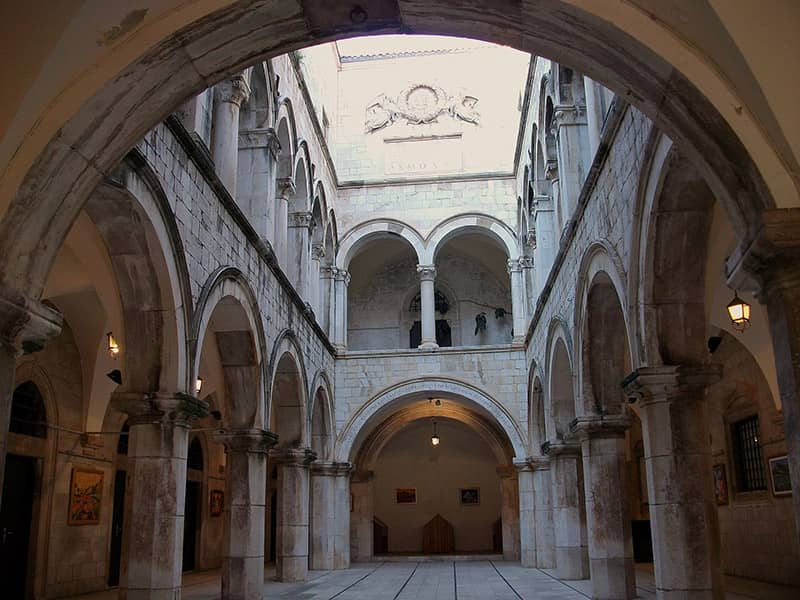
- The shaded portico and atrium - the main visitor-facing space, known for its calm atmosphere and beautiful stone details.
- Historic storage access points - doors from the atrium and the first-floor portico historically led to storages, reflecting Sponza's role in trade and administration.
- Memorial Room of the Dubrovnik Defenders - a small, powerful room inside the palace that displays photographs of Dubrovnik defenders who died in the Croatian War of Independence. Plan for a quiet, respectful visit.
- Archives in operation - the archives reading room is located upstairs, which is why summer visitor flow to the atrium is managed to preserve a suitable working environment.
If you are short on time, even a quick walk through the atrium is worth it for the architecture and the contrast to the busy Stradun just outside.
Why visit Sponza Palace?
Sponza Palace is a quick, high-impact stop in Dubrovnik Old Town - even if you do not plan to spend long inside. It combines standout Gothic-Renaissance architecture with a peaceful atrium just steps from the busiest part of Stradun, plus one of the most moving modern-history exhibits in the city.
- Admire Dubrovnik Gothic-Renaissance architecture - the palace is a refined 16th-century landmark with a shaded portico and atrium built for both beauty and function.
- Step into a calmer space off Stradun - the atrium is known for its tranquil atmosphere, making it a great break from Old Town crowds (especially in summer).
- Spot the famous “honest weights” message "Fallere nostra vetant et falli pondera. Meque pondero cum merces ponderat ipse deus" (Our weights do not permit cheating. When I measure goods, God measures with me.) - Sponza’s historic role in trade is literally written into the building through its well-known inscription about fair measures.
- Connect the palace to Dubrovnik’s trading power - Sponza was designed as a commercial and administrative centre (customs and storage), and it is also linked to key state functions such as the mint and arsenal.
- Visit the Memorial Room of the Dubrovnik Defenders - a small but powerful space with photographs of Dubrovnik defenders who perished in the Croatian War of Independence.
- See cultural life in a historic setting - the atrium hosts rotating exhibitions and cultural programmes during the summer season.
Want local context without planning every stop yourself? A small-group Dubrovnik Old Town food and drink walking tour is an easy add-on - it takes you through key landmarks and you will pass by Sponza Palace as part of the route.
Dubrovnik Food and Drink Walking Tour with a Local Guide (Sponza Palace included)
Taste your way through Dubrovnik on a small-group walking tour that mixes local food and drink with Old Town stories. Over around 3 hours you will stop at four different spots to sample Dubrovnik specialties (with drinks included), while your guide shares cultural insights and points out key landmarks along the way - including passing by Sponza Palace.
Book this tour if you want a relaxed, social way to explore beyond the tourist traps, pick up local recommendations, and experience Dubrovnik through its flavours.
Architecture highlights to look for
Sponza Palace is a standout example of Dubrovnik’s transitional Gothic-Renaissance style - and it rewards slow looking. Even if you only pass through briefly, the facade and atrium are packed with details that reflect the building’s original role as a tightly regulated commercial hub.
- Transitional Gothic-Renaissance design - the palace blends late Gothic forms with Renaissance symmetry, a signature look of early 16th-century Dubrovnik.
- Facade “layering” by floor - look for the Renaissance arcades on the ground floor, Gothic three-light window openings (triforium-style) on the first floor, and more Renaissance-style windows above, all arranged in a notably balanced composition.
- Master stonework - much of the stone-mason work is traditionally attributed to the Andrijić brothers from Korčula, which helps explain the crisp carving and harmonious proportions of the arcades and courtyard detailing.
- The shaded portico and arcaded atrium - step inside for the calm, cloister-like atmosphere that contrasts sharply with Stradun outside. This is the main space visitors experience and the best place to appreciate the palace up close.
- Commercial-function clues - doors and passages off the atrium hint at how the palace supported Dubrovnik’s trade system, with customs administration and storage functions. Historical accounts also connect the palace to the Republic’s mint and other state services, reinforcing that this was a working economic engine, not just a decorative landmark.
A short history of Sponza Palace
Sponza Palace, also known as Divona, was built in the early 16th century (1516-1522) in Dubrovnik’s distinctive Gothic-Renaissance style, based on the design of municipal engineer Paskoje Miličević. From the start it was created as a civic building at the centre of the Republic’s trade and administration, with functions tied to customs control, storage and other state services.
Over the centuries, Sponza served a range of public roles - most famously as a customs office and bonded warehouse, and it is also widely associated with the Republic’s mint and arsenal. Its inner courtyard (atrium) functioned as a commercial meeting point where fair trade was enforced, echoed by the well-known inscription about honest weights and measures.
Divona - Dubrovnik’s customs house
The name Divona is linked to the palace’s customs role (from “dogana”, customs). In a maritime republic built on regulated trade, the customs house was more than a checkpoint - it was part of the system that protected the city’s economy and reputation, with officials overseeing goods, duties and standardized measures.
One of the few Old Town buildings to survive the 1667 earthquake
Dubrovnik was devastated by the 1667 earthquake, but Sponza Palace is repeatedly noted as one of the rare major Old Town buildings to survive largely intact. That survival is one reason it remains such an important reference point for what Dubrovnik’s public architecture looked like before the disaster.
How long do you need at Sponza Palace?
Sponza Palace is an easy stop to fit into any Old Town walk. The experience is flexible - you can pop in for a quick look at the atrium, or stay longer if you want to include the Memorial Room or catch a seasonal exhibition.
- 5-10 minutes - quick look at the portico and atrium for architecture and photos.
- 15-25 minutes - atrium plus a calm visit to the Memorial Room.
- 25-45 minutes - atrium, Memorial Room, and extra time if an exhibition is running or you want to slow down and spot details like the facade layers and inscription.
If you are visiting Dubrovnik on a tight schedule, pairing Sponza Palace with nearby Old Town highlights on a guided walk can be a time-efficient way to get context without adding extra planning.
Tips for visiting
- Go early or later in the day - Luža Square and Stradun get busiest mid-day, especially when cruise crowds are in town. Visiting early morning or later afternoon makes the stop calmer and better for photos.
- Know what is (and is not) open - Sponza Palace houses the Dubrovnik State Archives, so access is focused on the atrium and the Memorial Room rather than a full museum-style interior.
- Check seasonal access - in summer the atrium can require a ticket, while outside the summer period it is typically free. Always confirm the current notice at the entrance.
- Visit the Memorial Room respectfully - keep voices low, avoid phone calls, and take photos only if it is clearly permitted on-site.
- Use it as a shade stop - the atrium is a great place to cool down for a few minutes during hot months, especially after walking the City Walls or Stradun.
- Combine it with nearby landmarks - because Sponza is on Luža Square, it is easy to pair with Rector’s Palace, St Blaise Church, Orlando’s Column, and the Cathedral area without extra walking.
Nearby attractions in Dubrovnik Old Town
Sponza Palace is on Luža Square at the end of Stradun, so you are already surrounded by major Old Town sights. These are the easiest nearby stops to combine with your visit.
- City Bell Tower (Gradski zvonik) and Luža Square - right next door and one of the most photographed corners of Old Town.
- Orlando's Column - a few steps from Sponza Palace, in the same square.
- St Blaise Church - Dubrovnik’s patron saint church, directly beside Luža Square.
- Rector's Palace - nearby on the Old Town circuit, a key landmark of the former Republic.
- Dubrovnik Cathedral and Treasury (Cathedral of the Assumption) - a short walk south from Luža Square, close to the city’s religious and treasury highlights.
- Old Port (Stara luka) - a short stroll downhill from the square, great for photos and boat-trip departures.
- Jesuit Stairs and St Ignatius Church - one of the most iconic photo spots in Old Town, within easy walking distance.
- Stradun - Dubrovnik’s main street runs straight from Pile Gate to Luža Square, ideal for a classic Old Town walk.
- Pile Gate and Ploče Gate - the two main entrances to Old Town, useful reference points for planning your route.
Working Hours
09:00 - 21:00 (summer)
Features
Home to Dubrovnik State Archive
Address & contact details
Street: Stradun 2, 20000 Dubrovnik
Sponza Palace FAQ
Is Sponza Palace free to enter?
Outside the summer months, access to the atrium is free. During the summer months, entry to the atrium is possible with a ticket. The Dubrovnik State Archives also notes that atrium entry is free for Dubrovnik residents throughout the year.
How much is the Sponza Palace ticket?
In the summer months, the Dubrovnik State Archives lists an individual ticket at 5 EUR and a group ticket at 3 EUR for entry to the atrium.
Is Sponza Palace included in the Dubrovnik Card?
No - the Dubrovnik State Archives states that entry to Sponza Palace is not included with the Dubrovnik Card.
What parts of Sponza Palace can visitors see?
Visitor access mainly focuses on the ground-floor portico and atrium. The building houses the Dubrovnik State Archives, and the reading room is on the upper floor, which is why visitor numbers are managed in the summer months.
What are the Memorial Room of the Dubrovnik Defenders opening hours?
Winter hours are 10:00-15:00. Summer hours (1 May-31 October) are 09:00-21:00.
Do I need to book in advance?
Usually not for a quick stop. In peak season, visiting early or later in the day can feel calmer, and you should be prepared to buy an atrium ticket if required.