
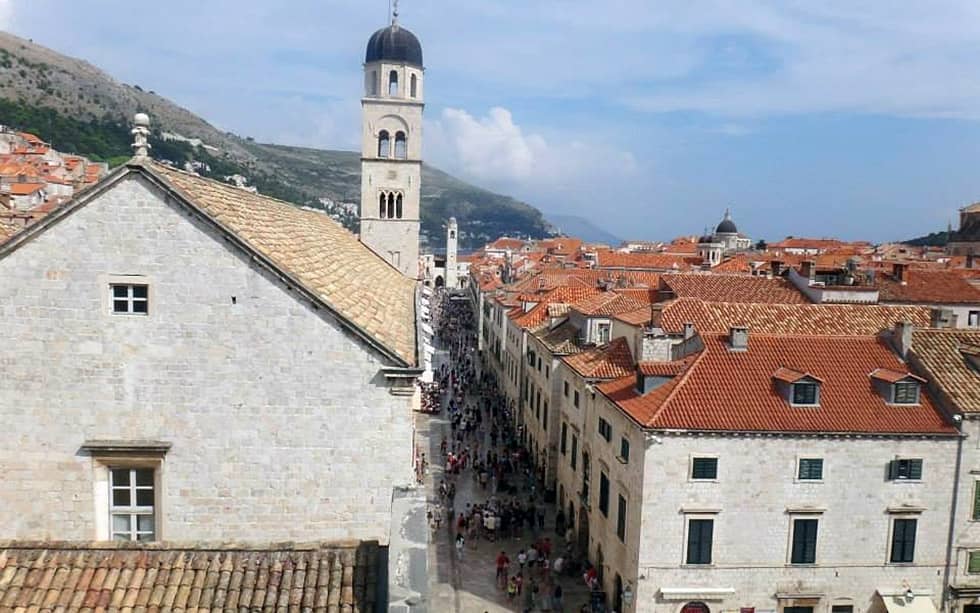
Stradun, also known as Placa, is the main pedestrian street through Dubrovnik Old Town and the easiest route for understanding the historic centre. The broad limestone promenade runs for about 300 metres from the Pile Gate side of the city to Luža Square, passing within a few steps of many of Dubrovnik’s most important fountains, churches, palaces and public buildings.
Stradun lies within the UNESCO-listed Old City of Dubrovnik and functions as much more than a sightseeing street. It is Dubrovnik’s traditional promenade, a meeting place, a route for major public celebrations and one of the few broad, largely level spaces inside a historic centre otherwise known for narrow lanes and steep stone stairways.
If this is your first visit to Dubrovnik, walking Stradun from Pile Gate to Luža Square is one of the simplest ways to get oriented before exploring the surrounding streets.
Stradun: quick overview
- Also called: Placa
- Where: Dubrovnik Old Town
- Length: about 300 metres
- Runs between: the Pile Gate side of the Old Town and Luža Square
- Cost: free
- Access: public pedestrian street, accessible day and night
- Time needed: 5-10 minutes to walk straight through; 30-60 minutes if you stop at nearby sights
- Best time: early morning for quiet streets; evening for atmosphere
- Best for: orientation, architecture, people-watching, cafés and connecting Dubrovnik’s main Old Town landmarks
What is Stradun?
Stradun is the principal east-west pedestrian route through Dubrovnik’s walled historic centre. Enter through Pile Gate and you reach its western end almost immediately, beside Big Onofrio’s Fountain.
From there, the street runs almost perfectly straight through the Old Town before opening into Luža Square, where several of Dubrovnik’s most important civic and religious monuments are concentrated.
Although visitors generally call it Stradun, Placa is the traditional name you will also see associated with the street.
Stradun is part of the Old City of Dubrovnik UNESCO World Heritage property. It is not a separate UNESCO site in its own right.
Why Stradun is the heart of Dubrovnik Old Town
Dubrovnik’s historic centre contains steep stairways, narrow lanes, small squares and tightly packed buildings. Stradun is the exception: broad, straight and comparatively level, it naturally became the main circulation route and public gathering place.
For visitors it works as an excellent orientation line. Many of the Old Town’s major attractions either stand directly on Stradun, occupy the squares at its ends, or are only a minute or two away through a side street.
- Western end: Pile Gate, Big Onofrio’s Fountain, Franciscan complex and City Walls entrance
- Central section: historic shopfronts, cafés and narrow side streets
- Eastern end: Luža Square, Sponza Palace, Orlando’s Column, St Blaise Church and City Bell Tower
- Just beyond: Rector’s Palace, Dubrovnik Cathedral and Old Port
Walk it once and the rest of the Old Town becomes much easier to understand.
Dubrovnik Super Saver:
Cable Car Ride and Old Town Walking Tour plus City Walls
Embark on an unforgettable journey through the stunning city of Dubrovnik, renowned for its breathtaking architecture and rich history. Stroll along the narrow and winding streets of the UNESCO World Heritage Site of Dubrovnik Old Town. Be awe-inspired by the mesmerising views from the 16th-century city walls, and take your experience to the next level by taking a cable car ride to Mt. Srd for panoramic views of the city.
Book your tour now and discover Dubrovnik with a knowledgeable tour expert.
History of Stradun
The street occupies the low central ground around which medieval Dubrovnik developed. Historical accounts traditionally associate this area with the division between earlier settlements that were gradually joined as the city expanded and consolidated.
By the Middle Ages, Stradun had become the principal street of the organized urban centre. Dubrovnik’s Statute of 1272 regulated many aspects of city life and urban development, helping shape the ordered street plan still recognizable inside the walls today.
The limestone pavement
Stradun’s pale stone paving is one of its defining features. Centuries of foot traffic have polished the limestone until parts of the surface appear almost glossy, especially under streetlights or after rain.
The effect is beautiful but practical footwear matters: smooth limestone can become slippery when wet.
The 1667 earthquake and rebuilding
The catastrophic 1667 Dubrovnik earthquake destroyed or badly damaged much of the city. The reconstruction that followed had a major influence on the appearance of Stradun today.
Rebuilding regulations produced rows of relatively uniform stone façades and commercial premises rather than recreating the more varied Gothic and Renaissance buildings that had previously lined parts of the street.
This helps explain why Stradun has such a coherent architectural appearance compared with many other medieval European main streets.
Historic shopfronts
Commerce has long been central to Stradun. Traditional stone shopfronts were designed so a doorway and display or service opening could be incorporated into the same façade, keeping business activity at street level while accommodation and domestic rooms occupied floors above.
What to see along Stradun
The simplest way to explore Stradun is from west to east, starting at Pile Gate and finishing around Luža Square.
1. Pile Gate
Pile Gate is Dubrovnik Old Town’s principal western entrance and the most common starting point for a Stradun walk.
Once through the gate complex, descend into the Old Town and you arrive immediately beside Big Onofrio’s Fountain and the western end of Placa.
2. Big Onofrio’s Fountain
Big Onofrio’s Fountain is one of Dubrovnik’s most recognizable public monuments and a popular meeting point.
The fountain was built as part of Dubrovnik’s historic water-supply system and marks the beginning of the classic Stradun walk.
3. Franciscan Monastery area
Immediately beside the western end of Stradun is the Franciscan complex, known for its cloister, church and historic pharmacy tradition.
Even if you do not enter, its position helps explain how closely Dubrovnik’s religious, commercial and civic buildings are packed around the main street.
4. The central promenade
The middle of Stradun is less about a single monument and more about the street itself: polished limestone, repeated façades, narrow lanes climbing away from the promenade and a constant flow of people between the two ends of the Old Town.
This is the best section for noticing the traditional shopfront architecture and stepping briefly into quieter side streets before returning to the main route.
5. Luža Square
At the eastern end, Stradun opens into Luža Square, the ceremonial and civic heart of the historic city.
Several of Dubrovnik’s major monuments are concentrated here and in the surrounding few metres.
6. Sponza Palace
Sponza Palace stands prominently beside Luža Square and is one of Dubrovnik’s most important surviving historic civic buildings.
7. Orlando’s Column
Orlando’s Column stands in the square near the eastern end of Stradun and has long been associated with Dubrovnik’s civic identity and public life.
8. Church of St Blaise
The Baroque Church of St Blaise is dedicated to Dubrovnik’s patron saint and occupies one of the most prominent positions around Luža Square.
9. City Bell Tower
The City Bell Tower rises above the eastern end of Stradun and provides one of the street’s strongest visual endpoints.
Its famous bronze bell-striking figures, known as the Zelenci, are part of Dubrovnik’s civic iconography.
10. Rector’s Palace and Cathedral
Continue only a short distance beyond Stradun to reach the Rector’s Palace and Dubrovnik Cathedral.
Best time to walk Stradun
Early morning
Early morning is the best period if you want to see the architecture clearly, photograph the street with fewer people and walk before summer temperatures rise.
This is also when Stradun feels most different from its busy daytime personality.
Late afternoon
Late afternoon can work well once some daytime excursion traffic begins to ease. The light becomes softer, but restaurants, cafés and shops remain active.
Evening
Stradun is particularly atmospheric after dark. The polished limestone reflects the streetlights and the promenade becomes a social space rather than simply a sightseeing route.
If you have enough time, walk Stradun twice: once early in the morning and once after dinner.
Midday in July and August
This is usually the least comfortable time for a leisurely walk. The street is exposed, reflected heat from the stone can be noticeable and large visitor numbers can make the central route very busy.
Use the hottest hours for lunch, museums, churches or shaded side streets when practical. See our Dubrovnik weather guide for seasonal planning.
Stradun at night
Stradun is not an attraction that closes when sightseeing hours end. Because it is a public city street, it remains accessible at night and becomes one of Dubrovnik’s principal evening gathering places.
Cafés and restaurants remain active, people stroll between Pile and Luža, and the illuminated façades give the street a very different character from the daytime.
Even if you have already seen Stradun during a walking tour, it is worth returning independently after dark.
Festivals and events on Stradun
Stradun has long functioned as Dubrovnik’s ceremonial public space and continues to host major processions, concerts and seasonal celebrations.
Depending on when you visit, activity around Stradun can include:
- Festivity of St Blaise: celebrations and processions connected with Dubrovnik’s patron saint
- Dubrovnik Summer Festival: performances and cultural events throughout the historic centre
- Dubrovnik Winter Festival: decorations, music and seasonal programmes
- New Year celebrations: public concerts and festivities
- Other concerts and civic events: Stradun and Luža Square regularly act as central venues
Check our Dubrovnik events guide for current programmes rather than relying on permanent event dates on this page.
Is Stradun free to visit?
Yes. There is no entrance fee to walk Stradun. It is a public pedestrian street inside Dubrovnik Old Town and is accessible day and night.
Individual attractions near the street may charge admission, including the Dubrovnik City Walls, museums and certain historic interiors.
Accessibility and walking conditions
Stradun is one of the easiest sections of Dubrovnik Old Town for visitors with limited mobility because the main promenade is broad and relatively level.
The more significant accessibility challenge comes when leaving Stradun. Many side streets, particularly those climbing north toward the upper parts of the Old Town, contain long flights of stone steps.
- Main promenade: broad and largely level
- Surface: smooth limestone
- When wet: can become slippery
- Side streets: many include stairs and steep gradients
- Nearby monuments: accessibility varies individually
If step-free movement is important, use Stradun as the central route and choose side-street detours carefully.
Cafés, restaurants and shops on Stradun
Stradun has always been associated with commerce, and its ground floors remain filled with cafés, shops and other businesses.
Sitting on or near the promenade can be worthwhile for the setting and people-watching, but the most prominent locations do not necessarily offer the best value. If choice or price matters more than having a table directly on Stradun, explore the lanes and squares a short distance away.
For more ideas, see our Dubrovnik shopping guide and Dubrovnik bars and nightlife guide.
How to get to Stradun
Stradun is entirely inside the pedestrian Old Town, so you cannot drive directly onto it.
Via Pile Gate
Pile Gate is the most convenient entrance for most visitors. Once through the gate complex, Stradun begins almost immediately beside Big Onofrio’s Fountain.
Via Ploče Gate
If you are approaching from the eastern side of Dubrovnik, enter through Ploče Gate and continue through the Old Town toward Luža Square. Stradun begins at the western side of the square.
From Gruž Port and Main Bus Station
Gruž is several kilometres from the Old Town. From Dubrovnik Ferry Port or the Main Bus Station, continue by local bus or taxi toward the Old Town and enter through Pile.
Use our Dubrovnik city bus map for current routes.
Local bus fares
Libertas operates Dubrovnik’s city buses, with multiple routes serving Pile. Ticket types and fares can change, so check the current operator price list if you are planning several journeys.
Card payment is available on Libertas city and suburban buses, although carrying another payment method is sensible when travelling.
From Dubrovnik Airport
Dubrovnik Airport is outside the city. Airport buses, taxis and private transfers connect it with Dubrovnik, but drop-off arrangements and schedules can change.
For current airport transport information, see our Dubrovnik Airport guide and Dubrovnik Airport shuttle guide.
From Lapad and Babin Kuk
Local buses are the simplest public-transport option from Lapad and Babin Kuk. Aim for Pile, then enter the Old Town on foot.
Easy Stradun walking route
For a first visit, this west-to-east sequence gives you the main street and several of Dubrovnik’s most important landmarks without unnecessary backtracking:
- Enter through Pile Gate.
- Stop at Big Onofrio’s Fountain.
- See the Franciscan complex beside Stradun.
- Walk slowly along the central section of Placa.
- Finish the main street at Luža Square.
- See Sponza Palace and Orlando’s Column.
- Visit Church of St Blaise.
- Continue to Rector’s Palace and Dubrovnik Cathedral.
- Finish at the Old Port or return along a different side street.
How long do you need for Stradun?
10 minutes
Enough to walk directly from one end to the other without stopping.
30-60 minutes
Better for a normal first visit with photographs, Onofrio’s Fountain, Luža Square and short detours.
2-3 hours
Use Stradun as the centre of a larger Old Town route that includes churches, palaces, museums and a café stop.
Half day
Combine Stradun with the City Walls and several major monuments around Luža Square.
Stradun and the Dubrovnik City Walls
Stradun and the City Walls offer very different perspectives on Dubrovnik and work well together.
Stradun shows you the city from street level: façades, public squares, cafés and everyday movement. The walls give you the overhead view of rooftops, towers, sea and the full urban layout.
The principal City Walls entrance is beside Big Onofrio’s Fountain near the western end of Stradun, making it easy to combine the two.
In summer, consider walking the walls early and returning to Stradun later rather than doing both during the hottest part of the day.
Nearby attractions
- Pile Gate - principal western entrance to the Old Town
- Big Onofrio’s Fountain - immediately beside Stradun
- Dubrovnik City Walls - main entrance at the western end
- Sponza Palace - beside Luža Square
- Church of St Blaise - Dubrovnik’s patron-saint church
- Rector’s Palace - a short walk beyond the eastern end
- Dubrovnik Cathedral and Treasury - near Rector’s Palace
- Maritime Museum - useful for Dubrovnik’s maritime history
- House of Marin Držić - museum dedicated to one of Dubrovnik’s most important writers
For a wider sightseeing plan, browse our Dubrovnik attractions guide.
Guided tours that include Stradun
You do not need a guide to walk Stradun, but a good Old Town tour can explain the street’s architectural details, Dubrovnik Republic history, rebuilding after the 1667 earthquake and the significance of monuments that are easy to walk past without context.
Stradun is included in most general Old Town walking tours because it links the western and eastern civic centres so naturally.
Dubrovnik Discovery Old Town Walking Tour
Step inside Dubrovnik’s Old Town on an intimate, story-rich private tour led by a knowledgeable local guide.
Walk past ancient gates, towers, and mighty fortresses as the city’s dramatic history unfolds—from medieval glory to the 1990s conflict. Visit two fascinating museums, explore iconic filming locations from Game of Thrones and other movies, and soak up must-see sights like Stradun and the Rector’s Palace.
Was Stradun damaged during the 1991 attacks on Dubrovnik?
The Old City of Dubrovnik suffered damage during the attacks of 1991, and restoration work followed during the post-war period. UNESCO and Croatian conservation institutions were involved in the wider restoration and preservation of the historic city.
Today the restored Old City remains one of Croatia’s most important protected historic centres.
Stradun and Game of Thrones
Dubrovnik became internationally known as a major filming location for Game of Thrones, and Stradun appears within the wider network of Old Town locations visited on filming tours.
The street’s much greater significance, however, comes from its centuries-long role in the history and everyday life of Dubrovnik rather than its modern screen appearances.
Access
Free public pedestrian street, accessible day and night.
Why visit?
The main promenade and practical sightseeing spine of Dubrovnik Old Town.
Address
Placa
20000 Dubrovnik
Croatia
FAQ - Stradun Dubrovnik
What is Stradun in Dubrovnik?
Stradun is the main pedestrian promenade through Dubrovnik Old Town. It connects the Pile Gate side of the historic centre with Luža Square and passes close to many of the city’s major monuments.
Is Stradun the same as Placa?
Yes. Placa and Stradun refer to the same main street through Dubrovnik Old Town.
How long is Stradun?
Stradun is about 300 metres long.
How long does it take to walk Stradun?
You can walk from one end to the other in about 5-10 minutes without stops. Allow 30-60 minutes if you want to photograph the street and visit nearby landmarks.
Is Stradun free to visit?
Yes. Stradun is a public pedestrian street and there is no entrance fee. Individual attractions nearby may charge admission.
What can you see along Stradun?
Highlights include Big Onofrio’s Fountain, the Franciscan complex, Luža Square, Sponza Palace, Orlando’s Column, Church of St Blaise and the City Bell Tower. Rector’s Palace and Dubrovnik Cathedral are just beyond the eastern end.
What is the best time to visit Stradun?
Early morning is best for quiet streets and photography. Evening is best for atmosphere. Midday in July and August is generally the hottest and busiest period.
Is Stradun open at night?
Yes. It is a public street and remains accessible throughout the night. Evening is one of the most atmospheric times to walk it.
Is Stradun wheelchair-friendly?
Stradun itself is broad and relatively level, making it one of the easier parts of Dubrovnik Old Town for visitors with limited mobility. Many surrounding side streets, however, contain steep stairs.
Why is Stradun so shiny?
Centuries of foot traffic have polished the limestone paving until much of it has a smooth, glossy appearance.
Is Stradun slippery?
It can be when wet. The polished limestone becomes smooth after rain, so footwear with good grip is useful.
Why do the buildings on Stradun look so similar?
Much of the uniform appearance comes from rebuilding after the devastating 1667 earthquake, when reconstruction rules produced more standardized stone façades along the main street.
Is Stradun part of a UNESCO World Heritage Site?
Yes. Stradun lies within the UNESCO-listed Old City of Dubrovnik, which has been on the World Heritage List since 1979.
Can you eat and drink on Stradun?
Yes. Cafés, restaurants and shops operate along Stradun and the surrounding streets. Businesses directly on the main promenade may be more expensive than alternatives a short walk away.
Was Stradun damaged during the war?
Parts of Dubrovnik Old Town were damaged during the attacks of 1991. Restoration and conservation work followed throughout the historic centre.
Was Game of Thrones filmed on Stradun?
Stradun forms part of the wider Dubrovnik Old Town area used for filming and visited on Game of Thrones location tours, although its historical importance extends far beyond the series.