
The House of Marin Držić is a small literary museum in Dubrovnik Old Town dedicated to the life, plays and political ideas of Marin Držić, the city's greatest Renaissance playwright. Sometimes compared with Shakespeare because of his importance to national drama, Držić was a sharp observer of Dubrovnik society whose comedies mocked greed, vanity, hypocrisy and human stupidity.
The museum is most worthwhile for visitors interested in literature, theatre and Renaissance Dubrovnik. It is not a preserved house filled with Držić's original belongings, but an interpretive museum using documents, costumes, theatre material and multimedia to reconstruct his life and work.
House of Marin Držić quick overview
| Best for | Literature, theatre and Renaissance Dubrovnik |
|---|---|
| Time needed | About 30-45 minutes |
| Adult ticket | €8 |
| Student / school ticket | €5 |
| Family ticket | €20 |
| Location | Široka 7, Dubrovnik Old Town |
| Closed | Monday |
| Top highlights | Biography timeline, conspiracy letters, theatre costumes and audiovisual displays |
Is the House of Marin Držić worth visiting?
Yes, if you are interested in literature, theatre or the social history of the Dubrovnik Republic. The museum is small and more interpretive than object-heavy, so it is best approached as a short cultural stop rather than one of Dubrovnik's major visual attractions.
Visitors who know nothing about Marin Držić can still get a useful introduction to one of the most important figures of Croatian Renaissance culture. If literature is not a major interest, the museum makes most sense as part of a wider Old Town itinerary or as an additional stop when using the Dubrovnik Pass.
Allow around 30-45 minutes. Visitors who use the audio guide and read the displays carefully may stay longer.
Who was Marin Držić?
Marin Držić was born in Dubrovnik, probably in 1508, into a non-noble merchant family. He became a cleric and musician as well as a playwright, travelled through parts of Europe and spent time in Italy, Vienna and Constantinople before dying in Venice in 1567.
Držić is regarded as the greatest Croatian Renaissance playwright and one of the major writers of European Renaissance comedy. His best-known works include Dundo Maroje, Novela od Stanca, Tirena, Skup, Grižula and Hekuba.
His comedy is very different from the elevated style associated with some later Dubrovnik writers. Držić focused instead on recognisable human weaknesses - greed, pretension, stupidity, desire and the conflict between clever outsiders and established authority.
This earned him a reputation as a master of satire and comedy, while his characters and dialogue remain central to the Croatian theatrical tradition.
Držić's conspiracy letters
The most surprising part of Držić's biography came near the end of his life. In 1566, while living in Italy, he wrote a series of political letters to Cosimo I de' Medici and Francesco de' Medici in Florence.
In them, Držić criticised the government of the Dubrovnik Republic and proposed political changes that would reduce the exclusive control of the ruling nobility. His letters reveal a much more radical side than the comic playwright familiar from his theatre.
Later generations have interpreted the episode in very different ways. Some saw the letters as disloyal to the Republic, while others viewed them as evidence of opposition to an oligarchic political system.
The conspiracy letters form an important part of the museum's permanent exhibition and help explain why Držić remains such a complex figure in Croatian cultural history.
Is this really Marin Držić's house?
Not in the simple sense suggested by the museum's name.
Marin Držić was not born in the present building. The exact location of his childhood home is uncertain, although historical documents suggest that the Držić family house stood somewhere near the Rector's Palace.
The current museum building stands beside the Domino Church, also known as the Church of All Saints. Držić inherited family patronage rights connected with the church and served as its rector, so he had a genuine connection with this site.
The building itself was erected after the catastrophic Dubrovnik earthquake of 1667, long after Držić's death. It stands partly on the site of earlier structures associated with the church.
The House of Marin Držić is therefore better understood as a memorial and interpretive museum rather than a preserved Renaissance residence.
What to see inside the House of Marin Držić
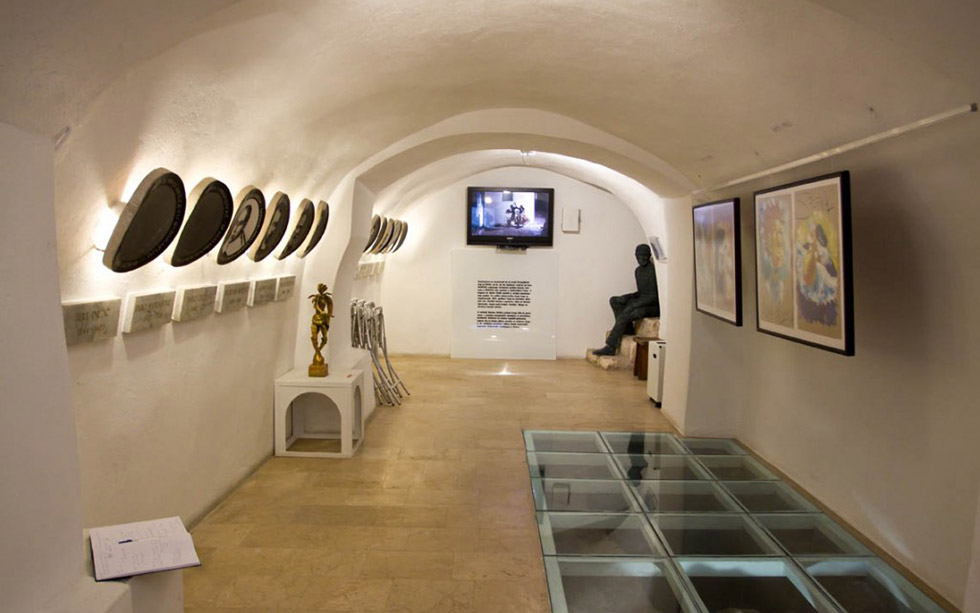
Very few personal objects belonging directly to Držić survive, so the permanent exhibition uses documents, reconstructed material, theatre costumes, art and multimedia to tell his story.
Biography timeline
Years from Držić's life, from 1508 to 1567, are displayed along the staircase, turning the movement through the museum into a chronological journey through his biography.
Family and genealogy
The permanent exhibition explains the Držić family background and includes a genealogical tree. His family's position is important because Držić came from Dubrovnik's wealthy commoner class rather than the noble families that controlled the Republic's government.
The conspiracy letters
Reproductions and interpretation of Držić's political letters provide one of the most intriguing parts of the museum. They show that his criticism of Dubrovnik society extended beyond comic theatre into serious political thought.
Theatre costumes and characters
Costumes and theatrical references introduce characters from Držić's plays and help visitors understand how his comedies have continued to be performed long after his death.
Theatre posters and programmes
The museum preserves posters, photographs, programmes and other material documenting performances of Držić's works in Croatia and abroad.
Portraits and contemporary art
The collection also includes portraits by modern artists, small sculptures and works of applied art inspired by Držić, his characters and his literary legacy.
Audio and visual interpretation
Audiovisual displays help compensate for the limited number of surviving personal objects. The museum also provides an official audio guide covering Držić's life, work and the historical setting of Renaissance Dubrovnik.
Dundo Maroje and Držić's famous plays
Dundo Maroje is Marin Držić's best-known comedy and the work most international visitors are likely to encounter first. The surviving play was performed in Dubrovnik in 1551 and follows a wealthy merchant searching Rome for his irresponsible son Maro, who is happily spending his father's money.
The plot allowed Držić to explore money, power, deception and human weakness through fast-moving comedy. Like many of his plays, it used recognisable social types while giving clever servants and outsiders some of the sharpest observations.
Other important works include Novela od Stanca, Tirena, Skup, Grižula and his adaptation of Hekuba.
Držić's plays have continued to be staged centuries after his death and remain an important part of Croatian theatre.
House of Marin Držić tickets
| Ticket | 2026 price |
|---|---|
| Adult | €8 |
| Schoolchildren and students | €5 |
| Family ticket | €20 |
| Dubrovnik museums and galleries combined ticket - adult | €20 |
| Combined ticket - student | €10 |
| Combined family ticket | €45 |
The family ticket is valid for up to two adults with children aged 14 or younger.
The combined Dubrovnik museums and galleries ticket is valid for seven days from its first use and includes the House of Marin Držić together with the Rector's Palace, Maritime Museum, Ethnographic Museum Rupe, archaeological exhibitions in Revelin and several other city museums and galleries.
Children under seven and residents of Dubrovnik-Neretva County currently receive free admission. Several other categories also qualify for free entry.
Opening hours
Tuesday-Sunday
09:00-20:30
Monday
Closed
The House of Marin Držić is also closed on Christmas Day, New Year's Day, the Feast of St Blaise and Easter.
Is the House of Marin Držić included in the Dubrovnik Pass?
The Dubrovnik Pass includes the City Walls together with city museums and galleries and public transport. The House of Marin Držić participates in Dubrovnik's city museum ticket system, making it a natural additional cultural stop for visitors already using the pass.
If you are not buying the Dubrovnik Pass but plan to visit several museums, compare the €8 individual admission with the €20 combined museum and gallery ticket.
How to find the House of Marin Držić
The museum is at Široka 7 in the heart of Dubrovnik Old Town, only a short walk from Stradun.
From Stradun, turn into Široka Street and walk toward the western part of the Old Town. The museum stands beside the small Domino Church.
Because the museum is centrally located and relatively small, it fits easily between larger attractions rather than requiring a separate journey.
What to combine with the museum
The House of Marin Držić works well as part of a cultural walk through Dubrovnik Old Town.
The Rector's Palace is particularly useful for understanding the political system of the Republic that Držić later criticised in his conspiracy letters.
Nearby Ethnographic Museum Rupe offers a contrasting look at traditional everyday life in the wider Dubrovnik region, while the Maritime Museum explains the shipping and trade that supported the Republic's prosperity.
For more options, see our complete guide to museums in Dubrovnik.
Address and official information
House of Marin Držić
Široka 7
20000 Dubrovnik
Croatia
Official website: House of Marin Držić