
Pile Gate (Vrata od Pila) is Dubrovnik’s best-known and busiest entrance to the Old Town, opening from the western side of the City Walls straight onto Stradun (Placa), the city’s main street. The name “Pile” is commonly linked to the Greek word for “gate,” which fits its historic role as the primary way in and out for centuries.
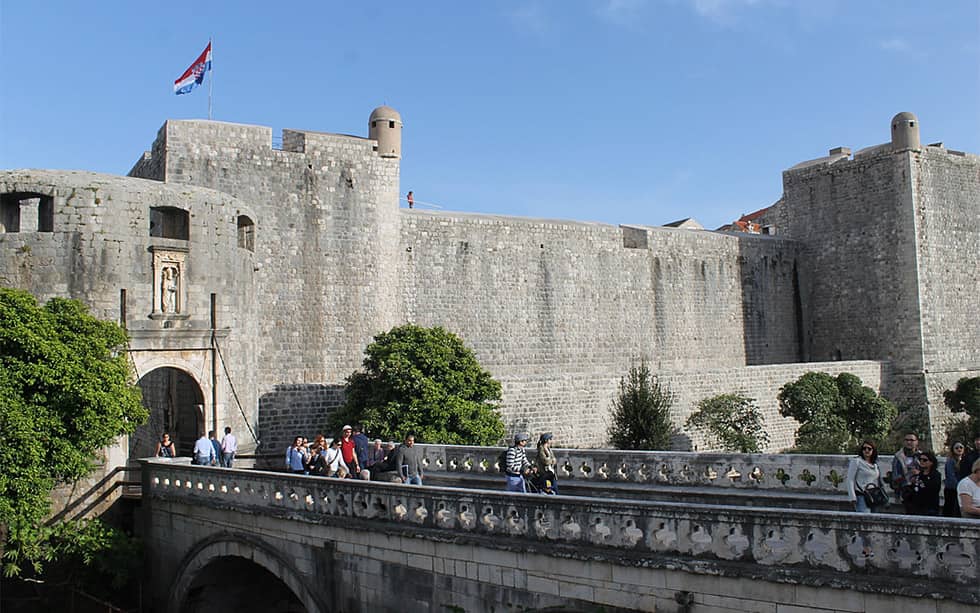
This is not a single doorway but a fortified entrance complex: an outer gate and an inner gate, joined by two bridges across the former defensive trench. The approach features a stone bridge supported by arches, associated with the 15th-century defensive upgrades and the work of architect Paskoje Miličević, and it connects to a wooden drawbridge section that was designed to be raised for security. The wooden drawbridge was traditionally raised each evening as part of the city’s defences, helping control access and protect the Old Town overnight.
As you cross toward the outer gate, you can still spot the practical details of the old mechanism, elements such as the winch and counterweights that helped lift the drawbridge. Above the gates you’ll see the statue of St Blaise (Sv. Vlaho), Dubrovnik’s patron saint, watching over the entrance and welcoming visitors into the walled city.
Pile Gate is also a convenient “starting line” for sightseeing: you are steps from iconic Old Town landmarks just inside the walls, and close to a main access point for walking the Dubrovnik City Walls. Pop-culture fans may also recognize this area from Game of Thrones filming in Dubrovnik, see our guide to Game of Thrones filming locations in Dubrovnik and more attractions in Dubrovnik.
Pile Gate quick overview
- What it is: Dubrovnik’s main western gate into the Old Town, formed as a double-gate entrance complex with bridges across the former defensive trench.
- Local name: Vrata od Pila.
- Where it is: On the western side of the Old Town walls, approached from the Pile/Brsalje area.
- What you’ll see: Two gates (outer and inner), a stone bridge plus a former wooden drawbridge (historically raised at night), and the statue of St Blaise above the entrance.
- Cost: Free to walk through the gate; tickets apply only if you’re entering paid attractions nearby (such as the City Walls).
- Time needed: 5-15 minutes for a look and photos; 45-90 minutes if you combine it with nearby highlights just inside the walls.
- Best for: First-time visitors, a straightforward Old Town entry point, and a practical starting location for Stradun (Placa) and nearby sightseeing.
- Good to know: The main entrance to the Dubrovnik City Walls is on Placa by the Inner Pile Gate, close to this entrance.
- Nearby landmark: The Large Onofrio’s Fountain is immediately inside the western entrance area, making it an easy “first stop” once you enter.
Where is Pile Gate in Dubrovnik?
Pile Gate sits on the western side of Dubrovnik’s Old Town walls, at the edge of the Pile/Brsalje area just outside the historic centre. This approach is a natural meeting point for visitors: from the Brsalje terrace you get a clear sense of the fortifications and views toward Lovrjenac Fort before you cross the bridge and pass through the gates into the walled city.
Once you enter, you’re effectively at the western “start” of Stradun (Placa), the Old Town’s main limestone-paved street, which runs across the city to the eastern entrance at Ploče Gate.
Map and orientation
- Look for the bridge approach: the classic entry route is over the bridge toward the outer gate, with the fortified walls rising on either side.
- Use Brsalje as your landmark: the terrace area outside the gate is an easy reference point and a handy spot to pause and orient yourself before entering.
- Arriving by public bus: most city buses terminate at Pile Square (Old Town), with the final stop right in front of Pile Gate, use our Dubrovnik City Bus Map to match your nearest stop to the best line.
- Heading into the Old Town: walk through the gates and continue straight to reach Stradun (Placa), the city’s central pedestrian spine.
- Quick nearby reference: Lovrjenac Fort is visible from the western approach area, helping you confirm you’re at the “Pile side” of the Old Town.
How to get to Pile Gate
- On foot: If you’re already in or near the Old Town, Pile Gate is the easiest west-side entry point, follow the pedestrian flow along the outside of the walls toward the bridge approach and you’ll arrive at the gate in minutes.
- By local bus: For most visitors, the simplest public-transport option is the city bus to Pile Square (Old Town), with the final stop directly in front of Pile Gate. Use our Dubrovnik City Bus Map to identify the best line from your area and confirm the current timetable.
- From Gruž (main bus station and ferry port): If you’re arriving by coach, start with our Dubrovnik Main Bus Station guide. For ferry arrivals, see the Dubrovnik Ferry Port guide. From Gruž, local buses and taxis connect you to Pile Square (Old Town), making Pile Gate a practical entry point into the historic centre.
- From Dubrovnik Airport: Airport connections typically drop you at Old Town edge points rather than inside the walls. Start with our Dubrovnik Airport guide, then continue on foot to Pile Gate from the Old Town perimeter.
- Taxi / transfer drop-off: Vehicles cannot enter the Old Town, so taxis and transfers drop passengers outside the walls near the Pile/Brsalje area. From there, it’s a short walk to the bridge approach and the gates.
What to see at Pile Gate
Pile Gate is more than a single archway, it’s a layered defensive entrance designed to slow movement, control access, and protect the western approach to Dubrovnik’s Old Town. As you arrive, take a moment to look at the gate as a complete system: bridges, trench, outer gate, inner gate, and the details that made the drawbridge work.
The outer gate and bridge approach
Your approach begins across the stone bridge with arches, built as part of Dubrovnik’s defensive upgrades and commonly linked to engineer Paskoje Miličević. Ahead is the Renaissance-era outer gate set into a rounded defensive structure, creating a controlled "funnel" into the city rather than a wide-open entrance.
The wooden drawbridge and defensive mechanism
Between the bridges and gates you can still spot practical remnants of the drawbridge system, features such as the winch and counterweight elements that once helped raise the wooden section. The wooden drawbridge was traditionally raised each evening to control access and help protect the Old Town overnight.
The inner gate and St Blaise statue
After the outer gate, you pass into the inner gate, often described as a Gothic arch, marking the final threshold into the Old Town. Look up to see St Blaise (Sv. Vlaho), Dubrovnik’s patron saint, whose statue above the entrance is one of the gate’s most recognisable details.
The dry moat and trench area
The gate complex was built over what was historically a defensive trench; today, this space is often experienced as a dry moat area beside the approach. It’s a useful place to pause, step aside from the flow of foot traffic, and appreciate how the walls, bridges, and gates fit together.
History and architecture (quick, visitor-friendly)
Pile Gate was designed as a layered, defensive entrance on Dubrovnik’s landward side, with multiple thresholds and a bridged approach that made it harder for unwanted visitors to enter the city quickly. Today, you can still read that logic in the layout - a bridge approach over the former trench, an outer gate, a controlled passage, and an inner gate that opens directly onto Stradun (Placa).
- 15th-century upgrades: The stone bridge approach and Gothic elements are commonly linked to the major fortification works of the 1400s, including designs associated with Dubrovnik architect-engineer Paskoje Miličević (often dated to 1471 for the bridge works).
- 16th-century outer gate: The imposing outer gate is typically dated to the 1500s (often cited as 1537) and formed part of a Renaissance-style, semicircular defensive structure that tightened control over the entrance.
- Drawbridge security: The wooden drawbridge section was raised at night as a practical security measure, reflecting Dubrovnik’s long tradition of strict access control during the Republic era.
- St Blaise above the entrance: Look up for the statue of Dubrovnik’s patron saint, St Blaise (Sv. Vlaho) - a landmark detail at the gate and, according to the Dubrovnik Tourist Board, the work of sculptor Ivan Meštrović.
City Walls access near Pile Gate
If you are planning to walk the Dubrovnik City Walls, Pile Gate is the most convenient place to start. The main entrance is on Stradun (Placa) by the Inner Pile Gate, positioned between the western section of the walls and St Saviour Church. From here, a staircase takes you up onto the ramparts in the direction of Minčeta Fort.
- Where to enter: Go through Pile Gate into the Old Town, step onto Stradun (Placa), and look for the City Walls entrance by the Inner Pile Gate near St Saviour Church.
- Tickets: You can buy tickets at the entrance area or online in advance. If you plan to visit multiple sights, it can also be worth comparing inclusions and savings with the Dubrovnik Pass.
- Best time strategy: This entrance is the most popular and can develop queues. If you want a quieter start, go early in the morning or later in the day, especially in peak summer.
- What to expect: The initial climb includes steep steps, so wear stable shoes and take it slowly if it is hot or crowded.
Want to see Pile Gate and the City Walls without stressing about tickets, timing, or where to start? An organised tour is an easy way to experience Dubrovnik’s top sights in one smooth itinerary, a local guide to bring the history to life, and smart routing that avoids the worst crowds and heat.
Dubrovnik Super Saver:
Cable Car Ride and Old Town Walking Tour plus City Walls
Embark on an unforgettable journey through the stunning city of Dubrovnik, renowned for its breathtaking architecture and rich history. Stroll along the narrow and winding streets of the UNESCO World Heritage Site of Dubrovnik Old Town. Be awe-inspired by the mesmerising views from the 16th-century city walls, and take your experience to the next level by taking a cable car ride to Mt. Srd for panoramic views of the city.
Book your tour now and discover Dubrovnik with a knowledgeable tour expert.
Best things to do near Pile Gate
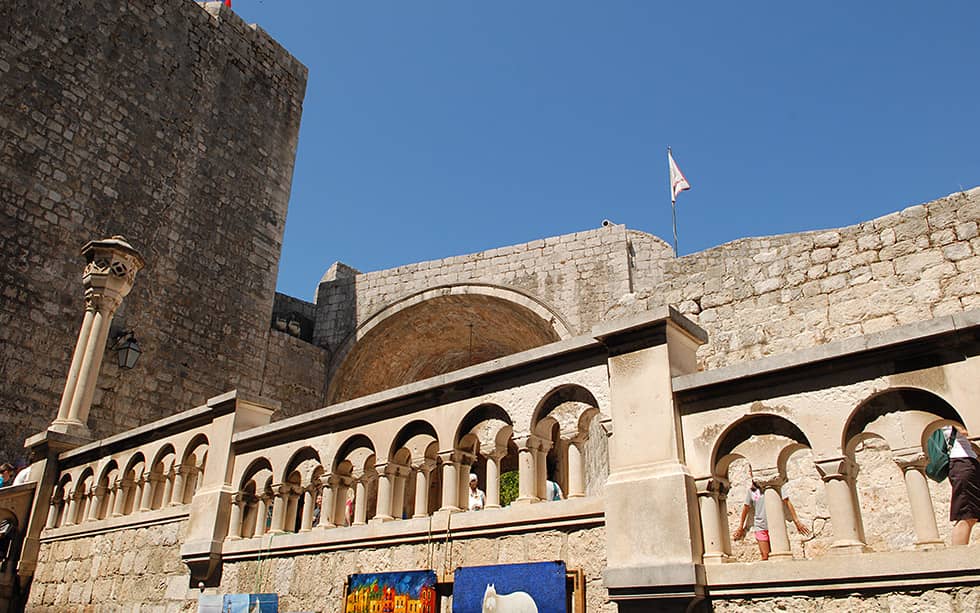
- Walk Stradun (Placa): Step through the gate and you are immediately on Dubrovnik’s main street. A slow stroll along the polished limestone is the best way to absorb the Old Town atmosphere and spot key landmarks as you go - start with our guide to Stradun.
- Stop at the Large Onofrio’s Fountain: Just inside the western entrance, this landmark fountain is a classic first photo stop and a practical place to pause before you dive deeper into the Old Town - see Onofrio’s Fountain.
- Visit the Franciscan complex and pharmacy: A few minutes from the gate along Stradun, the Franciscan sites are one of the easiest cultural add-ons to combine with a Pile Gate entry.
- See Bokar Fort from the outside: Near the seaward side of the walls, Bokar Fort is part of the defensive system that protected the Pile approach, and it is a great spot to appreciate how the fortifications wrap around the western corner.
- Climb to Fort Lovrjenac: Perched on a cliff just west of the Old Town, Lovrjenac offers some of the best views back toward the walls and historically helped defend the Pile Gate side of the city - plan your visit with our Fort Lovrjenac guide.
- Detour to West Harbour (Kolorina): From the Pile area it is a short walk down to the waterfront for dramatic wall views, boats, and a quieter sea-level perspective before you continue sightseeing.
- Explore more Old Town highlights: If you want to build a full day around this entrance, browse our guide to attractions in Dubrovnik and pick what fits your time and interests.
Pile Gate vs Ploče Gate - which should you use?
Pile Gate and Ploče Gate are the two main entrances to Dubrovnik’s Old Town, and the best choice usually comes down to where you are coming from. Pile Gate is the main western entrance and the most common arrival point for visitors using city buses, tours, and transfers. Ploče Gate is the eastern entrance and is the most convenient option if you are approaching from the Ploče side of town, especially the direction of hotels, beaches, and viewpoints along the eastern perimeter.
Whichever gate you choose, you will quickly end up on the same central route because Stradun (Placa) connects the two entrances straight through the heart of the Old Town. If you want the classic first impression with easy orientation, Pile Gate is usually the simplest start. If you are staying on the eastern side or you want a smoother approach from Ploče, entering via Ploče Gate can save time and steps.
Practical tips for visiting
Best time to go and crowd tips
Pile Gate is a major pinch point for foot traffic, especially from late morning to mid-afternoon when day-trippers and cruise excursions peak. For a calmer experience and better photos, aim for early morning or later afternoon when the Old Town is cooler and the flow through the gate is smoother.
If you are planning your day around cruise crowds, check the Port of Dubrovnik arrivals schedule in advance. On busy ship days, the area around Pile can feel packed, while quieter days can feel completely different.
Heat, footwear, and comfort
In warm months, the stone surfaces around the gate and inside the Old Town can heat up quickly and there is limited shade in exposed areas. Bring water, wear stable footwear, and take short breaks just inside the gate before continuing up any stair-heavy routes.
Accessibility notes
Pile Gate is often the most straightforward Old Town entrance for visitors with limited mobility because the approach can be relatively level compared to other routes. The main street Stradun is the flattest stretch inside the Old Town, while many side streets involve steps, slopes, and uneven paving, so plan a route that stays mostly on the central spine if you are using a stroller or wheelchair.
Photography tips
- For the classic gate shot: step back toward the Brsalje side so you can capture the bridge approach and the full entrance.
- For details: look up for the St Blaise statue and scan the entrance area for surviving mechanical elements linked to the former drawbridge.
- For the best light: morning and late afternoon usually give softer light and fewer people in your frame.
Safety and etiquette
Pile Gate is busy and tightly funnelled, so keep an eye on belongings in crowds and move to the side if you need to stop for photos. If you are travelling in peak season, expect short bottlenecks and be patient as groups filter in and out.
Suggested mini-itineraries
10-15 minutes - Pile Gate and quick photos
- Pause on the Brsalje side to take in the bridge approach and the full gate complex.
- Walk through the outer and inner gates and look up for the St Blaise statue above the entrance.
- Stop just inside for a fast landmark photo at Onofrio’s Fountain, then decide whether to continue along Stradun or step aside for a quieter viewpoint.
60-90 minutes - Add the best nearby highlights
- Enter via Pile Gate and walk the first stretch of Stradun at a relaxed pace.
- Stop at Onofrio’s Fountain and nearby Old Town landmarks along the west end of Stradun.
- Continue toward the central squares for atmosphere, then finish with a short detour either back toward Pile for viewpoints or onward toward the Old Port.
2-3 hours - Add City Walls or Fort Lovrjenac
- Option A - City Walls: Go through Pile Gate to Stradun and start the Dubrovnik City Walls at the main entrance by the Inner Pile Gate near St Saviour Church, then follow the wall route for views and fortifications.
- Option B - Fort Lovrjenac: Visit Fort Lovrjenac first for sweeping views back toward the walls, then enter the Old Town through Pile Gate and continue along Stradun at ground level.
- Optional 10-minute add-on: Before or after, walk down to West Harbour (Kolorina) for dramatic sea-level views of the walls on the Pile side.
If you are planning to do the City Walls and Fort Lovrjenac (plus a couple of museums), it is worth checking the Dubrovnik Pass before you buy individual tickets. The pass is designed for visitors who want to bundle the headline sights and save time at ticket queues, and it can also make your day easier by combining key attractions with public transport, so you can focus on the views, the history, and the photos instead of logistics.
Game of Thrones fans can turn the Pile Gate area into a mini film-location walk - Pile Gate and nearby Pile Bay were used for scenes set around King’s Landing’s harbour and the city entrance. The easiest way to see the best spots (and understand what you are looking at) is to join a guided tour, especially if you want to connect the Pile area with other filming locations around the Old Town and viewpoints like Fort Lovrjenac, with side-by-side screenshots and behind-the-scenes stories along the way.
Dubrovnik Game of Thrones Tour
with Optional Lokrum Island Visit
Step into the real-life King’s Landing on a guided walking tour through Dubrovnik’s Old Town.
Starting near Pile Gate, you will follow your guide to key filming locations and hear behind-the-scenes stories from the production, with scene photos to help you match each spot to what you saw on screen. The route typically includes highlights around the Old Town and continues up to Fort Lovrijenac for some of the most iconic viewpoints.
If you want to extend the experience, choose the optional Lokrum Island add-on - a classic filming location and an easy half-day escape from the crowds.
Working Hours
Open 24 hours
Features
Game of Thrones filming location
Address & contact details
Street: Vrata od Pila
Postcode: 20000
City: Dubrovnik
FAQ about Pile Gate, Dubrovnik
Is Pile Gate the main entrance to Dubrovnik Old Town?
Yes. Pile Gate is Dubrovnik’s main western entrance into the Old Town and the most common arrival point for visitors. It is a fortified double-gate complex with bridges leading into the city and it opens straight onto Stradun (Placa).
Do you need a ticket to visit Pile Gate?
No - walking through Pile Gate is free. You only need tickets for paid attractions nearby, such as the Dubrovnik City Walls or Fort Lovrjenac.
Where is the Dubrovnik City Walls entrance near Pile Gate?
The main City Walls entrance is on Stradun (Placa) by the Inner Pile Gate, near St Saviour Church. Enter through Pile Gate, step onto Stradun, and look for the entrance and ticket area close to the western end of the main street.
What is the difference between Pile Gate and Ploce Gate?
Pile Gate is the western entrance and the most common starting point for first-time visits. Ploce Gate is the eastern entrance and is usually more convenient if you are coming from the Ploce side of town. Both gates connect via Stradun (Placa) through the centre of the Old Town.
What is Pile Gate called in Croatian?
Pile Gate is called Vrata od Pila. The eastern gate is called Vrata od Ploča.