
When sightseeing Split, the Golden Gate is among the best attractions. The gate was, under Venetian influence, called "Porta Aurea", in translation - Golden Gate, and it has kept this name until today.
In a hurry? Start at the Gregory of Nin (Grgur Ninski) statue on the north side of Diocletian’s Palace, the Golden Gate is right beside it. From here, it’s an easy walk into the palace core and toward highlights like the Temple of Jupiter.
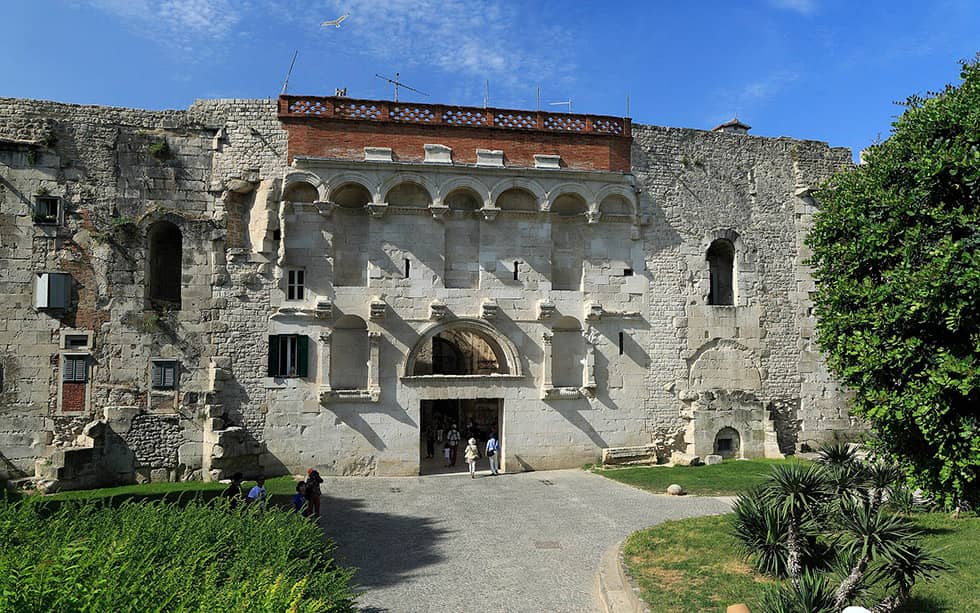
Built as an integral component of Diocletian's Palace, the Golden Gate was the main landward entrance through which the Emperor would enter the complex. The gate has a rectangular form and a richly decorated front with niches that once featured sculptures of the four tetrarchs: the Emperors Diocletian and Maximian in the upper row, and their successors Galerius and Constantius Chlorus in the lower row. Between the upper niches was a central panel associated with Jupiter, the supreme Roman god.
In Roman times, the Golden Gate was known as the "Porta septemtrionalis" (the Northern Gate) and, according to the local tradition, Diocletian used it when he first entered the palace on June 1st, 305 AD.
Quick facts about the Golden Gate
- Also known as Zlatna vrata, Porta Aurea (Golden Gate), and the Roman Porta septemtrionalis (Northern Gate).
- Where: the north wall of Diocletian's Palace, right next to the Gregory of Nin (Grgur Ninski) statue.
- Why it matters: the main landward entrance used for ceremonial arrivals - Diocletian is said to have entered through it on June 1st, 305 AD.
- Open: open 24 hours.
- Tickets: no ticket is needed to see the gate itself (it is part of the public palace streets).
- Time needed: 5-15 minutes for the gate and statue, or 60-120 minutes if you continue deeper into the palace to sights like the Temple of Jupiter and the Diocletian’s Palace Cellars.
- Best time to visit: early morning for fewer people, late afternoon for softer light, and after dark for the atmosphere.
If you want more than a quick photo stop, a guided walking tour is a great way to understand what you’re looking at. A good local guide adds context you won’t get from a plaque, why this was the main imperial entrance, how the palace layout worked, and which small details around the gate and nearby streets most visitors miss, while also helping you follow the most efficient route to the key sights inside the old town.
Split-Private Walking Tour of Diocletian's Palace & Old Town, Golden Gate included
Private Walking Tour with licensed resident guides (PhD/Master’s level in history, archaeology, and economics).
Private walking tour for history lovers with combined authentic storytelling, surprising discoveries, and fun. Your guides are Split natives with deep local insight into Dalmatia and first-hand perspective on recent history, including the Communist era and the Homeland War.
Explore Split’s medieval old town, the Golden gate and the spectacular Palace of Roman Emperor Diocletian, with the option to add a visit to the Palace Cellars museum area - one of the best-preserved parts of the complex.
What is the Golden Gate in Split?
The Golden Gate (Zlatna vrata), also known as Porta Aurea, is the grand northern entrance of Diocletian's Palace, built in the early 4th century as the emperor’s main ceremonial landward gate. It opens onto the palace’s main north-south street, making it one of the easiest entry points for a first walk toward the central squares and landmarks inside the old town.
Today, the gate is part of Split’s public historic core (no ticket needed to see it), and it’s also a convenient landmark for starting a self-guided route through the UNESCO-listed heart of the city.
Where is it? How to find the Golden Gate
The Golden Gate is on the north wall of Diocletian's Palace, right next to the Gregory of Nin (Grgur Ninski) statue. If you see the huge statue, you’re already there, the gate is directly beside it.
Once you pass through the gate, you’ll step onto the palace’s main north-south street that leads toward the Peristyle and the central sights. It’s one of the easiest entry points for a quick "palace highlights" walk that can include stops like the Temple of Jupiter and the Diocletian’s Palace Cellars.
Walking directions
- From the Riva promenade: walk inland (north) into the old town toward Diocletian's Palace, then follow signs/flow toward Grgur Ninski and Zlatna vrata (Golden Gate) on the north side.
- From Split Ferry Port / Main Bus Station: walk along the waterfront to the Riva promenade, then head inland through the old town toward the palace, continuing to the north side for the Grgur Ninski statue and the Golden Gate.
- From People’s Square (Pjaca / Narodni trg): head toward the palace walls, then continue toward the north side of the old town until you reach the Grgur Ninski statue and the Golden Gate.
Map
Address & contact details
- Golden Gate (Zlatna vrata / Porta Aurea), Dioklecijanova palača - North entrance
- Postcode: 21000, City: Split
Names through history: Zlatna vrata, Porta Aurea & the Roman "north gate"
Locals call this entrance Zlatna vrata ("Golden Gate"), while many guides also use the Latin name Porta Aurea. In Roman times, it was known as Porta septemtrionalis, literally the Northern Gate, and it marked the palace’s main landward entrance.
The name "Golden" does not mean the gate was made of gold. It’s a later title (sources link it with Venetian-era naming) that reflects the gate’s status as the most representative and richly decorated entrance to Diocletian's Palace, right next to the Gregory of Nin (Grgur Ninski) statue.
History: the main landward entrance to Diocletian’s Palace
The Golden Gate was built as the palace’s principal northern (landward) entrance and the most representative arrival point for official processions. In Roman times it was known as Porta septemtrionalis, and the Emperor Diocletian entered the palace through this gate on June 1st, 305 AD.
Its position also made it practical: from the palace’s central area (Peristyle), the main street (Cardo) led toward the Golden Gate and onward in the direction of ancient Salona, the key Roman centre near Split.
UNESCO context: the historic complex of Split
The Golden Gate is not a standalone monument, it is part of Diocletian’s Palace, the late Roman complex that became the foundation of Split’s old town and later earned UNESCO World Heritage status for the wider historic area built around it. If you continue your walk from the gate, the route naturally connects to major palace highlights such as the Temple of Jupiter, the Sphinx, and the Diocletian’s Palace Cellars.
Architecture: what to look for at the Golden Gate
The Golden Gate is the most representative and richly decorated entrance to Diocletian’s Palace. It was built in a rectangular form with a strong defensive setup, originally with double doors (and even a portcullis) to control access to the palace from the north.
Niches and (missing) statues
Look closely at the facade: the niches once held figure sculptures of the four tetrarchs - Emperors Diocletian and Maximian, and their successors Galerius and Constantius Chlorus. Between the upper niches there was also a central panel associated with Jupiter, which matched the imperial symbolism of the palace.
Defensive layout (double gate + courtyard "trap")
The gate was designed with a defensive courtyard between the outer and inner openings, a propugnaculum, so that movement could be controlled before you reached the palace street inside. It is one of the easiest places in Split to visualize how the palace walls functioned as real fortifications, not just a "pretty" entrance.
Details most people miss
- Ground level: centuries of soil buildup changed the perceived height of the openings, so the gate does not look as tall today as it did in antiquity.
- Orientation: the inner opening leads directly onto the main north-south street (Cardo), a useful clue if you want to continue deeper into the palace core toward sights like the Temple of Jupiter and the Diocletian’s Palace Cellars.
St. Martin’s Church above the Golden Gate
Directly above the Golden Gate, inside the northern wall of Diocletian’s Palace, you can spot one of Split’s most unusual micro-sights: the tiny Church of St. Martin (Crkva sv. Martina). It is built into the palace wall itself, in a narrow space that originally served the palace guards, which is why the church feels more like a hidden passage than a typical chapel.
Despite its size (around 1.64 m wide and 10 m long), it’s considered one of the oldest churches in Split and a fascinating example of how Roman defensive spaces were later reused as sacred places. If it’s open when you pass by, it’s a quick, peaceful stop that adds extra depth to your Golden Gate visit before you continue deeper into the palace streets.
Features
- Iconic entrance to Diocletian’s Palace - perfect starting point for a quick Old Town walk.
- Great photo and meeting spot right by the Grgur Ninski (Gregory of Nin) statue.
- Easy route to the top palace highlights, including the Temple of Jupiter and the Diocletian’s Palace Cellars.
- Night visit friendly - the gate and statue area look especially atmospheric after dark.
- Bonus hidden sight: St. Martin’s Church is built into the wall above the gate (worth a quick look if open).
Grgur Ninski statue next to the Golden Gate
Right next to the Golden Gate you’ll see one of Split’s most famous "first stop" landmarks, the monumental Gregory of Nin (Grgur Ninski) statue, created by celebrated Croatian sculptor Ivan Meštrović. Because it stands directly outside the palace’s north entrance, it’s an easy meeting point and a natural place to start your walk into Diocletian’s Palace.
Don’t be surprised by the crowds around the feet: there’s a local tradition that touching (or rubbing) the statue’s big toe brings good luck, which is why the toe looks noticeably shinier than the rest of the bronze. It’s a quick photo stop, and from here you can step straight through the Golden Gate and continue toward palace highlights like the Temple of Jupiter.
What to see next (5-minute radius)
Once you’ve seen the Golden Gate and the nearby Gregory of Nin (Grgur Ninski) statue, you’re perfectly placed to continue to Split’s core palace sights on foot.
- Peristyle (Peristil) - the central ceremonial square of Diocletian’s Palace and a natural "hub" for exploring the historic core.
- Cathedral of Saint Domnius - the former imperial mausoleum and one of the most important landmarks inside the palace complex.
- Vestibule - a dramatic circular hall with an open top, sitting on the route between the Peristyle and the imperial area.
- Temple of Jupiter - a short, high-impact stop near the Peristyle with some of the most memorable Roman-era atmosphere.
- Sphinx in Split - a quick “don’t-miss” detail near the palace’s central zone that many visitors walk past.
- Diocletian’s Palace Cellars - the famous substructures beneath the southern part of the palace and one of the best-preserved areas to experience the scale of the complex.
- Other palace gates for orientation: Silver Gate (east), Iron Gate (west), and Brass Gate (south, linked with the waterfront route and the palace substructures).
If you want the full story behind the Golden Gate and the palace landmarks around this northern entrance, consider joining a Split walking tour led by a licensed local guide with a Magister (Master’s) degree in History. It’s one of the best ways to start at Golden Gate, see Diocletian’s Palace and Old Town highlights in the right order, and catch the "hidden details" around the gate, walls, and streets that most visitors miss on a self-guided walk.
Walking Tour of Split with a "Magister" of History
See Split the smart way: start at the Golden Gate and explore the Old Town with a local, history-first guide.
On a guided walking tour, you’ll follow a logical route from Zlatna vrata (Golden Gate) through the key palace landmarks, including the Grgur Ninski statue, Diocletian’s Palace, the Cathedral of Saint Domnius, and the Temple of Jupiter, with the kind of context and “hidden details” that are easy to miss when you’re sightseeing alone. It’s a great choice if you have limited time in Split but still want to go beyond the basics and understand what you’re actually looking at.
Easy self-guided route: Golden Gate to the Riva
This is the easiest "first-time in Split" walk: start at Zlatna vrata (Golden Gate), cut through the palace core, then finish on the waterfront. Plan 45-90 minutes depending on how many quick stops you make (and whether you add the cellars).
- Start at the Golden Gate and the nearby Gregory of Nin (Grgur Ninski) statue for photos.
- Walk through the gate into Diocletian’s Palace and follow the main flow toward the central square.
- Stop at Peristil (Peristyle), the palace’s most iconic open space, then glance at the nearby Sphinx.
- Make a short detour to the Temple of Jupiter for one of the most atmospheric corners of the palace.
- Step into the Vestibule, the dramatic imperial antechamber on the route toward the southern side.
- For a cooler break (especially in summer), go down into the Diocletian’s Palace Cellars and continue toward the sea exit.
- Exit by the Brass Gate, then finish with a stroll on the Riva promenade for cafés and waterfront views.
If you’re short on time, do steps 1-3 and then head straight to the Riva; if it’s hot, prioritize the Palace Cellars for shade and a quick "below street level" perspective.
Visiting tips (crowds, photos, accessibility)
- Crowds: for the quietest experience at the Golden Gate and around Grgur Ninski, go early in the morning or later in the afternoon when most day-trip groups are between stops.
- Best light for photos: late afternoon gives softer light on the stonework, while after dark the area around the gate and statue is beautifully lit for evening photos.
- Heat break: in summer, plan your "cool stop" inside the Diocletian’s Palace Cellars before finishing on the Riva.
- Shoes: wear comfortable footwear with good grip, the old town is made for walking, and the historic stone surfaces can be smooth and uneven.
- Accessibility: the palace streets are narrow in places and the stone paving can be bumpy; strollers are doable but not always comfortable, and wheelchairs may find some sections challenging.
- Quick plan if you have limited time: Golden Gate + Grgur Ninski, then head straight to Peristil and the Temple of Jupiter for maximum "highlights per minute".
FAQ
Is the Golden Gate in Split made of gold?
No. “Golden Gate” (Zlatna vrata / Porta Aurea) is a name that reflects its status as the most representative palace entrance, not the material it was built from.
Is there an entrance fee?
No ticket is needed to see the gate itself - it’s part of the public streets of Diocletian’s Palace and Split’s Old Town.
What’s the easiest way to find the Golden Gate?
Go to the Gregory of Nin (Grgur Ninski) statue - the Golden Gate is right next to it on the north side of the palace.
How long should I spend here?
Plan 5-15 minutes for the gate and the statue, or 60-120 minutes if you continue through the palace to highlights like the Temple of Jupiter and the Diocletian’s Palace Cellars.
What should I see right after the Golden Gate?
Walk straight into the palace and head toward Peristil (Peristyle), then add a quick stop at the Temple of Jupiter; if it’s hot, drop into the Palace Cellars for a cooler break before you exit toward the waterfront.