
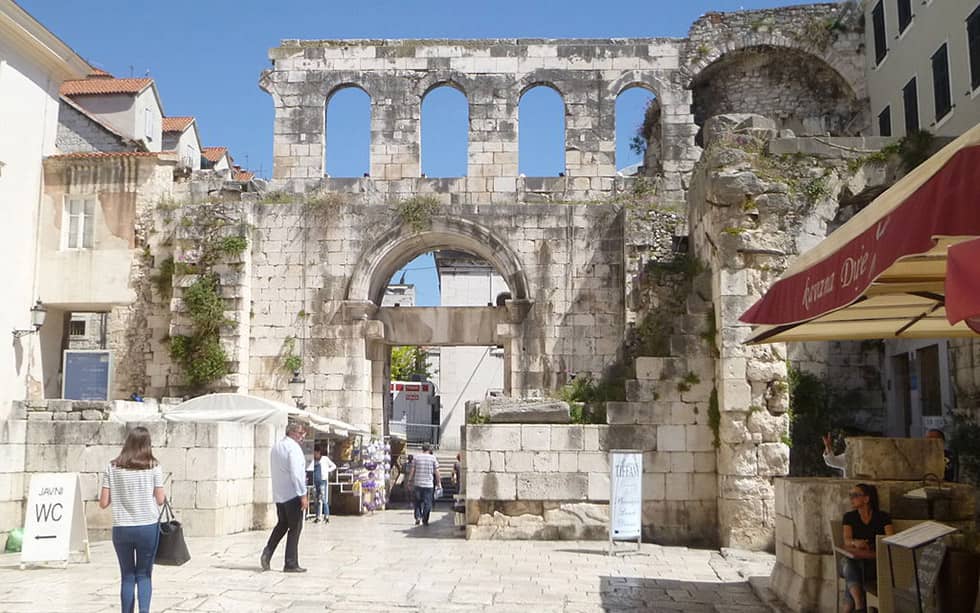
Silver Gate in Split, also known as Srebrna vrata or Porta Orientalis, is the eastern entrance into Diocletian’s Palace. It is one of the four historic palace gates and a useful starting point if you are entering the old Roman core from the market side of Split.
The gate is not a ticketed attraction or a long standalone visit. Its value is in the setting: you pass from the busy eastern edge of the Old Town into the ancient street line of the palace, following the decumanus toward Peristyle (Peristil), Iron Gate and the old city squares.
Silver Gate highlights
- Best for: Quick history stop, Diocletian’s Palace walk, Roman street layout and market-side access.
- Location: East side of Diocletian’s Palace, beside the Pazar / Green Market area on Hrvojeva Street.
- Time needed: 5-10 minutes for the gate itself, or 30-60 minutes when combined with the Palace core.
- Cost: Free public passage - no ticket required.
- Best route: Enter from the market side, pass through Silver Gate, then continue toward Peristyle and Iron Gate.
- Nearby sights: Golden Gate, Iron Gate, Brass Gate, Peristyle and the old Palace streets.
What Is the Silver Gate in Split?
The Silver Gate is the eastern entrance into Diocletian’s Palace and one of the four main Roman gates that once controlled access into the imperial complex. In Croatian it is called Srebrna vrata, while its Roman name, Porta Orientalis, reflects its position on the east side of the Palace.
For visitors, Silver Gate works best as a short but meaningful stop on a wider Split attractions walk. From here, the old palace street runs west along the decumanus, leading deeper into the Roman layout toward Peristyle, the old city squares and Iron Gate.
- Position: Eastern gate of Diocletian’s Palace.
- Historic role: A controlled entrance into the Roman palace from the east.
- Visitor value: Best appreciated as part of a walk through the Palace street grid.
- Good to know: It is less monumental than Golden Gate, but easier to understand in daily use because people still pass through it naturally.
History of the Silver Gate
The Silver Gate was known in Roman times as Porta Orientalis, the eastern gate of Diocletian’s Palace. It opened onto the main east-west palace street, the decumanus, which still leads visitors through the Roman core toward Peristyle, Iron Gate and Pjaca (Market).
In the Early Christian period, the area above the gate gained a religious role. The gate was associated with St. Apollinaire, a saint widely venerated around the Mediterranean, and the sentry corridor above the entrance was adapted into a small church so the patron saint could symbolically protect the approach into the city.
Compared with Golden Gate, the Silver Gate was more modestly decorated, but it still formed part of the palace’s controlled defensive system. The gate was closed from the Middle Ages until 1952, when it was reconstructed after wartime damage and the destruction of the Baroque church Dušica, also known as the Church of the Holy Innocents.
- Roman name: Porta Orientalis, meaning the eastern gate.
- Original role: Eastern access into Diocletian’s Palace along the decumanus.
- Early Christian layer: The sentry corridor above the gate was adapted into a church.
- Later history: The gate remained closed from the Middle Ages until its 1952 reconstruction.
- Recent moment: Pope John Paul II passed through the Silver Gate during his visit to Split in 2000.
What to See at the Silver Gate
The Silver Gate is not a large attraction, so the best way to visit is to slow down and look at the details around the entrance. The main things to notice are the Roman wall line, the gate passage, the remains of the defensive towers and the way the ancient street still pulls you into the heart of Diocletian’s Palace.
- The eastern palace entrance: Stand outside the gate first, near the market side, to understand how the entrance sits in the old palace wall.
- The Roman street line: Walk through the gate and continue along the decumanus, the east-west route that once crossed the Palace.
- Traces of the towers: Look for the remains of the octagonal towers on each side of the gate, which help show how controlled the original entrances were.
- Arches and niches: The Silver Gate was less richly decorated than Golden Gate, but you can still notice the architectural details that framed the entrance.
- The market-side approach: Arriving from Pazar gives the gate its best everyday context, with modern Split flowing directly into the Roman Palace.
- The route toward Peristyle: After entering, keep walking straight into the Palace core, where the street leads toward Peristyle and the old central squares.
Silver Gate is easy to pass through without realizing how much history is built into this small entrance. That is true across much of the Palace: Roman walls, medieval streets, churches, courtyards and everyday city life all overlap in a compact area where the most interesting details are not always obvious at first glance.
For a clearer understanding of how Silver Gate fits into the wider Roman layout, a guided walk through the Old Town and Diocletian’s Palace is well worth considering.
SPLIT-PRIVATE Walking Tour of Old Town & Diocletian's Palace
Private Walking Tour+Cellars Museum
This private walking tour is a strong choice if you want more than a quick look at Split’s Old Town. Led by licensed local guides with deep historical knowledge of Dalmatia, it connects Diocletian’s Palace, the medieval streets and the city’s more recent past into one clear, easy-to-follow story.
The route focuses on the Palace of Emperor Diocletian, built in the early 4th century and now part of Split’s UNESCO-listed historic core, with the option to include the Cellars Museum, one of the best-preserved parts of the complex. Because it is a private tour, the pace is more flexible and there is more room for questions, local context and "behind the scenes" details you would likely miss on a self-guided walk.
How to Visit the Silver Gate self-guided
Silver Gate is easiest to visit as part of a short walk through the eastern side of Diocletian’s Palace. Start outside the Palace near Pazar, Split’s open-air market, then pass through the gate and continue straight along the old Roman street line toward Peristyle and Iron Gate.
You do not need a ticket or a fixed plan for the gate itself. Treat it as a quick orientation stop: look back at the eastern wall from outside, walk through slowly, then use the route to connect the market, the Palace core and the old town squares in one natural line.
Best walking route
- Start at Pazar: The Pazar (Green Market) side gives the Silver Gate its clearest everyday context, with modern Split pressed directly against the Roman Palace wall.
- Enter through Silver Gate: Pause inside the passage to notice the gate structure, stonework and old street alignment.
- Continue toward Peristyle: Follow the Roman decumanus into the Palace core, where the ancient layout becomes easier to understand.
- Carry on to Iron Gate: Keep walking west if you want to trace the old east-west route across the Palace toward Pjaca.
- Loop back via the waterfront: After exploring the Palace, continue south toward Brass Gate and Split Riva for an easy circular walk.
Best time to visit
Morning is the most interesting time to approach from the market side, when Pazar is active and the contrast between everyday Split and the Roman Palace feels strongest. Late afternoon or early evening is better for a slower walk, softer light and less heat in the stone streets.
Silver Gate Location and Nearby Landmarks
Silver Gate is on the east side of Diocletian’s Palace, beside Hrvojeva Street and the Pazar / Green Market area. This makes it one of the easiest Palace gates to find if you are arriving from the bus station, ferry port, market or eastern end of the waterfront.
Use the gate as a simple orientation point. Outside, you have the market and the busy edge of central Split; inside, the Roman street line leads you straight into the Palace core and toward some of the best-known attractions in Split.
- Diocletian’s Palace: Silver Gate is part of the historic Palace complex, so it fits naturally into any Diocletian’s Palace walk.
- Pazar / Green Market: The open-air green market sits just outside the eastern wall, making it the most useful landmark for finding the gate.
- Peristyle: Walk west from Silver Gate into the Palace core to reach the ceremonial square at the centre of the Roman complex.
- Iron Gate: Continue along the old east-west route to reach Iron Gate and Pjaca on the western side of the Palace.
- Golden Gate: Turn north inside the Palace area if you want to compare Silver Gate with the more monumental Golden Gate.
- Brass Gate and Riva: Walk south through the Palace cellars route toward Brass Gate and Split Riva.
Silver Gate vs the Other Gates of Diocletian’s Palace
Silver Gate is one of four historic entrances into Diocletian’s Palace, each placed on a different side of the Roman complex. If you are exploring the Palace on foot, comparing the gates helps you understand how the old imperial residence worked as both a fortified structure and a living city plan.
| Gate | Position | Best for |
|---|---|---|
| Silver Gate | East side of the Palace | Entering from Pazar, following the decumanus and seeing everyday Split meet the Roman core |
| Golden Gate | North side of the Palace | The most monumental gate, the classic photo stop and the route once reserved for the emperor |
| Iron Gate | West side of the Palace | Continuing toward Pjaca, the old city squares and the western edge of the Palace |
| Brass Gate | South side of the Palace | Entering from Riva, the waterfront and the route through the palace cellars |
For most visitors, the best route is not to choose one gate, but to use them as orientation points. Start at Silver Gate or Brass Gate, cross the Palace through the old Roman street grid, then compare the quieter passages with the more ceremonial approach at Golden Gate.
Practical Tips for Visiting Silver Gate
Silver Gate is simple to visit, but a little context makes the stop more rewarding. Treat it as a working historic passage rather than a museum entrance: people still move through it as part of daily Split, just as the old Roman street line still guides visitors into the Palace core.
- Allow 5-10 minutes: The gate itself is a quick stop, but give yourself longer if you want to continue through Diocletian’s Palace.
- Look from both sides: Start outside the eastern wall near Pazar, then walk through and look back from inside the Palace for better context.
- Use it for orientation: Silver Gate is a useful reference point if you are coming from the market, ferry port, main bus station or eastern side of the Old Town.
- Visit early or late: Morning works well if you want market atmosphere; late afternoon is better for softer light and a slower Palace walk.
- Wear comfortable shoes: The Palace streets are stone-paved and can feel uneven, especially if you continue toward Peristyle, Iron Gate and the old town squares.
- Do not expect a ticket desk: Silver Gate is a free public passage, not a paid attraction with controlled entry.
- Combine it with the other gates: For a better sense of the Roman layout, compare Silver Gate with Golden Gate, Brass Gate and the western side of the Palace.
FAQ About Silver Gate Split
Where is the Silver Gate in Split?
Silver Gate is on the eastern side of Diocletian’s Palace, beside Hrvojeva Street and the Pazar / Green Market area. It is easy to reach from Split Ferry Port, the main bus station and the eastern end of the waterfront.
Is Silver Gate part of Diocletian’s Palace?
Yes. Silver Gate is one of the four historic entrances into Diocletian’s Palace. It stands on the east side of the Roman complex and leads into the old east-west street line known as the decumanus.
Do you need a ticket for Silver Gate?
No. Silver Gate is a free public passage and you do not need a ticket to walk through it. Some nearby sights inside Diocletian’s Palace may have entry fees, but the gate itself is free to visit.
How long do you need to visit Silver Gate?
Allow about 5-10 minutes for Silver Gate itself. If you use it as the start of a Diocletian’s Palace walk, allow at least 30-60 minutes to continue toward Peristyle, Iron Gate, Brass Gate and the old town squares.
What is the Roman name of Silver Gate?
The Roman name of Silver Gate is Porta Orientalis, meaning the eastern gate. You may also see it called Srebrna vrata in Croatian or Porta Argentea in Latin-style references.
Which gate of Diocletian’s Palace is best to enter through?
Silver Gate is best if you are arriving from Pazar, the ferry port, the main bus station or the eastern side of Split. Brass Gate is best from Riva, Golden Gate is the most monumental entrance, and Iron Gate is useful from Pjaca and the western side of the Old Town.
What can you see near Silver Gate?
Nearby sights include Pazar / Green Market, Peristyle, the old palace streets, Iron Gate, Brass Gate, Split Riva and the wider Diocletian’s Palace area. Silver Gate is a good starting point for a short self-guided walk through the Roman core of Split.
Is Silver Gate accessible for strollers or wheelchairs?
Silver Gate is an open public passage, but the surrounding old-town streets are stone-paved and can be uneven or crowded. Strollers can usually pass with care, while wheelchair users may find the area easier with assistance, especially during busy summer hours.