
The Iron Gate in Split is the western entrance to Diocletian's Palace, linking the Roman palace streets with Pjaca, the historic People's Square. Also known by its Roman name Porta Occidentalis, it is one of the most atmospheric places to pause while walking through Split Old Town.
Unlike a museum-style attraction, the Iron Gate is part of daily city life. Locals and visitors still pass through it on the route between the palace core, the city clock, and the medieval square outside the western wall. Look up as you pass: the layers above the gate, including the church and bell tower of Our Lady of the Belfry, show how Roman Split gradually became a medieval city. It is free to visit, open as part of the Old Town streets, and best seen while walking between Peristyle, the palace lanes, and Pjaca (People’s Square).
Iron Gate highlights
- The 24-digit city clock - Look above the gate for one of Split's most unusual details: a clock face marked with 24 digits instead of the usual 12. It is one of the easiest visual clues that you are standing at the western side of the old palace core.
- Our Lady of the Belfry - The small church above the gate was originally dedicated to St Theodore and later became known as Our Lady of the Belfry. Its position shows how medieval Split reused Roman palace structures instead of removing them.
- The Roman defensive passage - The Iron Gate was part of a more controlled entrance system, with a defensive space rather than a simple opening in the wall. This is one of the best places to understand how the palace once managed movement in and out of the fortified complex.
- The view toward Pjaca - Step through the gate toward People's Square, locally known as Pjaca, and the urban shift becomes clear. Behind you is the Roman palace grid; ahead is the medieval civic centre where Split expanded outside the palace walls.
- Cypriani Benedetti Palace - Near the gate, look for the late noble palace associated with the Cypriani Benedetti family. Its decorative windows add another layer to the mix of Roman, medieval, and later architecture around the entrance.
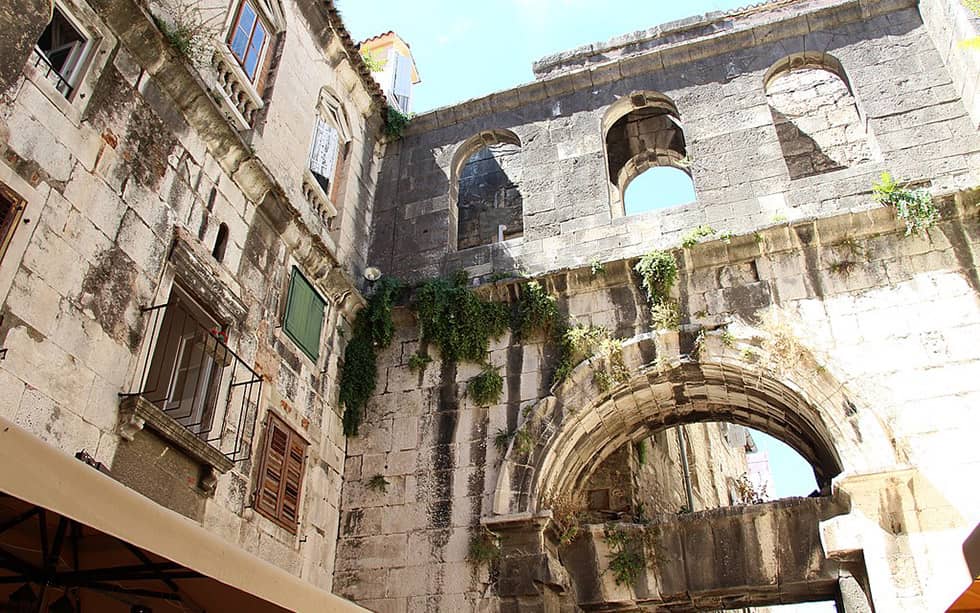
What Is the Iron Gate in Split?
The Iron Gate is the western entrance to Diocletian's Palace in Split. Its Roman name was Porta Occidentalis, while Porta Ferrea, Iron Gate, is the name most commonly used today. The Iron Gate stands on the west side of Diocletian's Palace, where the Roman palace streets meet Pjaca, Split's historic People's Square. It was not just a doorway through the wall, but part of a controlled entrance system with an outer gate, inner gate, and defensive space between them.
Today, the Iron Gate works more like a city passage than a separate monument. You will pass it naturally while walking between the palace core, the city clock, and the old civic centre outside the western wall.
Why the Iron Gate Matters
The Iron Gate matters because it shows how Diocletian's Roman palace became the living centre of medieval Split. In one small passage, you can see Roman defence, early Christian symbolism, medieval city life, and the connection between the palace streets and Pjaca.
The Iron Gate was originally part of the palace's western defensive system, not just a simple opening in the wall. Visitors passed through a controlled entrance area, with the gate and guard space forming part of the Roman palace's security. Over time, that military function changed as Split grew beyond the palace walls.
By the Middle Ages, the Iron Gate had become an important everyday link between the old palace core and the newer civic centre around Pjaca. The space around the gate was used for public life, including a courthouse, religious worship, small shops, and city movement. This is why the Iron Gate feels different from a preserved ruin: it still works as part of Split's street network.
The layers above and around the gate are especially important. The site preserves traces of Roman architecture, Christian adaptation, the Church of Our Lady of the Belfry, the bell tower, and the city clock. For a quick stop, the Iron Gate gives one of the clearest examples of Split's main historical pattern, Roman structure reused, adapted, and lived in for centuries.
How to Visit the Iron Gate
The Iron Gate is free to visit and works as an open public passage in Split Old Town. You do not need a ticket, and most visitors see it naturally while walking between Diocletian's Palace, the city clock, and Pjaca. You can visit the Iron Gate at any time of day, but it is easiest to appreciate when you are not rushing through it. Stand on the palace side first, look up toward the clock and bell tower, then step through toward Pjaca to see how the Roman palace wall opens into Split's medieval civic square.
| Practical detail | What to know |
|---|---|
| Location | Ul. Ispod ure, on the west side of Diocletian's Palace, beside Pjaca |
| Entry | Free outdoor passage; no ticket is needed to see the gate itself |
| Opening hours | Open 24 hours as part of the public Old Town street network |
| Best time | Early morning for fewer people; evening for the liveliest Old Town atmosphere |
| Time needed | 5-10 minutes for the gate itself; longer if you combine it with Pjaca and the palace streets |
| Best approach | Walk from Peristil toward Pjaca, or enter from People's Square under the city clock |
The Iron Gate is also a useful orientation point. If you are inside the palace, it leads west toward Pjaca, Marmont Street, and the wider city centre. If you are already on Pjaca, the gate brings you back into the old Roman street grid of Diocletian's Palace.
Best Walking Route Around the Iron Gate
The easiest route is Peristil - Temple of Jupiter - Iron Gate - Pjaca - Riva or Marmont Street. It keeps the Iron Gate in context, showing how the Roman palace core connects with Split's medieval civic square.
The Iron Gate works as part of a short self-guided walk through the western side of Diocletian's Palace. This route is compact, mostly flat, and easy to follow without a map once you are inside the Old Town.
- Start at Peristil - Begin in the ceremonial heart of Diocletian's Palace, where the main palace streets are easiest to understand.
- Detour to the Temple of Jupiter - Walk west from Peristil to the Temple of Jupiter, one of the most compact Roman monuments in the palace complex.
- Continue toward the city clock - Follow the narrow palace lane toward the western wall. The 24-digit clock above the gate is the easiest visual marker that you are reaching the Iron Gate.
- Pause at the Iron Gate - Stand on both sides of the passage if you can. From inside the palace, you see the Roman street logic; from the outside, you see how the gate opens toward Split's medieval public square.
- Step out onto Pjaca - People's Square is the natural continuation of the route. It shows how Split expanded outside the Roman palace and became a medieval civic centre.
- Finish toward the waterfront - From Pjaca, continue toward Riva for the seafront promenade, or turn toward Marmont Street for shops, cafés, and the wider city centre.
If you are short on time, this route can take 20-30 minutes with brief stops. If you want to photograph details, sit on Pjaca, or visit nearby monuments, allow closer to one hour.
If you enjoy noticing these small layers of history, the Iron Gate is exactly the kind of place where a guide can make the walk more rewarding. On your own, it is easy to pass through in a few seconds; with context, the gate becomes part of the bigger story of how Diocletian's Roman residence turned into the living centre of Split.
A guided walking tour of Split and Diocletian's Palace is especially useful if you want the gates, Peristil, palace streets, cellars, and hidden architectural details to connect into one clear route. It is a good option for first-time visitors who want more than photos and basic facts, but still prefer a compact introduction they can do in a couple of hours.
Walking Tour of Split and Diocletian's Palace
See Split’s Old Town with a guide who connects the palace gates, Roman streets, and medieval city into one clear story
This walking tour gives you a structured introduction to Diocletian’s Palace and the historic centre, so places like the Peristil, Golden Gate, palace cellars, and narrow stone lanes make more sense as you move through them.
It works well if you want to understand Split without spending the whole day on sightseeing. The small-group format keeps the pace manageable, with room for questions and local context along the way.
Iron Gate Compared with the Other Palace Gates
The Iron Gate is the best gate for understanding the link between Roman Split and medieval Split. The Golden Gate feels more monumental, the Silver Gate connects to the eastern palace route, and the Brass Gate is the main approach from the Riva and palace cellars.
Diocletian's Palace had four main gates, each serving a different side of the complex. Seeing them as a group helps make the palace easier to understand: the Iron Gate is not the largest or most dramatic, but it is one of the most useful for reading how the old Roman structure became part of the everyday city.
| Gate | Position | Best for |
|---|---|---|
| Iron Gate | West side of Diocletian's Palace | Pjaca, the city clock, medieval Split, and the route from the palace streets into the old civic square |
| Golden Gate | North side of Diocletian's Palace | The most monumental palace entrance, the old route toward Salona, and the nearby Gregory of Nin statue |
| Silver Gate | East side of Diocletian's Palace | The eastern palace entrance, the decumanus route, the Green Market side, and access toward the cathedral area |
| Brass Gate | South side of Diocletian's Palace | The Riva waterfront, palace substructures, and the common starting point for many Old Town walking routes |
If you only have a short time in Split, combine the Iron Gate with the Brass Gate and Golden Gate for the clearest contrast. The Brass Gate shows the sea-facing palace entrance, the Golden Gate shows the ceremonial northern approach, and the Iron Gate shows the western edge where Roman Split opens into the later medieval city.
Nearby Sights to Combine with the Iron Gate
The Iron Gate is best combined with Pjaca, Peristil, the Temple of Jupiter, Riva, and nearby palace streets. All are close enough to include in the same short walk through Split Old Town. The Iron Gate sits in one of the most convenient parts of Split's historic centre. In a few minutes on foot, you can move from the western gate into the palace core, out to the medieval square, or down toward the waterfront.
- Pjaca - People's Square - Step through the Iron Gate and you are almost immediately on Pjaca, the historic square outside the palace's western wall. It is one of the best places to understand how Split expanded from Roman palace into medieval city.
- Diocletian's Palace - Use the Iron Gate as one entry point into the wider palace complex. From here, you can follow the old Roman street layout toward Peristil, the cathedral area, and the southern palace cellars.
- Peristil - The central palace square is the natural next stop if you want the main Roman setting. It gives the Iron Gate more context by showing the ceremonial heart of the old imperial complex.
- Temple of Jupiter - This compact Roman monument sits close to Peristil and works well as a short detour before or after the Iron Gate. It is especially useful if you want to see how Roman religious buildings were later adapted for Christian use.
- Riva - From the Iron Gate and Pjaca, it is an easy walk down toward Split's waterfront promenade. This is the best continuation if you want a slower break after exploring the narrow palace streets.
- Marmont Street - If you want to continue into the modern city centre, head from Pjaca toward Marmont Street. It adds shopping, cafés, and a different urban layer to the short Old Town route.
Iron Gate Split FAQ
Where is the Iron Gate in Split?
The Iron Gate is on the west side of Diocletian's Palace, beside Pjaca, also known as People's Square. It connects the palace streets with one of Split's most important historic squares.
Is the Iron Gate free to visit?
Yes. The Iron Gate is an open public passage in Split Old Town, so there is no ticket for seeing the gate itself. You can visit it while walking through Diocletian's Palace and the surrounding historic centre.
Why is the Iron Gate also called Porta Occidentalis?
Porta Occidentalis means western gate. The name describes the gate's original position on the west side of Diocletian's Palace. Porta Ferrea, or Iron Gate, is the name more commonly used in travel guides today.
What is special about the clock above the Iron Gate?
The clock above the Iron Gate is unusual because it has 24 digits instead of the standard 12. It is one of the easiest details to spot when approaching the gate from Pjaca.
Which other Diocletian's Palace gates should I see?
If you are exploring Diocletian's Palace, try to see the Golden Gate, Silver Gate, Brass Gate, and Iron Gate. Each one shows a different side of the palace: the northern approach, eastern entrance, waterfront access, and western link to medieval Split.
How long do you need at the Iron Gate?
Allow 5-10 minutes if you are only stopping to look at the gate, clock, and passage. Allow 20-30 minutes if you want to combine it with Pjaca, the Temple of Jupiter, Peristil, and the surrounding palace streets.