
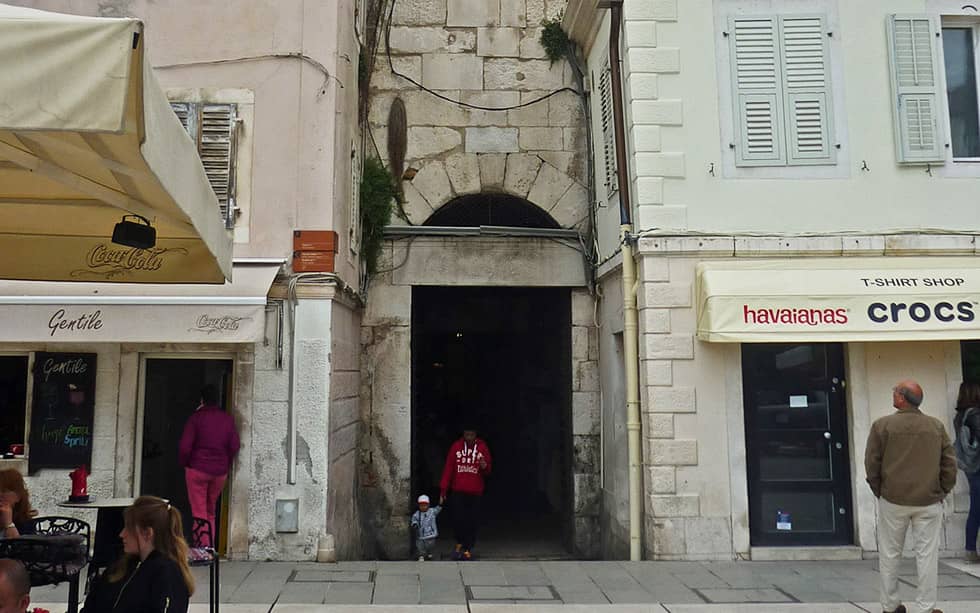
The Brass Gate is the southern entrance to Diocletian's Palace, opening from Split's Riva waterfront into the Cellars of Diocletian's Palace (Basement Halls). You may also see it called the Bronze Gate, Southern Gate, Porta Meridionalis, or Mjedena vrata.
Unlike the grander Golden, Silver and Iron Gates, the Brass Gate is modest and almost hidden in the south wall of the palace. That simplicity is part of its importance. This was the sea-facing entrance, once connected directly with the water before the modern promenade existed.
For visitors today, the Brass Gate is one of the easiest and most useful ways to enter the old palace core. Walk in from the Riva, pass through the basement halls, and you are naturally led toward the central palace area around Peristyle, the Cathedral of Saint Domnius and the main historic streets of Split.
Importance of the Brass Gate
The Brass Gate matters because it explains how Diocletian's Palace worked from the sea. It was not designed to impress in the same way as the northern Golden Gate; it was a practical entrance connected with the palace's southern side, the Substructures and the waterfront.
In Roman and later medieval use, this position made the gate especially important. The sea once came much closer to the palace wall, so the southern gate could function as a controlled access point, a service route and, in case of danger from the landward side, a safer exit toward the water.
That is why this small gate is one of the most useful places to understand the layout of the palace. Step through it from the Riva and you immediately enter the lower level of the imperial residence, before continuing toward the central palace streets above.
- Historically important: it was the palace's sea-facing southern entrance.
- Architecturally different: smaller, simpler and more functional than the other palace gates.
- Practical today: it is the easiest entrance from the Riva into the palace core.
- Best understood with context: combine it with the Diocletian's Palace Cellars rather than treating it as a standalone monument.
Best way to visit the Brass Gate
The best way to visit the Brass Gate is to use it as the start of a short Diocletian's Palace walk rather than as a standalone stop. Begin on the Riva, enter through the southern gate, continue through the palace Substructures and then walk up toward the Peristyle.
This route works especially well because it follows the natural movement from Split's waterfront into the Roman palace core. You see the gate, the basement halls and the central ceremonial area in one easy sequence, without needing to backtrack.
Quick route from the Riva
- Start on the Split Riva, facing the southern palace wall.
- Enter through the Brass Gate and continue into the Diocletian's Palace Cellars.
- Walk through the main vaulted passage toward the palace interior.
- Continue up to Peristyle, the central square of Diocletian's Palace.
- Add the Vestibule, Cathedral area or nearby palace lanes before returning to the waterfront.
How long to spend here
Allow only a few minutes for the gate itself, but plan around 20 to 45 minutes if you are combining it with the Cellars, Peristyle and nearby palace sights. If you are short on time in Split, this is one of the most efficient mini-routes because it links several major sights in a compact walking area.
For a more complete visit, use the Brass Gate as the opening point for a wider walk through Diocletian's Palace. It gives you the clearest sense of how the waterfront, basement level and central palace spaces connect.
If you only walk through the Brass Gate on your own, it is easy to miss why this small southern entrance mattered. A guided walk helps connect the gate with the palace Substructures, Peristyle, Vestibule and the wider Roman layout of Split, so the route feels less like a collection of separate sights and more like one historic complex.
For first-time visitors, a walking tour is also the easiest way to understand what you are looking at without spending the whole visit checking maps and signs. The route naturally pairs well with a Walking Tour of Split and Diocletian's Palace, especially if you want the Brass Gate to make sense within the bigger story of the Old Town.
Walking Tour of Split and Diocletian's Palace
Make the Brass Gate part of a clearer walk through Diocletian's Palace, not just a quick photo stop
This small-group walking tour gives useful context to the palace streets, gates and underground spaces, so places like the Brass Gate, Peristyle and palace substructures are easier to understand as parts of one Roman complex.
It is a practical choice if you want to see the historic centre with a local guide, keep the route focused, and leave with a better sense of how ancient Split became the living Old Town you see today.
Tickets, opening hours and access
The Brass Gate itself is free to visit. It is part of the public walking route through Diocletian's Palace, so you can pass through it from the Riva without buying a ticket.
The important distinction is the nearby palace Substructures. The open passage through the southern entrance is part of the normal pedestrian flow, but the museum-managed sections of the Diocletian's Palace Cellars have official opening hours and ticketing.
Current prices and hours guide
- Brass Gate: free public access from the Riva side.
- Substructures opening hours: Monday to Sunday, 8:30-20:00.
- Last admission: 30 minutes before closing.
- Substructures adult ticket: €10.
- Reduced ticket: €8 for eligible pupils, students, pensioners and Tourist Card holders.
- Family ticket: €18 for parents with children under 15.
Checked: April 2026 - verify current prices, closures and last-entry rules on the official Split City Museum price list before you go.
Access is easiest from the waterfront. Enter from the Riva through the Brass Gate if you want the simplest route into the lower palace level. If you are already inside the palace, you can also approach the Cellars area from the direction of Peristyle, but expect stairs and uneven stone in parts.
Because the Brass Gate is small and the surrounding passage can become crowded, it is best visited early in the morning, in the evening, or as part of a short walking route through the palace rather than as a separate attraction.
What to see nearby
The Brass Gate sits in one of the most useful positions in Split Old Town. From here, you can move from the waterfront into the palace basement halls, then continue toward the central Roman spaces without needing a separate route plan.
If you are short on time, focus on the sights directly connected to the gate: the Riva, the palace Cellars, Peristyle and the Vestibule. Together, they give you a clear sense of how the southern side of Diocletian's Palace connects with the living city around it.
- Diocletian's Palace Cellars: the most natural next stop after entering through the Brass Gate, with vaulted halls beneath the former imperial apartments.
- Peristyle: the central palace square and the best place to understand the ceremonial heart of Roman Split.
- Vestibule: a compact but atmospheric space between the imperial apartment area and the palace's central square.
- Split Riva: the waterfront promenade directly outside the gate, useful for orientation, coffee breaks and harbour views.
- Cathedral of Saint Domnius: a major landmark just beyond Peristyle, best added if you want to extend the walk into the religious and medieval layers of the palace.
- Other palace gates: compare the Brass Gate with the larger Golden, Silver and Iron Gates to understand how the palace connected with the city on different sides.
Where is the Brass Gate and how do you find it?
The Brass Gate is on the south side of Diocletian's Palace, directly beside the Split Riva. If you are standing on the waterfront and facing the palace wall, look for the low central passage that leads into the basement halls.
The easiest way to find it is to use the Riva as your landmark. From the palm-lined promenade, walk toward the palace wall and enter through the opening beneath the southern facade. You will pass into the Substructures first, then continue inland toward the central palace area.
- From the Riva: walk straight toward the palace wall and enter through the central southern passage.
- From Split Ferry Port: follow the waterfront west toward the palace and Riva, then enter from the south side.
- From the main bus or train station: walk toward the harbour, continue along the Riva and approach the palace from the waterfront.
- From inside Diocletian's Palace: follow signs or the natural flow downhill through the Diocletian's Palace Cellars toward the sea.
For orientation, the gate sits close to Obala Hrvatskog narodnog preporoda 22, 21000 Split. It is not a large decorative gate, so do not look for a monumental facade - the best clue is the entrance into the palace basement halls from the waterfront.
Practical tips before you go
The Brass Gate is easy to visit, but a little timing helps. Because it sits on the main route between the Riva, the Cellars and the palace interior, the passage can feel busy when walking tours, cruise passengers and day visitors arrive at the same time.
- Go early or later: mornings and evenings are usually more comfortable than the busiest middle part of the day.
- Use it as a route marker: treat the Brass Gate as the start of a palace walk from the waterfront, not as a separate attraction.
- Watch your footing: the surrounding stone surfaces can be uneven and slippery after rain.
- Expect short stops: the gate itself is quick to see, but the route through the Cellars and toward Peristyle deserves more time.
- Look both ways: from the Riva side you understand the sea-facing entrance; from inside the Cellars you understand how it feeds into the palace structure.
- Pair it with nearby sights: combine it with the Diocletian's Palace Cellars, Peristyle and the Split Riva for the best short route.
Brass Gate FAQ
Is Brass Gate the same as Bronze Gate?
Yes. Brass Gate and Bronze Gate are commonly used for the same southern entrance to Diocletian's Palace. You may also see it called Porta Meridionalis, the Southern Gate, or Mjedena vrata in Croatian.
Is the Brass Gate free to visit?
Yes, the Brass Gate itself is free to visit because it is part of the public walking route through Diocletian's Palace. Tickets only apply if you enter the paid museum-managed sections of the palace Substructures nearby.
Where does the Brass Gate lead?
From the Riva side, the Brass Gate leads into the lower palace area and the Substructures of Diocletian's Palace. Continue through the passage and you can reach the central palace area around Peristyle.
How long do you need at the Brass Gate?
You only need a few minutes for the gate itself. Allow 20 to 45 minutes if you want to continue through the Cellars, Peristyle and nearby palace sights at a relaxed pace.
Is the Brass Gate entrance good for visiting Diocletian's Palace Cellars?
Yes. The Brass Gate is the most natural entrance if you are coming from the Riva and want to visit the Cellars. It places you directly on the route through the Substructures toward the palace interior.
Can you visit the Brass Gate without a tour?
Yes, you can visit the Brass Gate independently at any time the public passage is accessible. A guided tour is useful if you want to understand how the gate, Cellars and central palace spaces connect historically.