
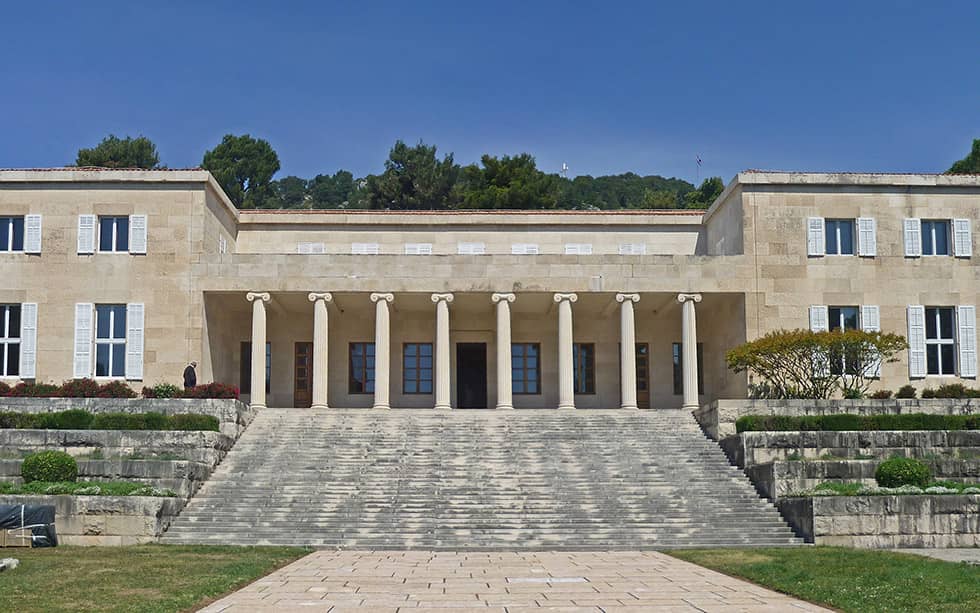
The Meštrović Gallery is one of Split's most important art museums, displaying works by Croatian sculptor Ivan Meštrović inside the seaside villa he created as a family home, studio and exhibition space. Set in the Meje neighbourhood below Marjan, the gallery combines sculpture, architecture, Mediterranean gardens and views toward the Adriatic.
The gallery reopened in April 2026 after a major energy-renovation project. Visitors can again explore Meštrović's sculptures in marble, bronze, wood and plaster, the preserved dining room, sculpture garden and the nearby Meštrović Crikvine-Kaštilac, which is included in the same ticket.
Meštrović Gallery quick overview
| Best for | Sculpture, art, architecture and quieter sightseeing in Split |
|---|---|
| Time needed | 45-60 minutes for the gallery, around 1.5-2 hours including Crikvine-Kaštilac |
| Adult ticket | €12 |
| Reduced ticket | €8 |
| Family ticket | €20 |
| Ticket includes | Meštrović Gallery and Meštrović Crikvine-Kaštilac |
| Opening hours | Tuesday-Sunday 08:00-18:00 |
| Closed | Monday and public holidays |
| Location | Meje, west of central Split and below Marjan |
Is the Meštrović Gallery worth visiting?
Yes, particularly if you enjoy sculpture, architecture or museums that are closely connected with the artist they represent. Even visitors unfamiliar with Ivan Meštrović can appreciate the combination of monumental sculpture, Mediterranean gardens and the elegant villa overlooking the sea.
The setting also makes the gallery feel very different from museums in central Split. It is quieter, surrounded by greenery and close to Marjan, so it works particularly well as part of a half-day away from the busiest streets around Diocletian's Palace.
Allow around 45-60 minutes for the gallery itself. If you also visit nearby Crikvine-Kaštilac, which is included in the same ticket, plan around 1.5-2 hours in total.
Who was Ivan Meštrović?
Ivan Meštrović was one of Croatia's most important modern sculptors and one of the country's most internationally recognised artists of the 20th century. His career took him through Vienna, Paris, Rome, London and the United States, while Split remained closely connected with his personal and artistic life.
Meštrović worked in marble, bronze, wood and plaster and created portraits, religious sculpture, monumental public works and architectural projects. Visitors to Split may already have encountered his work before reaching the gallery: the enormous statue of Gregory of Nin beside the Golden Gate of Diocletian's Palace is also his work.
The gallery in Meje is especially important because it brings Meštrović's art together with architecture and gardens that he helped conceive himself.
The villa Ivan Meštrović built in Split
Meštrović began buying land in the Meje area during the early 20th century with the intention of creating a residence for his family. Construction developed from the end of the 1920s through the 1930s, with Meštrović directing the overall concept and collaborating with architect Lavoslav Horvat and other designers and builders.
The villa was conceived for three connected purposes: living, working and exhibiting art. The private rooms were concentrated largely in the side wings while more representative spaces occupied the central part of the building.
The eastern wing, including Meštrović's studio and office, began taking shape in 1931. Further work added the central part of the villa, west wing, exhibition spaces, terraces and landscaped grounds through 1938 and 1939.
Meštrović and his family used the property from the early 1930s. The surviving dining room still preserves some of the domestic character of the former home and helps visitors see the building as more than a conventional art gallery.
In 1952, Meštrović donated the villa and other properties together with works of art to the Croatian people, establishing the basis for today's Ivan Meštrović Museums.
What to see at the Meštrović Gallery
The gallery presents works from different stages of Meštrović's career rather than simply displaying a large inventory of objects. Sculpture is the main attraction, but the building, garden, drawings, furniture and archival material all contribute to the experience.
Marble sculptures
The representative ground-floor spaces contain important works in marble, including Psyche from 1927 and Contemplation from 1924. Marble was one of the materials through which Meštrović explored the human figure, emotion and classical form.
Bronze works
The collection includes major bronze sculptures such as Distant Chords, Cyclops, Persephone, Virgin and Child and Job. Large bronzes also form an important part of the outdoor display.
Religious sculpture
Religious subjects occupied Meštrović throughout much of his career. One ground-floor exhibition area is devoted to sacred art, including wooden figures of Adam and Eve and the monumental Pietà.
The Job room
A dedicated space explores the figure of Job, a subject through which Meštrović expressed suffering and endurance. His powerful Job sculpture dates from the years after his own imprisonment and the upheavals of the Second World War.
The original dining room
The dining room is one of the places where the villa still feels like a home rather than a museum. Original Meštrović furniture is displayed alongside paintings and bronze portraits of members of his family.
Drawings and archival material
Beyond sculpture, the gallery preserves drawings, architectural material, photographs, correspondence and documents connected with Meštrović's life and career. The family archive found in the house provides particularly valuable insight into the artist and his family.
The sculpture garden
The garden is an important part of the Meštrović Gallery rather than simply landscaping around the museum. Mediterranean planting, stone terraces and large sculptures were conceived as part of the overall relationship between art, architecture and the setting below Marjan.
Bronze works can be viewed outdoors against cypress trees, gardens and the Split coastline. The open setting gives monumental pieces considerably more space than they would have inside a conventional exhibition hall.
Allow time to walk through the garden rather than heading directly from the entrance to the indoor collection.
Meštrović House in Split exhibition - 2026
The Meštrović Gallery reopened on 20 April 2026 following its energy renovation with the exhibition Meštrović House in Split - A Space of Life and Art.
The exhibition explores how the Meje villa was created as both a family home and a place for artistic work and display. It uses works from the museum collection together with family possessions, photographs, correspondence, archival material and rare film footage to reconstruct everyday life in the house.
As of August 2026, the exhibition forms part of the visitor experience. Temporary exhibitions can change, so check the gallery's current programme if a particular exhibition is important to your visit.
Crikvine-Kaštilac is included in your ticket
Do not leave after visiting the main gallery. The same admission ticket also covers Meštrović Crikvine-Kaštilac, around 200 metres farther along the coast at Šetalište Ivana Meštrovića 39.
Meštrović and his brother Petar acquired the remains of the old fortified Capogrosso agricultural estate in 1939. Ivan Meštrović subsequently transformed the complex into a distinctive combination of architecture, sculpture and religious art.
The main highlight is the Church of the Holy Cross, where Meštrović installed his Large Crucifix from 1916 and a cycle of 28 wooden reliefs depicting scenes from the life of Christ. The reliefs were created over more than three decades, between 1917 and 1950.
Crikvine-Kaštilac is quieter and more intimate than the main gallery and reveals a much more spiritual side of Meštrović's work. Since admission is already included, it is well worth allowing enough time to visit both locations.
How long do you need?
Allow around 45-60 minutes for the Meštrović Gallery if you want to see the main rooms and sculpture garden without rushing.
For the better experience, allow around 1.5-2 hours and continue to Crikvine-Kaštilac. The two sites are close together but present very different aspects of Meštrović's work.
Official guided tours of the museum last around 45 minutes and must currently be arranged in advance.
Meštrović Gallery tickets
| Ticket | 2026 price |
|---|---|
| Adult | €12 |
| Children, pupils, students, pensioners and eligible Tourist Card holders | €8 |
| Family with children under 15 | €20 |
| Children under 7 | Free |
The ticket includes admission to both the Meštrović Gallery and Meštrović Crikvine-Kaštilac.
Members of several professional art and museum associations currently receive free admission, as do eligible persons with disabilities and unemployed visitors upon presentation of the required documentation.
Tickets can be bought at the museum or online through the official Ivan Meštrović Museums ticket shop.
Opening hours
Tuesday-Sunday
08:00-18:00
Monday and public holidays
Closed
Last admission is 30 minutes before closing. Crikvine-Kaštilac currently follows the same opening hours.
Checked: August 2026. Verify current opening hours on the official website before visiting.
How to get to the Meštrović Gallery
The gallery is at Šetalište Ivana Meštrovića 46 in the Meje neighbourhood west of central Split, between the waterfront and the southern slopes of Marjan.
On foot
The museum gives an approximate walking time of 15 minutes from the Riva. Depending on where you start in central Split and your walking pace, allow roughly 15-25 minutes.
By bus
Public bus lines 7, 8, 12 and 21 currently serve the area. Check current Promet Split routes and timetables before travelling because services can change.
By taxi
A taxi is an easy option if you have limited time or mobility, particularly in hot summer weather.
Accessibility
The gallery's official visitor information states that visitors with mobility difficulties can access the garden, toilets in the garden and museum shop.
It does not currently state that every interior exhibition area is fully step-free. If access to specific rooms is important, contact the gallery before your visit for the latest information and assistance.
Meštrović Crikvine-Kaštilac is separately listed by the museum as accessible to visitors with disabilities, and guide dogs are permitted there.
Photography and practical tips
Photography for private purposes is currently permitted without flash. Professional photography or filming requires prior permission.
Wi-Fi is available at the gallery.
The gardens and coastal setting are part of the attraction, so the gallery is particularly pleasant when you have enough time to explore both indoors and outdoors rather than treating it as a quick museum stop.
Combine the Meštrović Gallery with Marjan
The gallery sits directly below Marjan, making the two easy to combine.
A good half-day plan is to walk from central Split to the gallery, visit the villa and sculpture garden, continue to Crikvine-Kaštilac and then explore the southern side of Marjan or nearby waterfront.
This combination offers a quieter contrast to the historic centre and Diocletian's Palace.
Split - "Emperor's City for History Lovers"
Private Walking Tour+Cellars Museum
Guided tour of Old Town Split, including the famous Diocletian's Palace (UNESCO World Heritage Site) and the basement cellars.
More museums in Split
The Meštrović Gallery is one of the strongest choices for art and modern Croatian culture. For ancient history, visit the Archaeological Museum, while our complete guide to museums in Split covers more collections across the city.
Address and official information
Meštrović Gallery
Šetalište Ivana Meštrovića 46
21000 Split
Croatia
Official website: Ivan Meštrović Museums - Meštrović Gallery