
Although later buildings encroached on parts of the site, Zadar’s Roman Forum still gives one of the clearest "readings" of an ancient city centre in Croatia, not because grand Roman structures survived intact, but because the forum’s open layout remains easy to recognise on the ground.
Often described as the largest Roman forum in Croatia (about 95 × 45 m), it was commissioned under the first Roman Emperor Augustus, supported by stone inscriptions dating to the period when the complex was completed.
In Roman Iader (modern-day Zadar), the Forum was the city’s main public stage where civic life, ceremonies, trade, and daily meetings unfolded. In antiquity, the square was framed by porticoes and colonnades, and a prominent temple complex (the Capitolium) once stood here, dedicated to the Capitoline triad: Jupiter, Juno, and Minerva.
Today, you can still spot stretches of the original pavement and stairs, plus two monumental columns. One column became notorious in the Middle Ages as the "Pillar of Shame", where offenders were publicly restrained, traces associated with that use are still pointed out on-site.
The Roman Forum - quick overview
- Location: Zadar Old Town (Poluotok), "The Forum" square by the Church of St. Donatus.
- Built: Construction began in the 1st century BC and was completed by the 3rd century AD; linked to Emperor Augustus via inscriptions.
- Size: About 95 × 45 m (commonly rounded to ~90 × 45 m).
- Admission: Free to visit (public open space with visible Roman remains).
- Working hours: Open 24/7 (outdoor site).
- Time needed: 15-30 minutes for a quick look, or 45-60 minutes if you want to slow down and explore details nearby.
- Best time to go: Early morning for fewer crowds, or late afternoon ("golden hour") for the best light. It’s also atmospheric after dark when the Old Town is lit.
Best of Zadar with St. Anastasia viewpoint
Join a guided sightseeing tour of Zadar and visit some of its most popular sites.
Your knowledgeable guide will take you on a walking tour to see the city's landmarks including the Zadar Land City Gates, Roman Forum, and the famous Sea Organ that produces unique sounds from the movement of the tides.
The tour also includes an admission ticket to the Cathedral of St. Anastasia. You'll also see the 9th-century Byzantine Church of Donat and walk along the ancient main street Kalelarga. The tour includes guidance from a certified local guide and the entrance fee for St. Anastasia's Cathedral Bell Tower.
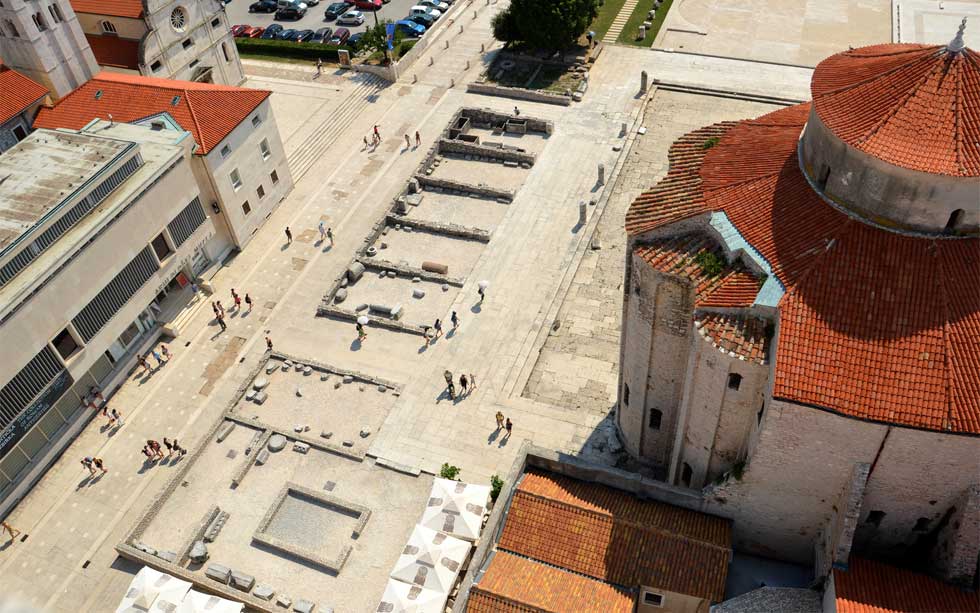
What is the Roman Forum in Zadar?
The Roman Forum is the historic main square of ancient Iader (Roman Zadar). Built from the 1st century BC to the 3rd century AD and associated with Emperor Augustus through stone inscriptions, it functioned as the city’s civic heart where public life, ceremonies, justice, and everyday meetings played out in the open.
Today, the Forum is still Zadar’s central gathering place, set among some of the Old Town’s most important landmarks. While many structures are gone, the site remains unusually easy to understand: you can still read the forum’s footprint, spot surviving Roman stonework, and imagine the original architectural frame of porticoes and the elevated temple complex (Capitolium), dedicated to Jupiter, Juno, and Minerva.
Why it’s worth stopping here
- Big significance, small effort: it’s an easy, walk-through site that explains Zadar’s Roman origins in minutes.
- Major scale: often cited as the largest Roman forum on the eastern Adriatic (and among the largest in Croatia).
- Layered history: Roman remains sit beside later medieval and ecclesiastical landmarks, showing how the city evolved around the same core.
- Unique detail: the nearby "Pillar of Shame" story adds a memorable medieval chapter to the Roman setting.
History of the Roman Forum in Zadar
Zadar’s Roman Forum was the civic heart of ancient Iader, developed from the late 1st century BC into the early 3rd century AD. Although parts of the area were later built over, the Forum remains one of the most convincing "snapshots" of an ancient city centre in Croatia, not because grand Roman buildings still stand, but because the square’s footprint and urban layout are still easy to recognise on the ground.
Often described as the largest Roman forum in Croatia (about 95 × 45 m), the complex is associated with the first Roman Emperor Augustus. That link is supported by stone inscriptions connected to the Forum’s construction and completion phases, helping place its monumental development firmly within the early imperial period.
In its heyday, the Forum was Zadar’s main public "stage": a paved open square framed by porticoes and colonnades, with spaces for traders (tabernae) and civic activity, and a prominent sacred zone. Two monumental columns marked the transition toward the raised Capitolium area and a temple dedicated to the Capitoline triad - Jupiter, Juno, and Minerva. Over the centuries the same central space continued to evolve, gaining later layers of history and meaning as the city changed around it.
In Late Antiquity (around the 6th century), a major earthquake is believed to have damaged parts of Zadar’s monumental Roman architecture, including structures around the Forum. Over time, surviving blocks and architectural elements were often reused as convenient building material for later construction in the Old Town.
Near the edge of the former Capitolium platform (the raised temple area), archaeologists identified remains associated with ritual altars. Look closely at the paving here and you can notice a shallow, narrow, elongated groove. It is commonly interpreted as a drainage channel connected with sacrificial rites—where liquids from offerings could have been directed away from the altar area.
Key timeline
- Late 1st century BC: Zadar becomes a Roman colony and the city develops with a Roman grid plan; the Forum forms the public core of the town.
- Augustan era: the Forum is associated with Emperor Augustus through inscriptions connected to its construction and completion phases.
- 1st century BC to early 3rd century AD: the complex grows into a monumental public square with porticoes, civic spaces, and a major temple zone.
- Late Antiquity (from the 4th century): parts of the forum area are transformed as Christian buildings and the episcopal complex develop around the same urban centre.
- 1943–1944 and after WWII: wartime destruction is followed by major clean-up, research, and conservation work that helps reveal and preserve substantial remains.
What the Forum looked like in Roman times
- Monumental scale: an open paved square of about 95 × 45 m, among the largest on the eastern Adriatic.
- Architectural frame: a two-level portico with colonnades enclosed the square on three sides, creating a grand “stage” for public life.
- Everyday activity: tabernae (shops/work spaces) and civic buildings supported trade and daily urban routines around the square.
- Sacred zone: two votive columns marked the transition to the raised Capitolium area with a temple dedicated to Jupiter, Juno, and Minerva.
On-site tip: Don’t rush across the square, slow down and look for changes in level, lines in the paving, and column bases. These details help you "read" where the porticoes and sacred zone once stood.
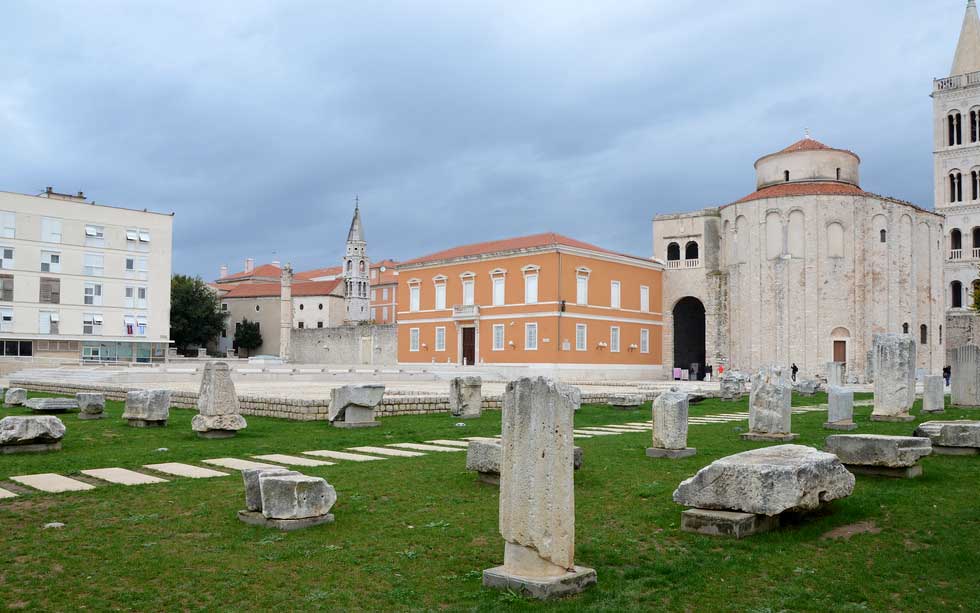
What you can still see today at the Roman Forum
The Roman Forum isn’t a "ruins park" with standing walls, think of it as an open city square where the most important Roman elements are still visible in the ground. If you slow down and look closely, the Forum becomes surprisingly easy to understand: lines in the stone, changes in level, and a few monumental survivors reveal how grand the space once was.
A planned city - urbs quadrata
In order to make the city look truly Roman, imperial surveyors measured at least five lines along the Peninsula (another indicator of antique building characteristics) and eight across. Where the main longitudinal and transverse streets intersected was the planned location of the Forum. This basic urban structure grid has not changed - the main longitudinal Roman street is now the Kalelagra while the transverse is the Simon Kožičić Benja street.
Today's layout
In the period of late antiquity, the foundations of Christian buildings were laid. They later developed into an episcopal complex with the basilica and annexes, and were joined by the rotunda in the Early Middle Ages, eventually destroying the complex of earlier erected buildings. In the course of history, the whole complex was reduced to rubble and the medieval square with a Renaissance cistern was built.
Most visitors cross the square in minutes, but the real experience comes from spotting the details that mark the Forum’s structure and later history. Use the quick checklist below as you walk; it will help you recognise what you’re seeing without needing a guidebook.
Key remains to look for
- Original paving and steps: sections of the Roman pavement and stairs are still visible and help define the forum’s main open space.
- Two monumental columns: the Forum preserves two large columns; one remains in its original position, which makes it an easy landmark to orient yourself.
- Column bases and stone fragments: scattered architectural pieces around the square hint at the former porticoes and colonnades that once framed the Forum.
- Capitolium edge: near the former raised temple zone, there are remains associated with altar bases (often highlighted in on-site explanations of ritual activity).
Good to know: One of the monumental columns is also tied to a memorable medieval story - the Pillar of Shame.
How to “read” the Forum in 5 minutes
- Scan for level changes: small steps and edges are clues to where the open square ended and the elevated architectural zones began.
- Follow the lines: alignments in the stonework help you imagine the rectangular footprint of the forum and its surrounding structures.
- Use the standing column as your anchor: it’s the easiest fixed point for understanding the site’s orientation and scale.
- Look for “micro-details” in the pavement: shallow grooves, cuttings, and base marks often indicate where important elements once stood.
- Connect the dots with the surroundings: the Forum sits beside major later landmarks (St. Donatus/Cathedral complex), showing how Zadar’s centre kept the same core through different eras.
Spotlight: The Pillar of Shame (stup srama)
One of the most memorable details at Zadar’s Roman Forum isn’t Roman at all, it’s medieval. A monumental Roman column on the site was later repurposed as a Pillar of Shame (stup srama), turning the Forum into a stage for public punishment and humiliation centuries after the fall of Rome.
In the Middle Ages, offenders were brought here and chained to the column for a set period of time, exposed to the public eye and the judgement of the city. It’s a striking reminder that Zadar’s central square has always been tied to "public life", from imperial ceremonies and markets to medieval justice.
How to find it
- Look for the monumental column in the Forum area: it’s the most obvious upright Roman element in the square.
- It’s the column associated with the "stup srama" story: many descriptions identify it as the one that remained in (or closest to) its original position on the Forum.
- Use landmarks to orient yourself: the Forum sits beside St. Donatus and the Cathedral complex, once you’re in the open square, the column is hard to miss.
What to look for
- Attachment points for chains: visitor explanations often highlight where chains were fixed to restrain offenders.
- Weathered surface and damage: centuries outdoors (and later use) left visible wear that contrasts with the column’s original monumental purpose.
- Context matters: stand back and imagine the medieval crowd in the same square where Roman citizens once gathered for civic life.
Tip: Visit twice if you can, once in daylight to spot details on the stone, and again after dark when the Old Town lighting makes the Forum feel dramatically different.
Visiting tips for the Roman Forum
The Roman Forum is an easy, “walk-through” sight in Zadar Old Town—there are no gates and no formal route, so you can approach it from any side and explore at your own pace.
To get the most out of a short visit, slow down and look for the subtle details in the stone: level changes, cuttings in the paving, and the monumental column(s) that help you orient yourself. A quick loop here pairs perfectly with nearby landmarks like St. Donatus, the Cathedral area, and the Old Town streets.
Best time to visit
- Early morning: quieter, cooler in summer, and easier for photos without crowds.
- Late afternoon: warmer light makes the stone textures stand out and the square feels more dramatic.
- After dark: the Old Town lighting gives the Forum a different atmosphere, especially if you enjoy evening walks.
Practical tips (worth knowing)
- Wear comfortable shoes: surfaces are mostly flat, but the stone can be uneven and slippery when wet.
- Accessibility: the square is generally easy to move through, but wheels may struggle on gaps/rough stone near the remains—take extra care with strollers and mobility aids.
- Photo etiquette: keep pathways clear and be mindful of guided groups—this is a public square as well as an archaeological site.
- Respect the ruins: avoid climbing on fragile stones or column bases; small damage adds up quickly at open-air sites.
Quick plan: Give the Forum 15–30 minutes, then continue along Kalelarga toward the seafront for the Sea Organ and Greeting to the Sun.
Want to understand what you’re looking at (and hear the stories behind Zadar’s Roman and medieval layers) without doing any prep? A guided walking tour is the easiest upgrade to your Forum visit, most routes pass through the Old Town highlights, explain the Forum’s layout in plain language, and connect it with nearby landmarks like St. Donatus and the seafront.
Zadar City Tour 120min Walk
Discover the history and culture of Zadar on a guided walking tour led by a fully licensed local guide.
It’s a simple way to see the city’s headline sights in one smooth route, often including ancient Roman remains, the Sea Organ, the Greeting to the Sun, and the impressive Land Gate with its triumphal-arch design.
Choose a morning or afternoon departure to fit your plans, meet at a central start point, and enjoy a small-group experience with plenty of time for questions. Along the way you’ll get the context behind the landmarks, so places like the Roman Forum feel less like "stones in a square" and more like a living story of Zadar.
Nearby sights to combine with the Roman Forum
The Roman Forum sits in the most walkable part of Zadar Old Town, so it’s easy to build a compact "best of Zadar" loop around it. If you only do one short walk, finish on the waterfront at sunset for the Sea Organ and Greeting to the Sun.
Easy Old Town loop (about 60-90 minutes)
- Start: Kalelarga (Zadar’s main Old Town street) and stroll toward the historic core.
- Stop 1: Roman Forum + the landmark churches right beside it (great “city-centre” photo spot).
- Stop 2: Continue to the seafront promenade (Riva) at the northwest tip of the peninsula.
- Stop 3: Sea Organ (listen to the waves "play" the steps).
- Finish: Greeting to the Sun (arrive before sunset and stay after dark for the light show).
Timing tip: Aim to reach the waterfront 30-60 minutes before sunset to get a good spot on the steps and watch the atmosphere change.
If you have extra time (add-ons nearby)
- People’s Square (Narodni trg): a classic Old Town coffee stop between sights.
- City walls & gates: take a short detour toward the southern edge of the peninsula for historic fortifications and photo angles.
- Viewpoints: if you want a panorama, look for a bell-tower viewpoint in the Cathedral area.
- More ideas: browse Zadar attractions for museums, beaches, and quick stops you can add without changing your route.
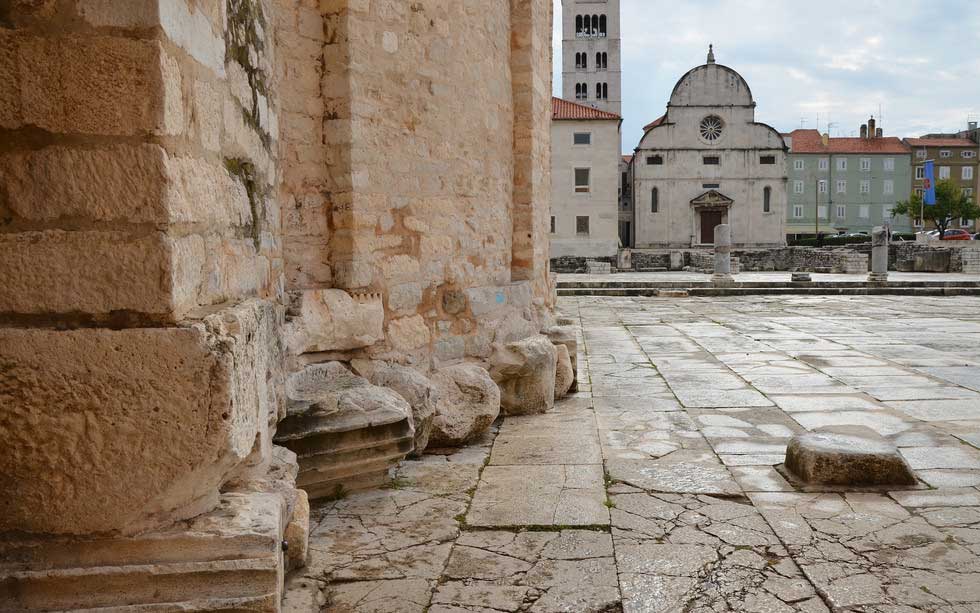
With the current arrangement (since 2011.), the "Poljana pape Ivana Pavla II." (Forum) has become an active public space in the historic centre of Zadar - as an outdoor living room with the permanent exhibition it hosts various events (concerts, film festival, other commemorative events).
Where is the Roman Forum in Zadar and how to get there
The Roman Forum is right in the historic centre of Zadar’s Old Town (Poluotok), in front of St. Donatus Church and next to the Archbishop’s complex. It’s one of those landmarks you’ll naturally "run into" while exploring the main streets of the peninsula.
Since this area is a no-car zone, it's best to park outside the Old Town walls. Ravnice is a convenient parking area nearby. For those who prefer exploring Zadar on foot, simply follow Kalelarga, the city's most popular street, to reach the Forum.
Getting there on foot (the easiest way)
- From the Old Town centre: walk toward Zadar’s main pedestrian street Kalelarga, pass through the central squares (often via Narodni trg), and continue until you reach the open square in front of St. Donatus.
- From the seafront: head inland toward the cluster of major landmarks (St. Donatus / Cathedral area). The Forum sits immediately beside them.
- Map search tip: search for "Forum (Zadar)" or "Roman Forum Zadar" - locals often refer to the whole square simply as "The Forum".
On-site surfaces: the square is generally flat, but expect uneven stone and gaps around the ruins, wear comfortable shoes and take care with strollers or wheels.
Arriving by car (parking tips)
- Old Town is mostly pedestrian: plan to park outside the peninsula and walk the last stretch into the centre.
- Look for signed public parking areas around the Old Town perimeter (near the bridge / city walls) and follow the posted zone rules.
- Rules can be seasonal: prices and charging hours vary by zone and time of year - always check the nearest signage or the city’s current parking information before leaving your car.
Roman Forum Zadar map
Use the interactive map below to navigate to the Roman Forum in Zadar Old Town (Poluotok). For easiest access, plan to approach on foot via the Old Town’s main pedestrian routes.
Roman Forum Zadar FAQ
Fast answers to the most common questions about visiting the Roman Forum (“The Forum”) in Zadar Old Town.
Is the Roman Forum in Zadar free to visit?
Yes. The Roman Forum is part of an open public square in Zadar Old Town, so you can walk through and explore the visible remains without buying a ticket.
What are the opening hours of the Roman Forum?
It’s an outdoor site in a public square, so it’s accessible at any time. For the best experience (and to see details in the stonework), visit in daylight or around golden hour.
Where exactly is the Roman Forum in Zadar?
The Forum is in the heart of Zadar Old Town (Poluotok), right by the landmark cluster around St. Donatus. On maps, searching for “Forum (Zadar)” or “Roman Forum Zadar” will take you to the square.
How big is the Roman Forum in Zadar?
The Forum is commonly described at around 45 × 90 meters (often written as ~90 × 45 m). It’s frequently cited as one of the largest forum complexes on the eastern Adriatic.
When was the Roman Forum built and who commissioned it?
Development began in the 1st century BC and continued into the 3rd century AD. The Forum is associated with the first Roman Emperor Augustus, supported by inscriptions linked to the complex’s completion phase.
How much time do you need at the Roman Forum?
Most visitors spend 15–30 minutes for a quick walk-through and photos. If you want to slow down, notice details in the paving, and explore the nearby landmarks, plan 45–60 minutes in the area.
What can you still see today at the Forum?
You can still spot sections of original paving and steps, monumental columns and column bases, and scattered architectural fragments. One column is also tied to the famous medieval “Pillar of Shame” story.
What is the “Pillar of Shame” (stup srama)?
It’s a medieval chapter of the Forum’s history: a Roman column was later used as a public pillory where offenders were restrained (often described as being chained) and exposed to public shame in the city’s main square.
Is the Roman Forum worth visiting at night?
Yes—Old Town lighting changes the mood of the square and makes for great atmosphere and photos. If you want to notice fine stone details (grooves, base marks), visit once in daylight too.
Is the Roman Forum accessible with a stroller or wheelchair?
The square is generally flat and easy to enter, but surfaces around the remains can be uneven (gaps, rough stone, small level changes). If you’re using wheels, take it slowly and stick to the smoothest lines through the square.