
The Sea Organ in Zadar (Croatian: Morske orgulje) is an architectural sound installation built into the steps of Zadar’s waterfront. Waves push air through pipes and resonating chambers beneath the promenade, creating a constantly changing sequence of tones shaped by the movement of the Adriatic.
Designed by Croatian architect Nikola Bašić and opened in 2005, the Sea Organ has become one of Zadar’s signature public spaces. It is free to visit at any time, but sunset is the most atmospheric period, especially when combined with the nearby Greeting to the Sun.
For more ideas around the peninsula, browse our Zadar attractions guide.
Sea Organ Zadar: quick overview
- Croatian name: Morske orgulje
- What it is: an architectural musical instrument powered by the movement of the sea
- Designer: Nikola Bašić
- Opened: 2005
- Location: western end of Zadar Old Town waterfront
- Price: free
- Access: public outdoor space, accessible day and night
- Best time: early morning for quiet listening; sunset for atmosphere
- Time needed: around 15-30 minutes, longer if you stay for sunset
- Nearby: Greeting to the Sun, Roman Forum, St Donatus, Cathedral of St Anastasia and Kalelarga
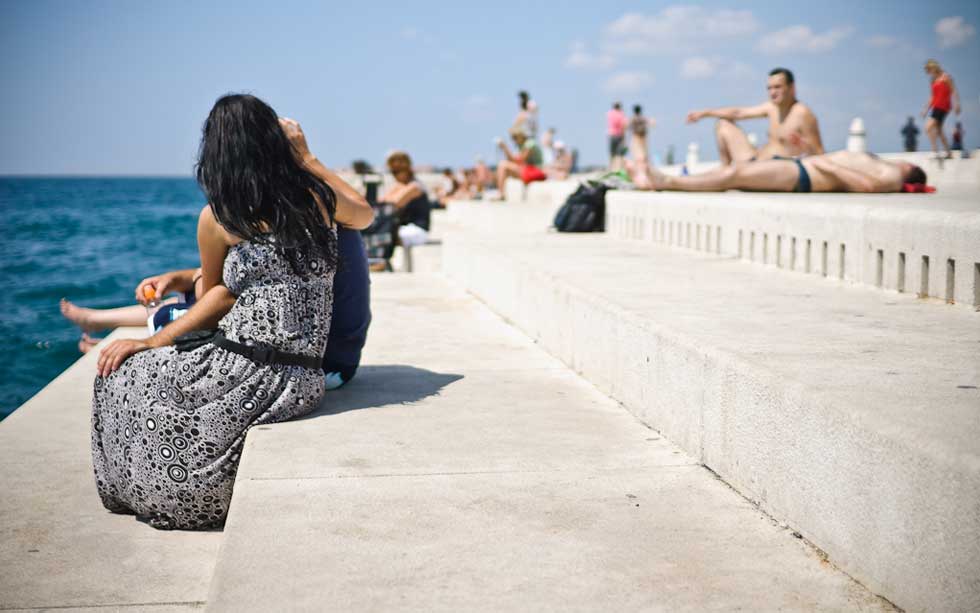
What is the Sea Organ in Zadar?
The Sea Organ is built directly into Zadar’s waterfront steps. Instead of producing music through a keyboard or electronic system, it uses waves, air pressure and a network of pipes hidden beneath the stone promenade.
The result is never exactly the same twice. On calm days the tones can be soft and intermittent; when stronger waves reach the waterfront, more pipes are activated and the sound becomes louder and more frequent.
The Sea Organ is also an important part of Zadar’s waterfront renewal. Rather than creating a conventional monument separated from everyday life, Nikola Bašić designed a public place where people can sit beside the sea while the architecture itself responds to natural conditions.
How does the Sea Organ work?
Beneath the stone steps is a system of 35 pipes and resonating chambers. Waves enter openings along the waterfront and create pressure inside the structure, pushing air through tuned pipes. The sound then escapes through openings in the promenade above.
The pipes are arranged to produce seven groups of five tones. The system gives the installation a recognizable harmonic character even though the exact sequence, rhythm and intensity are controlled by the sea.
- Calm sea: softer, less frequent tones
- Moderate waves: more continuous and varied sound
- Rougher conditions: louder and more forceful sequences
If you arrive and initially hear very little, stay for several minutes. A new set of waves can change the sound noticeably.
Best of Zadar with St. Anastasia viewpoint
Join a guided sightseeing tour of Zadar and visit some of its most popular sites.
Your knowledgeable guide will take you on a walking tour to see the city's landmarks including the Zadar Land City Gates, Roman Forum, and the famous Sea Organ that produces unique sounds from the movement of the tides.
The tour also includes an admission ticket to the Cathedral of St. Anastasia. You'll also see the 9th-century Byzantine Church of Donat and walk along the ancient main street Kalelarga. The tour includes guidance from a certified local guide and the entrance fee for St. Anastasia's Cathedral Bell Tower.
History and design
The Sea Organ was created during the redevelopment of Zadar’s western waterfront and opened in 2005. Architect Nikola Bašić transformed what had been a relatively hard, utilitarian waterfront edge into a stepped public space that reconnects the Old Town peninsula with the sea.
The installation received international recognition soon after opening, including the European Prize for Urban Public Space in 2006.
Bašić later designed the nearby Greeting to the Sun, creating two complementary waterfront installations: one interprets the movement of the sea through sound, while the other uses solar energy and light.
Best time to visit the Sea Organ
The Sea Organ is accessible throughout the day and night, but the experience changes considerably depending on crowds, light and sea conditions.
Early morning
Early morning is the best choice if you mainly want to hear the Sea Organ clearly. The promenade is quieter, there is less background conversation and you can usually sit close to the water without competing for space.
Late afternoon and sunset
Sunset is the most popular time to visit. The steps fill with people watching the sun drop over the Adriatic while the Sea Organ plays beneath them.
Arrive before sunset if you want a good place to sit. In July and August the area can become very busy during the final hour of daylight.
After dark
The Sea Organ continues to work after sunset. Evening is also the natural time to combine it with Greeting to the Sun, whose illuminated surface becomes much more visible once the sky darkens.
Sea Organ and Greeting to the Sun
The Greeting to the Sun is only a short walk from the Sea Organ, making the two attractions an easy pair.
A simple evening plan is:
- Arrive at the Sea Organ before sunset.
- Find a place on the steps and listen while the sun approaches the horizon.
- Stay through sunset.
- Walk to Greeting to the Sun as its lighting becomes more visible.
- Continue back through the Old Town for dinner or an evening walk.
This is one of the easiest free evening activities in Zadar and requires no fixed timetable or ticket.
Where is the Sea Organ?
The Sea Organ is on the western waterfront of the Old Town peninsula, at Obala kralja Petra Krešimira IV. It is built into the broad stone steps facing the Adriatic.
Zadar Old Town is compact, so walking is generally the easiest way to reach it.
From the Roman Forum and St Donatus
From the Roman Forum and Church of St Donatus, walk toward the waterfront and continue west along the promenade. The Sea Organ is only a short walk away.
By taxi
Ask for Morske orgulje or Sea Organ. Vehicles cannot use every pedestrian section of the waterfront, so expect a short final walk.
By car
Parking directly beside the attraction is limited, particularly during summer evenings. It is usually easier to park in an appropriate paid parking area and continue through the Old Town on foot.
Easy Zadar Old Town walking route
The Sea Organ works well as the final stop on a short sightseeing route through the historic centre:
- Roman Forum
- Church of St Donatus
- Cathedral of St Anastasia
- Kalelarga
- Sea Organ
- Greeting to the Sun
If you time the route for late afternoon, you can finish at the waterfront shortly before sunset.
Can you swim near the Sea Organ?
People do swim along parts of Zadar’s waterfront, but the Sea Organ steps are an urban public promenade rather than a managed beach.
If you enter the water nearby:
- use an access point that looks safe;
- take care on wet or slippery stone;
- watch local boat traffic and sea conditions;
- supervise children closely;
- avoid obstructing the main seating areas.
If you specifically want a beach day, use one of Zadar’s designated swimming areas rather than treating the Sea Organ as your main beach.
Accessibility
The waterfront promenade approaching the Sea Organ is generally level and straightforward to reach. The main listening and seating area, however, consists of broad stone steps descending toward the sea.
Visitors who cannot comfortably use the steps can still hear the installation from promenade level above them. The strength of the sound varies with wave conditions, so quieter days may require staying closer to the instrument.
Nearby things to see
- Greeting to the Sun: directly beside the Sea Organ and best experienced after sunset
- Roman Forum: the centre of Roman-era Zadar
- Church of St Donatus: one of the city’s most recognizable historic buildings
- Cathedral of St Anastasia: cathedral complex and bell-tower viewpoint
- Kalelarga: Zadar’s principal pedestrian street
See our complete Zadar attractions guide for more ideas around the peninsula.
Practical tips
- Listen for more than a minute: wave patterns change, so the sound often becomes more interesting after a short wait.
- Come early for sunset: the steps can become crowded in peak season.
- Watch the stone surface: the lowest steps can be wet from spray and slippery after rain.
- Keep children close: there is no barrier separating the lowest steps from the sea.
- Protect electronics: sea spray can reach the lower levels during rougher conditions.
- Summer sun: the waterfront is exposed, so use shade, sunscreen and water during the hottest part of the day.
Guided tours that include the Sea Organ
You do not need a guide to experience the Sea Organ, but many Zadar walking tours include it as part of a broader route through the Roman and medieval Old Town.
A guided tour is most useful if you want historical context for the Roman Forum, churches, city gates and waterfront rather than simply visiting the installation itself.
Zadar City Tour 120min Walk
Explore Zadar with a local guide in just 2 hours.
This small-group walking tour is an easy way to connect the dots between the city’s Roman roots and its modern waterfront icons. Starting from a central meeting point, you will stroll past ancient ruins and Old Town landmarks, then finish with Zadar’s signature sunset pair - the Sea Organ and Greeting to the Sun - plus the impressive Land Gate with its triumphal-arch design. Choose a morning or afternoon departure to fit your plans, and enjoy the extra insight you only get from a fully licensed guide.
Where to stay in Zadar
Staying on or close to the Old Town peninsula makes it easy to visit the Sea Organ early in the morning, return for sunset and walk back after dinner without worrying about parking.
- Villas in Zadar - larger and higher-end stays, often better suited to families and groups
- Hotels and accommodation in Zadar - the broadest selection for visitors who want easy access to the Old Town and waterfront
- Hostels in Zadar - budget-oriented and social accommodation, including options within walking distance of the peninsula
Access
Free public waterfront space, accessible day and night.
Best experience
Sit on the waterfront steps and listen as the sound changes with the waves.
Address
Obala kralja Petra Krešimira IV
23000 Zadar
Croatia
FAQ - Sea Organ Zadar
Is the Sea Organ in Zadar free?
Yes. The Sea Organ is a public waterfront installation and there is no entrance fee.
How does the Sea Organ work?
Waves push air through pipes and resonating chambers hidden beneath the waterfront steps. The air passes through tuned pipes and produces the tones heard along the promenade.
Who designed the Sea Organ?
The Sea Organ was designed by Croatian architect Nikola Bašić as part of the redevelopment of Zadar’s waterfront.
When was the Sea Organ built?
The Sea Organ opened in 2005.
What is the best time to visit the Sea Organ?
Early morning is best for quiet listening, while sunset offers the strongest atmosphere. Sunset is also the busiest period in summer.
Does the Sea Organ work all day?
Yes. It does not depend on opening hours or electricity to produce sound. Its intensity depends on wave and sea conditions.
Does the Sea Organ make sound when the sea is calm?
Usually, but the tones can be much softer and less frequent. Stronger wave action generally produces louder and more varied sound.
How long should I spend at the Sea Organ?
Allow around 15-30 minutes for a normal visit. Stay longer if you are waiting for sunset or simply want to sit and listen.
Can you visit the Sea Organ at night?
Yes. It is part of the public waterfront and remains accessible after dark.
Is the Sea Organ next to Greeting to the Sun?
Yes. The two installations are only a short walk apart and are commonly visited together around sunset.
Can you swim near the Sea Organ?
Swimming takes place along parts of Zadar’s waterfront, but the Sea Organ is an urban promenade rather than a designated beach. Use a safe access point and take care on wet stone.
Is the Sea Organ wheelchair accessible?
The promenade above the installation is generally accessible, but the main seating area consists of broad stone steps. The organ can still be heard from promenade level.
Is the Sea Organ worth visiting?
Yes. It is free, central and unlike a conventional monument: the experience changes with the sea, weather and time of day.