
Big Onofrio’s Fountain is one of the first landmarks you’ll see when you enter Dubrovnik Old Town through the western entrance by Pile gate. This 15th-century polygonal fountain is famous for its 16 stone-carved “maskerons” (decorative spouts) and for marking the triumph of Dubrovnik’s historic water-supply system, completed in 1438, which brought fresh spring water from Rijeka Dubrovačka around 12 km away. Today it’s a free, quick stop for a photo and a refreshing bottle refill before you head down Stradun or start the City Walls walk.
Big (Large) Onofrio’s Fountain quick overview
- Location: Just inside the western entrance to Dubrovnik Old Town by Pile Gate, at the start of Stradun (Placa).
- Built: 1438 (created for public use when Dubrovnik's water supply system was completed).
- Designed by: Onofrio della Cava (Naples).
- Cost: Free.
- Hours: Open 24 hours (outdoor landmark).
- Water source: The historic system brought spring water from Rijeka Dubrovačka, also known as the Ombla, around 12 km away.
What is Onofrio’s Fountain?
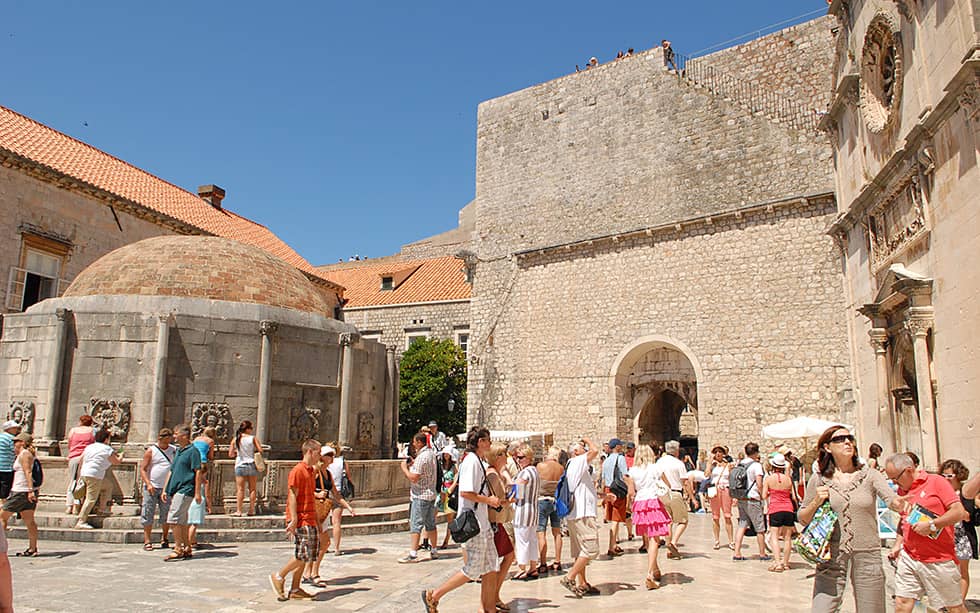
The Big (Large) Onofrio’s Fountain is a 15th-century public drinking-water fountain and one of Dubrovnik Old Town’s signature landmarks. It’s a large polygonal stone fountain with 16 carved “maskerons” (decorative faces/spouts) where water still runs, built to celebrate the completion of Dubrovnik’s city water supply in 1438. Designed by the Neapolitan architect Onofrio della Cava, it once marked the practical (and symbolic) arrival of fresh spring water into the walled city—so it’s both a beautiful piece of urban design and a reminder of how advanced Dubrovnik’s infrastructure was for its time.
You’ll also hear about the Small Onofrio Fountain, also linked to Onofrio’s waterworks, which sits at the eastern end of Stradun, together, the two fountains bookend the Old Town’s main street.
Where is it? (exact location in Old Town)
Big (Large) Onofrio's Fountain sits right by the western entrance of Dubrovnik Old Town. If you enter through Pile Gate, the fountain is immediately in front of you on the small open square at the start of Stradun (Placa), the Old Town's main street.
For maps, it is often listed around Poljana Paska Milicevica (Old Town), and it is one of the easiest meeting points in the historic centre.
Helpful landmark: the main entrance to the Dubrovnik City Walls is right by this square, essentially opposite the fountain near the Church of Holy Savior.
Best time to visit and photo tips
- Go early for the calmest experience: The area by Pile Gate and Stradun gets busy fast, so early morning is your best chance for crowd-free photos and an unhurried bottle refill.
- Try later evening for atmosphere: If you want the Old Town to feel lively but without the peak daytime tour-group rush, visit again later in the evening and shoot toward Stradun.
- Avoid the hottest part of the day in summer: Midday can feel intense in the Old Town. Refill here, then explore shaded side streets or time your longer walks (like the walls) for cooler hours.
- Photo angles that work: Step back to include the curve of the fountain with Pile-side Old Town stonework behind it, then take a second close-up shot of one of the carved spouts (maskerons).
- Watch your footing after rain: The limestone on Stradun can be slippery when wet, especially around busy spots where people gather for photos.
If you want to bundle Dubrovnik Old Town highlights in one go, consider a guided combo that starts right by the Old Town and covers the big-ticket sights efficiently. It is ideal if you want local context, a clear route through the Old Town, and the walls done with minimal planning.
Dubrovnik Super Saver:
Cable Car Ride and Old Town Walking Tour plus City Walls
Embark on an unforgettable journey through the stunning city of Dubrovnik, renowned for its breathtaking architecture and rich history. Stroll along the narrow and winding streets of the UNESCO World Heritage Site of Dubrovnik Old Town. Be awe-inspired by the mesmerising views from the 16th-century city walls, and take your experience to the next level by taking a cable car ride to Mt. Srd for panoramic views of the city.
Book your tour now and discover Dubrovnik with a knowledgeable tour expert.
How to get there
- On foot: If you are already in Dubrovnik Old Town, walk to the west end of Stradun (Placa). The fountain is right by Pile Gate.
- By local bus (Libertas): Get off at the Pile bus stop, the main public transport stop for the Old Town area. Many city lines terminate at or pass through Pile, including 1A, 1B, 3, 4 and 6 (depending on where you are staying). Use our Dubrovnik city bus map to plan the easiest route.
- From Gruž Port or the main bus station: Take a local bus toward Pile and walk a minute or two to the fountain. If you are arriving with luggage, start with Dubrovnik Main Bus Station in Gruž.
- From Dubrovnik Airport: The airport shuttle (Platanus) typically connects the airport with Gruž and an Old Town area stop near the cable car zone (stop patterns can vary), then you continue on foot to the Old Town entrances and the fountain. Use our Dubrovnik Airport shuttle bus guide to confirm the latest stops and timetable.
- By taxi or transfer: Vehicles cannot enter the Old Town, so you will be dropped outside the walls near Pile or Ploče, then walk to the fountain.
- By car: Driving and parking near the Old Town can be restricted and busy, especially in peak season. A practical option is to park at Public Garage Dubrovnik and walk down to the Old Town.
Why it matters
Big Onofrio's Fountain is more than a photo stop - it represents one of Dubrovnik's most important public works. The fountain was built for public use when the city water supply was completed in 1438, bringing fresh spring water from Rijeka Dubrovačka, 12 km away. In practical terms, that meant reliable drinking water inside the walls and a major upgrade to daily life in the Old Town.
Today, the fountain is still an easy landmark to recognise: a large polygonal structure with 16 stone-carved maskerons (spouts) where water runs. Because it sits right by Pile Gate at the start of Stradun, it has become a natural meeting point and the most convenient place to refill a bottle before exploring the Old Town or heading to the Dubrovnik City Walls.
History in brief
- 1438: Dubrovnik completes its city water supply, bringing spring water from Rijeka Dubrovačka (Ombla) about 12 km away, and Big Onofrio's Fountain is built for public use to mark the achievement.
- 1667: The great earthquake badly damages the fountain. The stone cupola collapses and much of the richer original decoration and sculptural elements are lost, with later reconstructions replacing the upper structure with the simpler form you see today.
- Today: The historic water supply is connected with the modern waterworks system, and the fountain remains a working landmark in the Old Town.
What to look for (architecture details)
16 sides and 16 stone "maskerons"
Start with the fountain's shape. Big Onofrio's Fountain is a 16-sided stone structure, and each side features a unique carved "maskeron" - a decorative face with a faucet projecting from the mouth. Walk a slow circle and compare the expressions and details, then look closely at the spouts: some maskerons show wear and a few have been damaged during past repairs.
Tip: take one wide photo that captures the full polygon shape, then a second close-up of your favourite maskeron.
Earthquake changes: what is different today
The fountain you see now is not exactly how it looked in the 1400s. The 1667 earthquake caused major damage and the original, more elaborate decoration did not survive. The stone cupola collapsed and later reconstructions replaced it with a similar but simpler version, which is why many descriptions mention lost sculptural elements.
Look up to the cupola area as well: some sources note the cupola work is linked with Petar Martinov of Milan, and that the original dragon statue once placed on top is missing after the 1667 earthquake.
Can you drink the water?
Yes - you can normally drink the water from Big Onofrio's Fountain. The fountain is fed by Dubrovnik's municipal water system, and the local water utility states the city's drinking water is of exceptionally high quality and managed under recognised water-safety standards.
Practical tip: As with any destination, if you see a local public notice about temporary water quality changes (for example after extreme weather), follow that advice for the day.
Big vs Little Onofrio: what is the difference?
They are two related public fountains tied to Dubrovnik's historic waterworks - and they sit at opposite ends of the Old Town's main street.
- Location: The Big (Large) Onofrio's Fountain is by the western entrance near Pile Gate, while the Little (Small) Onofrio Fountain is on the eastern part of Stradun (Placa), set in a niche on the City Guard facade.
- Look and feel: The big fountain is the landmark most people remember - a large polygonal structure with 16 carved stone spouts (maskerons). The small fountain is more discreet and easy to miss unless you know where to look.
- Why visit both: Together they help you understand how central water supply was to Dubrovnik's Old Town - you can start at the big fountain by Pile, then stroll the length of Stradun and spot the smaller fountain near the eastern end.
Nearby sights (2-10 minutes away)
- Dubrovnik City Walls - The main entrance is right here at the Pile end of Stradun, effectively opposite the fountain near the Church of Holy Savior, making it the easiest add-on if you are starting sightseeing here.
- Pile Gate - Step back outside the walls for classic photos of the gate, bridges, and the busy Old Town approach area (about 1-2 minutes).
- Church of Holy Savior - A quick cultural stop right by the start of Stradun, easy to combine with the City Walls entrance nearby (about 1-3 minutes).
- Fort Lovrijenac - Walk outside the Old Town and climb up to Dubrovnik's dramatic sea-cliff fortress for one of the best viewpoints back over the walls (about 10 minutes, plus stairs).
- Stradun (Placa) - The Old Town's main limestone street begins here. Even a short stroll gives you the classic Dubrovnik atmosphere, cafes, and photo spots (2-10 minutes, depending how far you walk).
- St Blaise Church and Sponza Palace - Follow Stradun to its eastern end for two of the most photographed landmarks on Luza Square (about 8-10 minutes from the fountain).
If you would rather see the Old Town highlights in a logical route with stories and historical context along the way, consider joining a guided tour. A good local guide can help you connect the landmarks, avoid common time-wasters, and make sure you do not miss the details that are easy to walk past in a busy Old Town.
Dubrovnik Discovery Old Town Walking Tour
Discover Dubrovnik’s famous and hidden landmarks
Dubrovnik is famous for its history and architecture, but it can be hard to appreciate the city properly on a self-led walk. Skip the guidebook and explore Dubrovnik Old Town with a local guide, linking the must-see sights with the stories that bring them to life. You will cover highlights like the Franciscan Monastery, Stradun, the Cathedral of the Assumption, and more, while also spotting details and hidden corners most visitors miss.
Suggested mini walking route (easy Old Town start)
- Enter the Old Town via Pile Gate and stop at Big Onofrio's Fountain for a quick photo and a water refill.
- If you want to do the walls, go straight to the nearby Dubrovnik City Walls entrance by the Inner Pile Gate, then return to street level and continue your walk.
- Walk east along Stradun (Placa) all the way to Luza Square, taking a few short detours into side streets if something catches your eye.
- At the eastern end, visit Sponza Palace, then step over to St Blaise Church and the nearby Rector's Palace.
- Finish in the cathedral zone at Dubrovnik Cathedral and Treasury, then head to the Dubrovnik Old City Port for harbour views and an easy end point.
If you want a fun twist on this mini route, consider swapping the standard sightseeing walk for a Dubrovnik Game of Thrones Tour. Starting near the Old Town entrances, it guides you through iconic filming locations while you still see real Dubrovnik highlights along the way, and the optional Lokrum add-on is an easy upgrade if you want a short boat trip and a scenic break from the crowds.
Dubrovnik Game of Thrones Tour & Optional Lokrum Island Visit
Discover where the popular HBO series "Game of Thrones" was filmed in Dubrovnik on this walking tour.
Follow your guide through the Old Town on foot, tracing iconic locations from Pile Gate to Fort Lovrijenac (St. Lawrence Fortress). Along the way you will hear behind-the-scenes stories and on-set gossip about how filming worked in the city.
Practical info
- Price: Free to visit - no ticket needed.
- Opening hours: Open 24 hours (outdoor landmark in a public square).
- Time needed: 5-10 minutes for a photo and a quick water refill, longer if you are meeting friends or people-watching.
- Best use: Refill your bottle here before walking down Stradun or starting the Dubrovnik City Walls.
- Footwear tip: When it rains, Stradun's polished limestone can be slippery - wear shoes with good grip and take extra care on smooth stone and metal drain covers.
- Good to know: This is one of the busiest meeting points in Old Town, so expect crowds in peak hours and keep valuables secure while taking photos.
Working Hours
Open 24 hours
Features
Water in the fountain is drinkable
Address & contact details
Street: Poljana Paska Milicevica
Postcode: 20000
City: Dubrovnik
Frequently asked questions
Where is Big Onofrio's Fountain?
Big Onofrio's Fountain is inside Dubrovnik Old Town by the western entrance near Pile Gate, right at the start of Stradun (Placa). It is one of the easiest meeting points in the historic centre.
Is Big Onofrio's Fountain free to visit?
Yes. It is a public outdoor landmark in a city square, so you can visit at any time without a ticket.
Can you drink the water from the fountain?
The fountain is part of Dubrovnik's water supply system, and Dubrovnik's drinking water is managed and monitored by the local water utility using modern safety standards and controls. If you have a sensitive stomach, you can still use the fountain for a quick rinse and refill from a cafe or your accommodation instead.
Why does the fountain look different from the original?
The fountain was damaged in the 1667 earthquake, including the cupola, and later reconstructions did not restore the original appearance. That is why the fountain today looks simpler than it once did.
What are the stone faces on the fountain?
Those are "maskerons" - carved stone faces with water spouts projecting from the mouth. Big Onofrio's Fountain has 16 sides and 16 different maskerons to spot as you walk around it.
What is the difference between Big and Little Onofrio's Fountain?
Big Onofrio's Fountain is by Pile Gate at the western end of Stradun. Little Onofrio Fountain is at the eastern end of Stradun near Luza Square, placed in a niche on the City Guard facade, and it is more ornate and easier to miss.
How much time should I plan for the fountain?
Most visitors spend 5-10 minutes for a quick look, photos, and a refill, then continue down Stradun or head to the City Walls.
What is the best time to visit for photos?
Early morning is best for cleaner photos with fewer people. Late afternoon and evening are also good if you want atmosphere and warm light, but expect more crowds in peak season.
Is the area slippery when wet?
Yes. The Old Town stone streets can be slippery after rain, especially on smooth, polished sections. Wear shoes with good grip and take care around wet stone and drain covers.