
The Church of St Blaise is one of the most recognizable landmarks in Dubrovnik Old Town and one of the clearest symbols of the city itself. Standing on Luža Square opposite Sponza palace (Divona) and just off Stradun, it is dedicated to St Blaise (Sv. Vlaho in Croatian), the patron saint of Dubrovnik, whose image appears throughout the city’s history, celebrations, and monuments.
Even if you are only exploring the Old Town for a few hours, this is one of the stops worth slowing down for. The present church, built in 1715 in Venetian Baroque style by the well-known Italian architect Gropelli, is not just visually striking from the outside, it also helps explain why St Blaise remains so central to Dubrovnik’s identity and why his feast day (Festival of St Blaise) still matters so much to local tradition.
In this guide, you will find the essential history of the Church of St Blaise, what to notice before you walk inside, why it matters beyond its facade, and how to fit it into a practical walk through Dubrovnik’s most important nearby sights.
Church of St Blaise highlights
If you want the short version before diving into the history, these are the key things to know about the Church of St Blaise in Dubrovnik.
- What it is: A Venetian Baroque church dedicated to Sv. Vlaho, the patron saint of Dubrovnik.
- Why it matters: It is one of the city’s most important religious and civic landmarks, closely tied to Dubrovnik’s identity and traditions.
- Where it is: On Luža Square at the eastern end of Stradun, opposite Sponza Palace.
- Why visitors stop here: The church stands in one of the most prominent positions in the Old Town and helps explain why St Blaise appears so often in Dubrovnik’s monuments, ceremonies, and public imagery.
- What to notice first: The broad staircase, elegant Baroque façade, and the strong visual presence of the church within Luža Square.
- Who should visit: First-time visitors, history-focused travelers, and anyone putting together a practical walking route through Dubrovnik Old Town.
- How much time to allow: Around 10 to 20 minutes for a short stop, or longer if you want to combine it with nearby landmarks.
Why St Blaise matters to Dubrovnik
To understand this church properly, it helps to know that Sv. Vlaho is not just a saint connected to one building. In Dubrovnik, he is part of the city’s identity, public memory, and annual traditions, which is why this church carries much more meaning than a quick Old Town photo stop.
- Patron saint of Dubrovnik: Sv. Vlaho has been honoured as the city’s protector since the 10th century, and his presence can still be felt across Dubrovnik’s churches, monuments, and historic symbols.
- Linked to a defining local tradition: According to Dubrovnik tradition, St Blaise warned the city about a Venetian plan to attack, which is why he is remembered not only as a religious figure, but also as the guardian of Dubrovnik.
- Part of the city’s civic identity: His feast day on 3 February is also the Day of the City of Dubrovnik, giving the celebration both religious and civic importance.
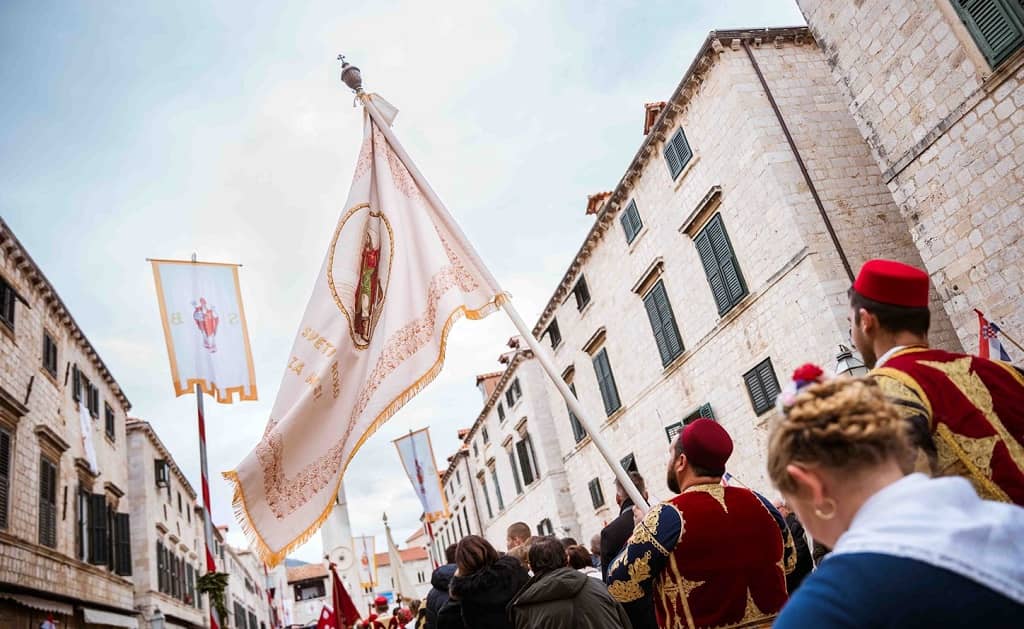
- Still central to local life: The Festivity of St Blaise remains one of Dubrovnik’s most important annual events, marked by mass, processions, banners, and long-standing ceremonial customs.
- Recognized by UNESCO: The festivity of Saint Blaise, the patron of Dubrovnik, is inscribed on UNESCO’s Representative List of the Intangible Cultural Heritage of Humanity.
That wider context is what makes the Church of St Blaise so important. It is not only a Baroque landmark in a prominent square, but one of the clearest places to understand how closely Dubrovnik’s history, faith, and identity are tied together. If you want to experience that setting with added local insight, it is especially rewarding as part of a guided Old Town tour that explains how this church connects to the surrounding landmarks and the story of the city as a whole.
Dubrovnik Cable Car Ride, Old Town Walking Tour plus City Walls
This Dubrovnik sightseeing package is a practical way to combine several of the city’s biggest highlights in one well-planned experience. It includes a cable car ride to Mt. Srđ for wide views over Dubrovnik and the Adriatic, followed by a guided walking tour through the UNESCO-listed Old Town, where landmarks such as the Church of St Blaise, Stradun, and Luža Square make much more sense with local context.
After the guided portion, the experience continues with prebooked access to the City Walls, so you can explore them at your own pace without arranging tickets separately. For first-time visitors in particular, it is a strong option because it brings together panoramic views, Old Town history, and one of Dubrovnik’s most famous attractions in a single, good-value tour.
The history of the church
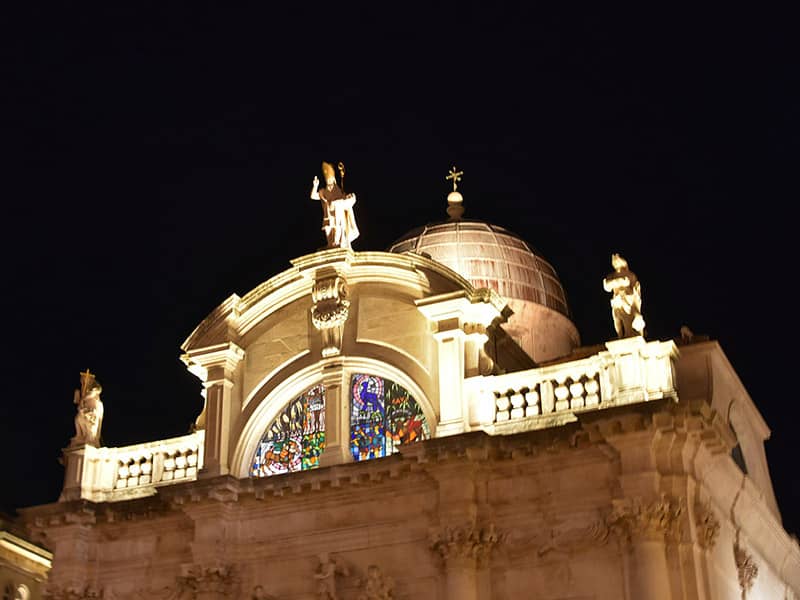
Standing prominently on Luža Square just off Stradun, the Church of St Blaise is one of those Dubrovnik landmarks that becomes more impressive the longer you look at it. By day, its broad staircase and Baroque facade draw attention from the square, while in the evening the stained-glass windows by Dubrovnik artist Ivo Dulčić add another layer of character to the building.
The site has been connected to the worship of Sv. Vlaho since 1368, but the church seen today belongs to the early 18th century. After a fire destroyed the earlier building, Dubrovnik commissioned a new church in Baroque style, built from 1706 to 1715 to the design of the Venetian architect and sculptor Marino Gropelli. One of the most important features linked to the church is the image of St Blaise holding a model of the old city, a detail that preserves the appearance of Dubrovnik before later destruction and rebuilding changed parts of its historic fabric.
- An older church stood here first: Before the current building, this site was occupied by a Romanesque church dedicated to St Blaise, dating from the 14th century.
- The old building did not survive intact: Although the earlier church endured Dubrovnik’s great 1667 earthquake better than many other structures, it was later destroyed in the fire of 1706.
- The Dubrovnik Senate ordered a new church: After the fire, the city authorities commissioned a replacement worthy of the city’s patron saint and its prominent position on Luža Square.
- Marino Gropelli led the rebuild: The new church was designed by the Venetian architect and sculptor Marino Gropelli, with construction beginning in 1706.
- The church you see today was completed in 1715: Its design reflects Venetian Baroque taste, which gives the building a different character from many of Dubrovnik’s earlier medieval landmarks.
- One precious object survived the fire: Inside, the church preserves a 15th-century silver statue of Sv. Vlaho, widely regarded as one of the most important surviving treasures connected to the earlier church.
- The statue carries an older image of the city: The model of Dubrovnik held by the saint is especially valued because it preserves the appearance of the pre-earthquake city and its earlier churchscape.
This layered history is part of what makes the church so compelling. It is not only a beautiful Baroque building, but also a place where medieval devotion, post-disaster rebuilding, and Dubrovnik’s civic identity all meet in one highly visible setting.
What to notice before you go inside
Before stepping inside, take a moment to look at the church from Luža Square rather than treating it as a quick stop on the way down Stradun. This is one of the best places in the Old Town to see how Dubrovnik’s architecture, public space, and civic symbolism come together in a single view.
The exterior was designed to make an impression. Unlike many of Dubrovnik’s earlier churches, this one presents itself with a more theatrical Baroque frontage, raised above the square, richly sculpted, and closely tied to the figure of Sv. Vlaho, the city’s patron saint.
- The staircase and raised setting: The broad steps and balustrade give the church a ceremonial feel and help it stand out immediately within Luža Square.
- The Baroque façade: Look for the more decorative, sculptural character of the front elevation, which feels very different from the simpler medieval forms found elsewhere in the Old Town.
- Gropelli’s hand as architect and sculptor: Marino Gropelli was responsible not only for the design of the church, but also for key sculptural elements, which is why the façade feels especially animated and detailed.
- The figure of Sv. Vlaho above the entrance: The city’s patron saint appears prominently on the façade, reinforcing the church’s role as more than just another historic building in the Old Town.
- The square around it: From here, you can appreciate how naturally the church anchors this part of the city, with Sponza Palace close by and the main flow of Stradun only a few steps away.
- The evening detail many people miss: If you pass here later in the day, the stained-glass windows by Ivo Dulčić add another visual layer that is easy to overlook in the daytime crowd.
What to see inside the church
The exterior may catch your attention first, but the interior is where the church becomes much more than a landmark on Luža Square. Inside, the focus shifts from the Baroque setting to the objects and details that connect Sv. Vlaho directly to Dubrovnik’s memory, especially the surviving silver statue and the preserved image of the older city.
The interior is richly decorated without feeling overwhelming, so it is worth slowing down rather than just stepping in for a quick look. Even a short visit gives you a better sense of why this church matters so much to Dubrovnik beyond its central location in the Old Town.
- The main altar: The visual centre of the church is the marble high altar, which immediately draws the eye and gives the interior much of its ceremonial character.
- The 15th-century silver statue of Sv. Vlaho: This gilt silver figure is the church’s most important treasure and the object most closely tied to the older church that once stood on this site.
- The statue that survived the fire: When the earlier church was destroyed in 1706, this silver statue was the most famous object to survive, which is one reason it carries such strong symbolic weight.
- The model of the old city: In the saint’s hand, you can see a model that preserves the appearance of older Dubrovnik and helps visitors imagine the city before later destruction and rebuilding changed parts of its historic fabric.
- The Baroque interior details: Look up at the elegant architectural framing, the decorative treatment around the altar, and the way the interior space feels more theatrical than many of Dubrovnik’s earlier churches.
- The stained-glass windows: The windows designed by Ivo Dulčić add a later artistic layer to the church and stand out especially well when the light catches them properly.
- A quieter side of the Old Town: If the square outside feels busy, the interior offers a very different mood, more reflective, more intimate, and easier to appreciate once the door closes behind you.
Can you visit the church today?
Yes, the Church of St Blaise is still an active place of worship and remains part of everyday religious life in Dubrovnik, not just the city’s sightseeing circuit. For visitors, that is part of its appeal, but it also means you should treat it differently from a museum with fixed tourist access rules.
The best approach is to visit with a little flexibility. Doors may be open for prayer, short visits, and services, but access can change around Mass, feast-day events, and church activity, so it is always worth checking posted notices on site if you want to step inside.
- It is an active church: Expect a quieter, more respectful atmosphere than at standard ticketed attractions in the Old Town.
- Mass times shape access: The parish schedule changes seasonally, so the best visiting window is often outside service times rather than during them.
- Current parish schedule: At the time of writing, weekday Mass is listed at 17:00 for most of the year and at 7:30 during July and August, with Sunday Mass at 8:00 and 12:00.
- Do not plan around fixed sightseeing hours: Because this is a working church, it is better to check locally on the day you plan to visit.
- Dress and behaviour matter: Keep voices low, avoid interrupting worship, and be discreet with photos if a service or private prayer is taking place.
- How long to allow: A short stop can take 10 to 15 minutes, but it is easy to combine with nearby landmarks on Luža Square and the eastern end of Stradun.
If you are walking through the Old Town on your own, the Church of St Blaise is an easy and worthwhile stop. But it becomes much more meaningful when it is explained in context , not just as a beautiful Baroque church on Luža Square, but as one of the clearest symbols of Dubrovnik’s history, patron saint tradition, and civic identity.
That is why many visitors find it more rewarding as part of a guided Old Town walk rather than as a standalone stop. A good tour helps connect the church with nearby landmarks such as Stradun, Sponza Palace, the Bell Tower, and Rector’s Palace, while adding the stories and historical detail that are easy to miss when you are simply passing through the square. If you want to see St Blaise Church as part of a broader introduction to Dubrovnik, the tour below is one of the easiest ways to do it.
Dubrovnik Discovery Old Town Walking Tour
Discover Dubrovnik’s Old Town with a private guide who can turn its streets, landmarks, and hidden details into a much clearer and more memorable experience.
As you move through the historic centre, you will trace the city’s story from the time of the Republic to the modern era, while stopping at major sights such as Stradun, the Rector’s Palace, and key filming locations from Game of Thrones and other movies. With museum visits included and a more personal pace throughout, this tour is a strong option for travellers who want more depth than a standard walk through the Old Town.
Feast of St Blaise and why this church matters even more in February
If you visit Dubrovnik in summer, the Church of St Blaise can feel like one beautiful stop among many in the Old Town. In early February, that changes completely. This is when the church becomes one of the emotional and ceremonial centres of the city, and when the bond between Dubrovnik and its patron saint is easiest to understand.
The key date is 3 February, the feast day of Sv. Vlaho and also the Day of the City of Dubrovnik. Around that date, the area around the church and Luža Square fills with religious ceremonies, banners, processions, and long-established local customs that have been passed down for generations. Read more about the Festival of St Blaise.
- The most important time of year here is early February: The celebration of Sv. Vlaho reaches its peak around 2 and 3 February, when the church and surrounding square become central to the city’s public life.
- It is not only a religious feast: In Dubrovnik, St Blaise’s day is also tied to civic identity, which is why the celebration feels broader than a church event alone.
- The church becomes a focal point: This is one of the places most closely associated with the ceremonies, prayers, gatherings, and visual symbolism of the festivity.
- You may see banners, clergy, and formal processions: The celebration traditionally brings together parish banners, church representatives, local residents, and visitors from the Dubrovnik area.
- The atmosphere is very different from a normal sightseeing day: Expect more ceremony, more people, and a stronger local presence than during an ordinary Old Town visit.
- It has UNESCO recognition: The Festivity of Saint Blaise, the patron of Dubrovnik, is inscribed on UNESCO’s Representative List of the Intangible Cultural Heritage of Humanity.
- It is worth planning around: If you are in Dubrovnik at the start of February, this church deserves more time than a quick photo stop - but it is wise to check the official city and church program because access patterns and crowd levels can be very different during the celebrations.
For many visitors, this is the missing piece of context. Once you know what happens here during the feast of Sv. Vlaho, the church no longer feels like just another historic building on Stradun - it feels like one of the places where Dubrovnik’s identity is still actively lived.
How to fit St Blaise Church into your Old Town walk
One of the best things about the Church of St Blaise is how easily it fits into a natural walk through Dubrovnik Old Town. Because it stands at the eastern end of Stradun on Luža Square, it works well either as a highlight near the end of your main Old Town stroll or as the point where you slow down and start exploring the surrounding landmarks more carefully.
This part of the Old Town is especially rewarding because several major sights sit within a very short distance of one another. Instead of treating the church as a stand-alone stop, it makes more sense to see it as part of a compact cultural cluster that includes palaces, civic monuments, and the cathedral area just beyond the square.
- Start with Stradun: Walk the city’s main street from west to east and let the church become one of the visual rewards at the far end of the promenade.
- Pause on Luža Square: This is the best place to take in the church façade properly and understand its position within one of Dubrovnik’s most important public spaces.
- Pair it with Sponza Palace: Sponza Palace stands directly opposite, making this one of the easiest and most logical attraction pairings in the Old Town.
- Continue to Rector's Palace: From the church, it is a short and natural continuation toward Rector's Palace, one of the key political and architectural landmarks of the old Republic.
- Add the cathedral area: If you want to extend the walk slightly, continue on to Dubrovnik Cathedral and Treasury for another major religious and historical stop.
- Keep it short if needed: Even on a tight schedule, the church works very well as a 10 to 15 minute stop within a broader Old Town route.
- Make it part of a wider attractions plan: If you are building a self-guided itinerary, the main Dubrovnik attractions guide is the easiest place to connect this stop with the rest of the city’s major sights.
For many visitors, this is the most practical way to experience the church. It is central enough to fit effortlessly into almost any Old Town route, but important enough that it deserves more than a quick glance while walking past.
Practical tips for visitors
The Church of St Blaise is easy to include in any walk through the Old Town, but a few small details can make the visit smoother. Because it is an active church rather than a standard ticketed attraction, the best approach is to visit respectfully, stay flexible, and treat it as a living part of Dubrovnik rather than just another monument on your checklist.
For most visitors, this is a short stop, but it sits in such an important part of the Old Town that it works best when combined with the nearby square and surrounding landmarks. A little awareness of timing and church etiquette goes a long way here.
- Check the situation on the day: Since this is an active church, access can vary around Mass, prayer, and special religious events.
- Avoid service times if you want a quiet look inside: If a Mass or church gathering is underway, it is better to return a little later than interrupt the atmosphere.
- Be respectful with photos: Quick photos are one thing, but it is best to stay discreet and avoid photographing people during prayer or worship.
- Allow a little extra time in this part of the Old Town: Even if the church itself only takes 10 to 15 minutes, the surrounding area deserves more than a rushed pass-through.
- Notice the entrance steps: The church is approached from the square by a broad staircase, which is worth keeping in mind if step-free access is important for your plans.
- Pair it with nearby sights: This stop works naturally with Sponza Palace, Rector's Palace, and Dubrovnik Cathedral and Treasury.
- Expect a different atmosphere during the feast of Sv. Vlaho: Around early February, this area becomes much busier and more ceremonial than on a normal sightseeing day.
- Use the location to your advantage: Because the church stands on Luža Square just off Stradun, it is one of the easiest landmarks to fit into a self-guided Old Town route.
When the church becomes part of the Dubrovnik Summer Festival stage
The Church of St Blaise takes on a different role during the Dubrovnik Summer Festival. At that point, it is no longer only a historic church on Luža Square, but part of one of the city’s most recognizable open-air settings, where architecture, ceremony, and performance come together in a way that feels uniquely Dubrovnik.
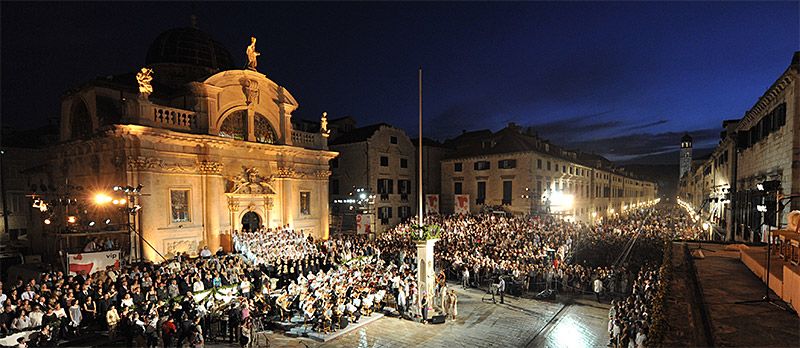
The front steps and the space in front of the church are especially important for the Festival’s opening atmosphere. This is where the ceremonial beginning of the festival is traditionally staged, with the raising of the Libertas flag and the square transformed into a cultural scene framed by Baroque architecture, evening light, and the dense historic fabric of the Old Town. Even for visitors who are not attending a full performance, the church looks different during the festival - less like a static monument and more like a living backdrop in the public life of the city.
- A true site-specific setting: Few places in Dubrovnik feel more closely tied to the Festival’s visual identity than the area in front of the Church of St Blaise.
- The opening mood is special: When the ceremony is held here, Luža Square gains a formal, theatrical atmosphere that is very different from an ordinary sightseeing evening.
- The church becomes part of the scenography: Its staircase, façade, and position beside Stradun help create one of the Festival’s most memorable public stages.
- Worth timing your walk carefully: If you are in Dubrovnik during the festival period, it is worth checking the programme before visiting, since access patterns, crowd levels, and the feel of the square can change significantly around major events.
Seen in that context, the church is not just one more stop on an Old Town route. During the Summer Festival, it becomes one of the places where Dubrovnik feels most like an outdoor stage and where the city’s religious, historic, and cultural identity all meet in the same square.
Location map and address
Use the map below to find the Church of St Blaise in Dubrovnik Old Town. The church stands on Luža Square, just off Stradun in one of the most central parts of the historic center.
Address details
Church of St Blaise
Luža 3, 20000 Dubrovnik, Croatia
FAQ about the Church of St Blaise in Dubrovnik
Where is the Church of St Blaise in Dubrovnik?
The church stands on Luža Square in Dubrovnik Old Town, right at the eastern end of Stradun and opposite Sponza Palace. It is one of the easiest historic churches to include in a self-guided Old Town walk.
Why is St Blaise so important to Dubrovnik?
Sv. Vlaho is the patron saint of Dubrovnik and has been honored in the city since the 10th century. According to local tradition, he warned Dubrovnik about a Venetian threat, which is why he is still seen as the city’s protector and why his image appears so often in Dubrovnik’s monuments, ceremonies, and public symbolism.
How old is the current church?
The church seen today was completed in 1715 in Venetian Baroque style. It was built after the earlier church on this site was destroyed in the fire of 1706, although worship connected to Sv. Vlaho at this location goes back much further.
Can you go inside the Church of St Blaise?
Yes, but it is best to think of it as an active church rather than a standard ticketed attraction. Access depends on whether the church is open outside Mass and other religious activity, so it is smart to check locally on the day and avoid service times if you want a quieter visit.
How much time do you need for a visit?
Most visitors only need around 10 to 20 minutes for a short stop, especially if they are combining it with nearby sights on Luža Square. If you want time to look carefully at the interior, the silver statue of Sv. Vlaho, and the surrounding landmarks, allow a little longer.
What is the best time to visit?
For a calmer stop, it is usually better to visit outside service times and outside the busiest middle hours on Stradun. If you are in Dubrovnik around 3 February, expect a very different atmosphere, since the feast of St Blaise is one of the city’s most important annual celebrations.
What should you see nearby after visiting the church?
The easiest nearby pairings are Sponza Palace, Rector's Palace, and Dubrovnik Cathedral and Treasury. Because the church sits just off Stradun, it also works naturally as part of a wider walk through the main Old Town landmarks.
Why is the feast of St Blaise such a big event?
The feast of Sv. Vlaho is both a religious celebration and a major expression of Dubrovnik’s civic identity. It is celebrated on 3 February, and the wider Festivity of Saint Blaise is recognized by UNESCO as part of the Intangible Cultural Heritage of Humanity.