
If you’re planning accessible holidays in Dubrovnik, this guide focuses on what matters most in practice: airport assistance (PRM), step-free transfers, easier areas to stay, Old Town reality checks, beaches with sea-access lifts, and local equipment rentals. Because Dubrovnik is historic and hilly, always confirm accessibility details directly with providers before you book.
Quick overview: what’s realistically accessible
- Most comfortable base areas (terrain-first): If you want flatter promenades and easier day-to-day mobility, many travelers prefer staying around Lapad (wide, flat promenade) rather than relying on steep Old Town streets for everything.
- Old Town (historic center): Expect a mix. The main street Stradun is flat and a common "easy route", and Pile gate is often cited as the simplest entry point, but cobblestones, narrow lanes, and steps are common beyond the main spine.
- Best "big view" option: The Dubrovnik Cable Car is reported as accessible at both stations (ramp at the lower station, elevator at the upper station).
- Beach access (sea lifts): Sea-access lifts for people with disabilities are listed at Copacabana Beach and Mandrač beaches, plus Veliki Zaton and Mali Zaton, and on the islands Koločep (Donje Čelo) and Šipan (Suđurađ).
- Key planning rule (Dubrovnik Airport): If you need PRM assistance when flying, request it through your airline/travel agent at least 48 hours before departure, and mention specifics like battery-powered wheelchairs or other equipment.
- Smart planning tool: Use Dubrovnik’s wheelchair accessibility geo-location database/map to spot obstacles and find easier routes before you go.
Before you go: book assistance and plan the terrain
Dubrovnik can be an amazing destination for travellers with disabilities, but it rewards planning. The historic centre is beautiful and compact, yet it includes cobblestones, slopes, and stair-heavy side streets. A smoother trip usually comes down to three things: choosing the right base area, arranging the right transport, and confirming accessibility details before you arrive.
Set expectations (Dubrovnik is historic and hilly)
- Old Town is partly accessible: the main spine can be manageable, but many lanes include steps, steep gradients, and uneven surfaces.
- Pick your base strategically: if you want easier day-to-day mobility, choose an area with flatter promenades and step-free hotel access, then visit the Old Town when it suits your energy levels.
- Plan shorter “access-first” days: one or two key accessible highlights per day often works better than trying to “do it all” in the centre.
If flying: request PRM assistance through your airline
If you need airport assistance (Passengers with Reduced Mobility / PRM), arrange it through your airline or travel agent in advance. Dubrovnik Airport’s guidance is to notify your airline at least 48 hours before departure and to share relevant details such as a battery-powered wheelchair, respirator, or guide dog.
Quick PRM checklist for your airline: mobility device type (manual/electric), battery type, chair weight/dimensions, whether you can transfer to an aisle chair, and whether you travel with a companion.
Under EU rules (Regulation (EC) 1107/2006), airports/airlines have obligations to provide assistance to disabled persons and persons with reduced mobility when traveling by air. If you run into problems, the usual path is to contact the airline/airport first; if unresolved, you may be able to file a complaint with the national enforcement body (in Croatia, the Croatian Civil Aviation Agency).
If cruising: plan shore logistics (vehicle lift/tie-down, accessible route)
Dubrovnik’s cruise port area is in Gruž, outside the Old Town. If you are arriving by cruise:
- Confirm whether your ship docks or tenders: tendering can add steps and transfer complexity.
- Book an accessible transfer early: ask specifically for step-free entry, sufficient door width, and secure tie-downs if needed.
- Choose “access-first” excursions: routes that focus on viewpoints, promenades, and step-free stops are often more enjoyable than dense Old Town stair routes.
Use an accessibility map/database to avoid bottlenecks
Before you arrive, use Dubrovnik’s wheelchair accessibility geo-location database/map to identify accessible facilities, obstacles, and easier routes. This can save a lot of time (and frustration) once you’re on the ground.
Sort equipment early (rentals and backup plan)
If you need to rent a wheelchair locally, the Dubrovnik Tourist Board notes that wheelchair rental may be possible via Caritas of the Diocese of Dubrovnik (phone: +385 91 323 3925, address: Vatroslava Lisinski 13a). Availability can vary, so it’s best to contact them well ahead of your trip.
Before you book anything: ask for exact details in writing (step-free entrance, lift availability and size, shower type, bed height, threshold steps, and the steepness of the nearest street). “Accessible” can mean very different things from one property to another.
Arriving via Dubrovnik Airport: PRM assistance and transfers
Dubrovnik Airport (DBV - Ruđer Bošković) is about 22.5 km from Dubrovnik. The drive is often 30-35 minutes, but in peak summer traffic you should plan extra time. If you use a wheelchair or have reduced mobility, your arrival will be much easier if you (1) request PRM assistance through your airline and (2) pre-arrange a step-free transfer that fits your exact needs.
How PRM assistance works (what to request, how early)
- Request PRM assistance in advance: Dubrovnik Airport advises that if you require assistance, you should inform your travel agent or airline at least 48 hours before departure. This is also the standard expectation referenced by Croatia's civil aviation authority for PRM rights.
- Share the right details: Tell the airline if you travel with a battery-powered wheelchair, respirator, or guide dog. If you travel with your own wheelchair, ask your airline about their rules for electric wheelchairs (these can differ by carrier).
- Expect the airline to use standard PRM categories: Many airlines classify assistance needs (for example, "WCHR" for help over longer distances). If you are unsure which category you need, describe what you can and cannot do (walk distances, manage stairs, transfer independently).
Practical tip: Keep your PRM request in writing (booking notes or email) and bring a screenshot to the airport. If you use a powered chair, carry the battery info sheet and any required airline documentation.
Accessible parking and curb-to-terminal basics
- Reduced-mobility parking: Dubrovnik Airport notes that it offers special parking facilities for people with reduced mobility. If you are driving or being dropped off, use the closest step-free access points and allow extra time in summer periods.
- If someone is picking you up: Agree on a simple meet point (for example, "Arrivals exit") and share a phone number that works on arrival.
Best transfer options to Dubrovnik (accessible taxi/van vs shuttle)
- Most reliable for wheelchairs: A pre-booked accessible taxi or private transfer (ramp or lift vehicle) is usually the smoothest option because it is tailored to your wheelchair size and transfer needs.
- Budget options: Dubrovnik Airport lists an official shuttle (Platanus) that departs shortly after flights land, and also notes public suburban bus lines 11, 27, and 38. These can work well for many travellers, but accessibility varies, especially on suburban bus lines, always confirm step-free access directly with the operator if you use a wheelchair. See Dubrovnik Airport shuttle bus timetable, stops & tickets
What to tell your driver or transfer operator (copy-paste template)
To avoid last-minute surprises, send these details when booking:
Message template:
Hello, I need a step-free transfer from Dubrovnik Airport (DBV) to [address/area] on [date] at approx. [time/flight]. I use a [manual/electric] wheelchair. Dimensions: [width x length], weight: [kg]. It is [folding/non-folding]. If electric: battery type [lithium/gel], removable [yes/no]. Passengers: [number]. Luggage: [number of bags]. Please confirm the vehicle has [ramp/lift], adequate door height/width, and (if needed) secure tie-downs. Please confirm the meeting point at Arrivals and provide a contact number.
- If you can transfer to a seat: say so (many standard vehicles can work if the chair folds and you can transfer).
- If you cannot transfer: request a wheelchair-accessible vehicle with a lift/ramp and proper restraints. Our transportation partner's wheelchair accessible vehicles can accommodate your specific needs, while keeping your budget in mind. If you would like to book a transfer or just request a quote send us an e-mail to
This email address is being protected from spambots. You need JavaScript enabled to view it. - If you have a guide dog: confirm acceptance and any paperwork expectations with the airline in advance.
Getting around Dubrovnik: buses, taxis, private transfers
Dubrovnik is compact, but the terrain can be demanding. For many travellers with reduced mobility, the best strategy is to combine public buses for the main corridors (Lapad - Babin Kuk - Gruž - Pile) with taxis or private transfers when you need guaranteed step-free access or want to avoid steep streets.
City buses (what is typical and what to check)
Libertas Dubrovnik runs the city bus network and publishes official timetables and a lines map. Many routes connect neighbourhoods and hotel zones to the Pile area near the Old Town entrance. Timetables can change without prior notice, so always double-check before you go.
- Accessibility reality: Many city buses are modern low-floor vehicles, and Libertas has introduced buses with wheelchair ramps, but do not assume every bus on every run will have a working ramp or enough space. Plan a backup.
- Before you board: Check the bus display (direction matters) and try to board at a stop with more space and less crowding if you need time to position safely.
- If you need a ramp: Ask the driver clearly and early. If the bus cannot accommodate you, switch to a taxi or ride-hailing for that trip.
- Useful resources: Use our Dubrovnik City Bus Map and Timetables, and consider the Libertas app for real-time line status when available.
Taxis and ride options (what to ask before booking)
Taxis and app-based rides can save a lot of energy in a hilly city, especially in summer heat. Uber and Bolt both operate in Dubrovnik, but standard cars are not the same as a wheelchair accessible vehicle.
- If you use a manual folding wheelchair: Ask if the trunk fits your folded chair and whether the driver can assist with loading (if needed).
- If you use a powered wheelchair or cannot transfer: You usually need a dedicated wheelchair accessible van (ramp or lift) and proper restraints - do not rely on standard taxis or apps.
- Confirm the basics: door width, step-free entry, seat height, space for a companion, and luggage capacity.
- Old Town drop-off: Ask for the closest legal drop-off point to your destination and confirm any access restrictions for vehicles near the historic centre.
Private accessible transfers (when they are worth it)
Private transfers are often the best choice when you need guaranteed step-free access, extra time for boarding, or a ramp/lift vehicle. They are also useful for airport runs, hotel changes, and day trips where you do not want to depend on bus accessibility or availability. Request a quote:
- Best for: powered wheelchairs, non-transfer travellers, larger chairs, travellers with medical equipment, and anyone who wants predictable logistics.
- Book early in peak season: accessible vehicles are limited compared to standard taxis.
- Send specs upfront: wheelchair dimensions, weight, folding or non-folding, battery type, and number of passengers.
Short-distance strategy: minimize hills and stairs
- Base yourself smart: choose a flatter area (for example, hotel zones with promenades) and visit Old Town in planned blocks rather than multiple steep trips per day.
- Chain your stops: do one area at a time to reduce transfers (for example, Pile - Stradun area - then back).
- Avoid peak crush: buses and the Old Town approach roads can be crowded; traveling earlier or later often feels easier.
- Always keep a Plan B: if a bus is not usable, switch to taxi or ride-hailing to avoid losing the day.
Old Town access: routes, surfaces, and key obstacles
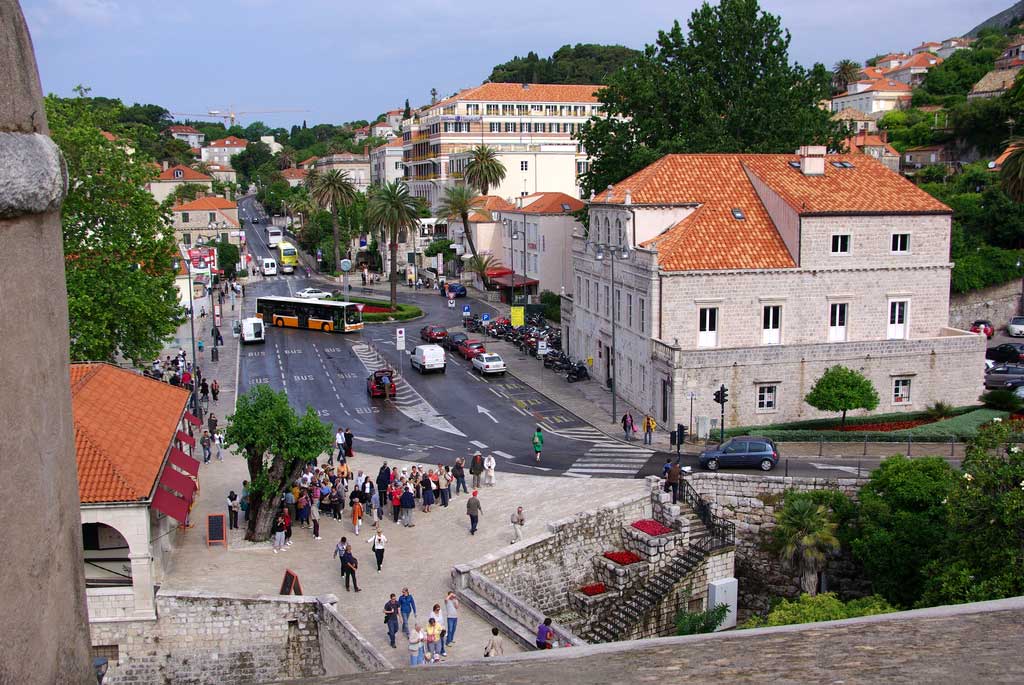
Dubrovnik Old Town (Stari Grad) is stunning, but it is a medieval city with cobblestones, slopes, and stair-heavy lanes. The easiest way to enjoy it with reduced mobility is to keep things simple: enter through the most practical gate for your location, stay on the main spine first, and choose a few step-free highlights rather than trying to cover every side street.
Most accessible entries and routes (Stradun first approach)
- Start with Stradun (Placa): Stradun is the main straight street through the Old Town and the most predictable "low-commitment" route for wheelchairs and limited mobility.
- Pile Gate (Vrata od Pila) is the most practical transport hub: If you arrive by bus or taxi, Pile Gate is usually the simplest entry because it connects directly to Stradun and sits by the main Old Town approach area.
- Ploče Gate (Vrata od Ploča) can be better if you are staying on the eastern side: If your hotel is in Ploče (near Banje Beach), entering from the east can reduce backtracking. Ploče Gate is often mentioned as an alternative entrance for the City Walls too (see City Walls entrances).
- Use a "main spine, then small detours" rule: Explore Stradun first, then only take side lanes when you can clearly see they are step-free and not too steep.
Common barriers: cobblestones, narrow lanes, steps, slopes
- Stone underfoot: Dubrovnik paving can be uneven, and polished stone can be slippery after rain. If the forecast is wet, keep your Old Town plan lighter.
- Steps appear fast: Many lanes branching off Stradun include short stair sets or steep staircases, even when the destination looks close on a map.
- Narrow passages and crowds: Width is not always the main issue - people density is. Crowds around gates and along Stradun can slow movement and make turning harder.
- Steep gradients: Even without stairs, some streets climb sharply. This is where a companion or pre-booked assistance can make the biggest difference.
Simple timing win: Visit Old Town early in the morning or later in the evening. Lower crowd levels often matter as much as ramps and slopes.
Recommended "wheelchair-friendly" Old Town loop (simple and realistic)
This route focuses on the easiest navigation first and keeps your "getting stuck by stairs" risk low. Adjust based on crowds and energy.
- Enter at Pile Gate and roll straight onto Stradun.
- Use Big Onofrio's Fountain as your easy meeting point (it sits right by the Pile end of Stradun).
- Stay on Stradun as your main corridor and treat side lanes as optional, not required.
- If you want a parallel street option: Ulica od Puča runs parallel to Stradun and can work as a short detour when conditions allow, but always check for steps and crowding.
- Pick one "east end" highlight near the cathedral and palace area, then turn back the same way to avoid stair traps. Good options include Dubrovnik Cathedral and Treasury, Rector's Palace, or the Aquarium (choose based on your energy and your access needs).
- Return along Stradun to Pile Gate for the most predictable exit.
City Walls: set expectations and choose a better viewpoint option
The Dubrovnik City Walls are iconic, but they involve many steps and narrow sections. If your priority is the classic panorama without the stair climb, plan for the Dubrovnik Cable Car instead and build your Old Town time around flatter routes.
If slopes or rough surfaces are hard for you: consider a private guide or accessible tour that keeps you on step-free routes and reduces decision fatigue inside the Old Town.
Accessible attractions and viewpoints
If you want the best experience with the least stress, focus on Dubrovnik attractions that are consistently described as accessible by official local sources, then build your day around one or two "must do" stops rather than trying to cover every historic building in one go.
Dubrovnik Cable Car and Srđ viewpoints
For many travellers with disabilities, the Dubrovnik Cable Car is the easiest way to get a "wow" panorama without a long climb. Official sources note adapted boarding ramps and an elevator at the upper station, plus accessible toilets, which makes this a strong alternative to stair-heavy viewpoints.
- Why it is a top pick: big views with step-free infrastructure compared to many Old Town heritage climbs.
- Good to know: crowds can be the biggest barrier in peak season. Aim for earlier or later visits for more space.
- Read more: Dubrovnik Cable Car (tickets, tips, accessibility)
Accessible cultural sights (officially noted examples)
- Dubrovnik Cathedral: wheelchair access is available via a ramp at the southern entrance. Dubrovnik Cathedral and Treasury
- Rector's Palace: can provide a transporter if necessary and with prior notice. Rector's Palace
- Aquarium: listed as accessible for wheelchair users. Dubrovnik Aquarium
Best practice: even when a sight is described as accessible, always confirm the exact entrance, lift access, and any temporary closures before you go. Historic buildings can have narrow doorways or short internal steps that change the "real" experience.
Museums: what is typically difficult and how to check ahead
Dubrovnik has excellent museums, but accessibility can vary a lot from one building to another, especially in the Old Town where many venues are in historic structures. If a museum is high on your list, contact them in advance and ask specific questions.
- Ask these questions: is there step-free entry, how wide is the narrowest doorway, is there a working lift (if the exhibition is upstairs), and is there an accessible toilet on site.
- Plan smarter: choose one museum that confirms step-free access, then pair it with an outdoor, flatter route (Stradun style) rather than stacking multiple indoor stops.
- Browse options: Museums in Dubrovnik
Accessible beaches and sea-access lifts
Dubrovnik is famous for its sea and sunsets, but many beaches are pebble or rocky with steps and uneven surfaces. If you are planning wheelchair accessible beach time in Dubrovnik, the most important thing is to choose locations with a realistic approach, and to confirm in advance whether a sea-access lift is installed and working that season.
Beaches with sea-access lifts (officially listed locations)
The Dubrovnik Tourist Board lists sea-access lifts for people with disabilities at the following locations (always confirm the current season setup before you go):
- Copacabana Beach (Dubrovnik)
- Mandrač Beach (Dubrovnik)
- Veliki Zaton (near Dubrovnik)
- Mali Zaton (near Dubrovnik)
- Koločep - Donje Čelo (Elaphiti Islands)
- Šipan - Suđurađ (Elaphiti Islands)
How to avoid a wasted trip: Lifts are typically installed for the swimming season and can be temporarily out of service. Before you go, check the latest official info from the Dubrovnik Tourist Board and, if possible, call the beach concession or your hotel for a same-day confirmation.
What to expect on Dubrovnik beaches (surfaces, access, facilities)
- Surface matters: pebble and stone can be tiring for walkers and difficult for small wheels. Some beaches have smoother access sections or concrete platforms, but it varies widely by location.
- Steps are common: even if you can reach the beach area easily, the final approach to the water may include steps unless there is a lift or a usable ramp.
- Facilities vary: accessible toilets, changing space, and shade are more likely near larger hotels and organized beach zones, but should never be assumed - confirm before you commit.
Tips for a smoother beach day
- Go early or late: less crowding makes moving, turning, and finding a comfortable spot much easier.
- Use the easiest base areas: beach zones in Lapad and Babin Kuk are often simpler for day-to-day mobility than the Old Town cliffs. Consider starting with Lapad Bay, Cava Beach, or Banje Beach and then decide what works best for you.
- Plan your transfer: book a taxi or transfer that can drop you as close as possible to the entrance you will actually use.
- Bring what helps: water shoes, sun protection, and extra drinking water can make a big difference, especially in peak summer heat.
More ideas: Beaches and parks in Dubrovnik
Where to stay: best areas and hotel considerations
For accessible travel in Dubrovnik, where you sleep matters as much as what you see. Many mobility issues on holiday come from the last 200 meters: steep streets, stairs to the entrance, or a "great location" that is only great if you can climb it. Aim for a base with flatter terrain, reliable transport links, and step-free access from street to reception.
Best areas for reduced mobility (terrain-first recommendations)
- Lapad (promenade and hotel zones): A popular choice for reduced mobility because it offers easier day-to-day walking and a flatter feel than the historic centre. Start your planning with Lapad Bay.
- Gruž (port and services): Useful if you want practical logistics (shops, port connections, and parking). The ferry port area is a transport hub; if you arrive by car or need easy drop-offs, see Gruž Port parking.
- Pile area (Old Town access without living inside it): If the Old Town is your main priority, staying closer to Pile Gate can reduce daily climbs and make taxi and bus access easier than accommodation deep inside the pedestrian zone.
Hotels: what to confirm (step-free entry, lift size, roll-in shower)
Do not book based on the word "accessible" alone. Confirm the specific features you need, ideally with real photos of the exact room and bathroom you will use.
Copy-paste checklist for hotels:
- Is there step-free access from the street to reception (no stairs at any point)?
- What is the narrowest door width on the route to the room (in cm)?
- Is there a lift, and what are the lift internal dimensions (in cm)?
- Is the shower roll-in (no lip/step), and is there a fixed or fold-down shower seat?
- Is there enough transfer space next to the toilet on the side I need?
- Can you share real photos of the entrance, bathroom, and shower (not stock images)?
As an example of the level of detail worth asking for, Hotel Lapad publishes accessibility specifics (including door width) in its FAQ. See Hotel Lapad FAQ and the listing page Hotel Lapad.
Private apartments: common pitfalls in Dubrovnik
- Hidden stairs: Many apartments have steps at the entrance or inside (split levels), even when photos look flat.
- Steep approach streets: A property can be "near Old Town" but still require a demanding uphill walk.
- Narrow bathrooms: Door widths and turning space are often the limiting factor, not just the bed.
- No on-site support: If something breaks (shower chair, lift access, door threshold), apartments may be harder to solve quickly than hotels.
If you want to browse options quickly, start here: Dubrovnik hotels and hostels in Dubrovnik.
Equipment rentals and local support services
Accessible travel in Dubrovnik is much easier when you sort equipment and support services before you arrive. Availability can be limited in peak season, so contact providers early, confirm what is included (delivery, fitting, deposits), and share exact details about your wheelchair and transfer needs.
Wheelchair rental options (officially listed)
- City Society of the Red Cross (Dubrovnik): The Dubrovnik Tourist Board lists wheelchair rental via the Red Cross. Phone: +385 20 418 810 and email:
This email address is being protected from spambots. You need JavaScript enabled to view it. . If you do not get a reply, the Red Cross also publishes an official contact email:This email address is being protected from spambots. You need JavaScript enabled to view it. . - Caritas of the Diocese of Dubrovnik: The Dubrovnik Tourist Board also lists wheelchair rental via Caritas (address: Vatroslava Lisinski 13a). Phone: +385 91 323 3925. Caritas also publishes additional contact options: +385 20 612 240 and email:
This email address is being protected from spambots. You need JavaScript enabled to view it. .
What to say when booking (copy-paste):
Hello, I would like to rent/borrow a wheelchair in Dubrovnik from [date] to [date]. I need [manual/powered] wheelchair. User height/weight: [ ]. I need [narrow seat/wide seat], and I will be staying at [hotel/address]. Do you offer delivery and pickup? What documents or deposit do you require? Please confirm availability and the exact pickup/delivery time.
Transporters for stairs (Old Town support)
Some historic Dubrovnik buildings and routes include unavoidable steps. In these cases, a stair solution can be useful:
- Institution-based help: The Dubrovnik Tourist Board notes that Rector's Palace can provide a transporter if necessary and with prior notice. See Rector's Palace.
- Private options (confirm availability): Some local providers have been listed as offering stair-climbing transporters. Because availability can change, always confirm directly with the provider before relying on this option.
Tourist information and accessibility planning support
If you need the latest local guidance, start with the Dubrovnik Tourist Board accessibility page and their wheelchair accessibility database/map. These resources help you plan easier routes and identify accessible facilities.
Medical clinics and pharmacies: plan for essentials
For health planning, keep it simple: know where to go if you need help, and carry the basics you cannot easily replace (prescriptions, charger parts for medical devices, spare batteries, and a short medical summary).
- Emergency number: Dial 112 for any emergency in Croatia.
- Local healthcare guidance: Use our Dubrovnik health guide for practical steps on clinics, hospitals, and pharmacies: Stay healthy in Dubrovnik. For general Croatia-wide guidance (insurance, emergency numbers, on-duty pharmacies), see Stay healthy in Croatia.
Practical essentials: toilets, parking, emergencies
This section is about the small details that can make or break an accessible day in Dubrovnik - where to find reliable toilets, how to handle parking and drop-offs near the Old Town, and what to do if you need urgent help.
Accessible toilets: where they are most likely
Public accessible toilets can be limited in historic centers, so plan your day around places that are more likely to have step-free restrooms and staff support.
- Dubrovnik Cable Car: Official local guidance notes the Cable Car has toilets for people with disabilities, along with ramps and an elevator. This makes it a good "reliable stop" on a day with viewpoints. Dubrovnik Cable Car
- Larger hotels and bigger attractions: If you are not staying in a hotel, it is still often the easiest place to find step-free access and a usable restroom (especially in Lapad and Gruž).
- Smart routine: Before you commit to a long route, do a quick "toilet check" - ask staff where the accessible toilet is and whether it is currently open.
Simple planning win: Build your day around "anchor stops" (hotel lobby, major attraction, viewpoint) where you know you can reset, hydrate, and use a restroom without stress.
Parking and drop-off strategy near key zones
The Old Town is largely a pedestrian zone, so the best approach is usually: park outside the historic core, then use an easy drop-off point or a short, flatter route into the center.
- Start with the parking hub: Use our overview to compare options and choose what fits your route and mobility needs. Dubrovnik parking
- Good "base" parking options to review:
- Old Town access point: For many travelers, the simplest entry is via Pile Gate, because it connects directly to Stradun and is a major bus and taxi approach area.
- If you have a disability parking card: Croatia follows EU-style reserved spaces. Only card holders may park in spaces marked for disabled parking, typically indicated with a wheelchair symbol. EU disability parking card - Croatia
Emergency basics: what to do if you need medical help
If you need urgent help in Dubrovnik, use the official emergency numbers below. The simplest rule is: call 112 and explain your location and the type of help needed.
Emergency numbers in Croatia:
112 - general emergency line
192 - police
193 - firefighters
194 - emergency medical assistance (ambulance)
195 - maritime search and rescue
1987 - road assistance
- For practical health guidance: see Stay healthy in Dubrovnik and Stay safe in Dubrovnik.
- Official reference: Emergency services in Croatia
Easier day trips near Dubrovnik (Cavtat, islands)
If you want a break from Old Town cobblestones and steep lanes, choose day trips that are naturally easier: flatter promenades, short distances, and simple logistics. Below are the best "access-first" options to consider, plus practical tips for ferries and tours.
Cavtat: why it is often easier for wheelchairs
Cavtat is a small seaside town south of Dubrovnik that many travellers find more manageable because it is compact and built around an easy waterfront rhythm. In practice, the promenade style seafront is usually the main reason it feels simpler than the Old Town.
- Best for: a relaxed half day with sea views, cafes, and short, predictable walking or rolling distances.
- How to plan it: go for the waterfront first, then add one extra stop only if the terrain feels good.
- Explore: Cavtat attractions and Cavtat beaches and parks
Island options: what is realistic for reduced mobility
Islands can be a great "slow travel" day, but the key variable is boarding and disembarking. If ferry access is workable for you, start with islands that have calmer ports and shorter distances from the dock to the main village area.
- Elaphiti Islands (closest and calm): Start with Elaphiti Islands. For planning, see Dubrovnik to Elaphiti Islands ferry guide.
- Koločep and Šipan (sea-access lift locations): Dubrovnik Tourist Board lists sea-access lifts on Koločep (Donje Čelo) and Šipan (Suđurađ). This can be a big advantage if sea entry is your priority.
- Lopud (popular day trip): Lopud is a common choice for a relaxed island day. Confirm the walking distance and surface from the dock to the exact beach or cafe you want, because "close on a map" can still feel long in the heat.
Lokrum: close to Dubrovnik, but not the easiest
Lokrum Island is very close to Dubrovnik and can work for some visitors with mobility limitations, but set expectations: the easiest area is near the harbour and monastery, while much of the island includes uneven paths, steps, and rocky terrain. Treat Lokrum as a short, selective visit rather than a full island hike day.
Ferries and boats: what to ask before you commit
Do not assume every vessel or dock is equally accessible. Ask these questions before you buy tickets, especially in peak season.
- Boarding: is there a ramp or step-free boarding option at the departure and arrival port for your specific sailing?
- Space on board: can you stay in your wheelchair safely, and is there room to turn?
- Toilets: is there an accessible toilet on board (many smaller vessels do not have one)?
- Assistance: if you need help boarding or disembarking, request it in advance. Jadrolinija states assistance is available for disabled passengers and persons with reduced mobility (ticketing, boarding, disembarking, and accommodation on board), and advises announcing your arrival by email to the agency in the departure port no later than the start of boarding.
Helpful references: Jadrolinija: passengers with disabilities and EU travel rights for reduced mobility.
Accessible tour operators: what to look for
If you prefer a guided day, the best accessible tours share a few traits: step-free vehicle access, realistic routing, and zero pressure to take stairs to "keep up."
- Vehicle: ramp or lift vehicle, and tie-downs if you stay in your chair.
- Route: planned for flat surfaces and short transfers, with an easy bathroom stop.
- Communication: they ask for your chair dimensions and your transfer ability before confirming.
More options: Day trips from Dubrovnik
FAQ: accessible travel in Dubrovnik
Is Dubrovnik wheelchair accessible?
Partly. Dubrovnik Old Town is medieval, so expect cobblestones, slopes, narrow lanes, and many stair-heavy streets. The easiest approach is to focus on the flattest Old Town corridor first - Stradun - and enter via Pile Gate, then add short detours only when you can clearly see they are step-free.
Which parts of Dubrovnik are easiest for reduced mobility?
Many travelers prefer areas with flatter promenades and better vehicle access rather than staying inside the Old Town pedestrian zone. Consider Lapad for day-to-day ease, Gruž for practical logistics, or the Pile area for simpler Old Town access.
Are there beaches with sea-access lifts in Dubrovnik?
Yes - official local guidance lists sea-access lifts at Copacabana and Mandrač (Dubrovnik), plus Veliki Zaton and Mali Zaton, and on the islands Koločep (Donje Čelo) and Šipan (Suđurađ). Always confirm the current season setup before you go, as installations and service status can change. Start with Copacabana Beach.
Do Dubrovnik buses accommodate wheelchairs?
Often, but not always. Many city buses are modern and low-floor, but accessibility can vary by vehicle and crowding. If you need guaranteed step-free access, keep a taxi or private transfer as a backup and plan routes with flexibility. See Getting around Dubrovnik.
How do I request airport assistance (PRM) at Dubrovnik Airport?
Request PRM assistance through your airline or travel agent in advance. Dubrovnik Airport guidance is to notify your airline at least 48 hours before departure and share details such as a battery-powered wheelchair, other equipment, or a guide dog if relevant. Use Arriving via Dubrovnik Airport for the exact checklist and transfer tips.
Can I rent a wheelchair or get local support services in Dubrovnik?
Yes. Official local guidance lists wheelchair rental options via the Dubrovnik Red Cross and via Caritas of the Diocese of Dubrovnik. Availability can be limited in peak season, so contact providers early and confirm delivery, pickup, and what is included. See Equipment rentals and local support services.
Official resources and reference links
Accessibility details can change (seasonal beach lifts, temporary works, vehicle availability). Before you travel, double-check the latest info using the official sources below.
Official Dubrovnik resources
- Dubrovnik Tourist Board - Information for persons with disabilities
- Accessible Dubrovnik map - Accessible tourism
- Dubrovnik Airport - Traveller guide
- Dubrovnik Airport - PRM accessibility info
Official Croatia and EU passenger rights
- Croatian Civil Aviation Agency - PRM rights (air travel)
- EU Regulation (EC) No 1107/2006 - PRM rights
- Croatia emergency services and numbers
Helpful guides on Absolute Croatia
- Stradun (Placa)
- Pile Gate
- Dubrovnik Cable Car
- Copacabana Beach
- Dubrovnik parking
- Stay healthy in Dubrovnik
- Stay safe in Dubrovnik
If you spot an outdated detail on this page (for example a seasonal lift that is not installed yet), please contact us so we can update it.