
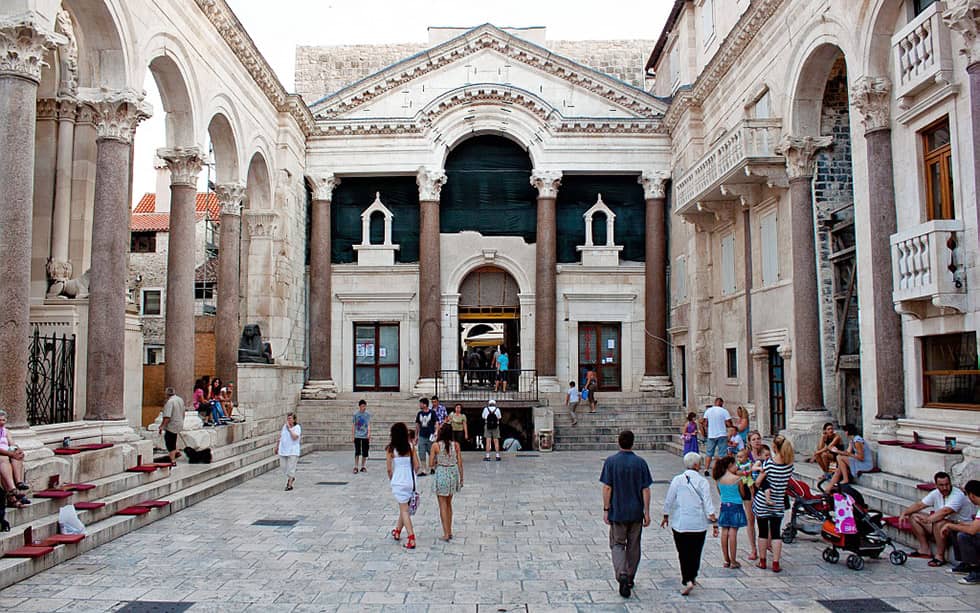
Peristil, also known as the Peristyle, is the monumental central square of Diocletian's Palace in Split. Built in the late 3rd and early 4th century as the ceremonial court of the imperial residence, it was where Emperor Diocletian appeared before his subjects. Today it remains one of the defining spaces within the UNESCO-listed Historical Complex of Split with the Palace of Diocletian, surrounded by the Cathedral of Saint Domnius, the Vestibule, the Sphinx and the nearby Temple of Jupiter.
Key Aspects of Peristil
- Historical role: Peristil was the ceremonial court of Diocletian's Palace, where the emperor appeared beneath the central part of the Protyron before his subjects.
- Architecture: Red granite columns, Roman arches and monumental stonework emphasized the imperial character of the square and framed the approach toward the emperor's apartments.
- Later history: After Split's new civic square, Pjaca, developed in the Middle Ages, Peristil increasingly became a religious centre around the former imperial mausoleum, now the Cathedral of Saint Domnius.
- Cultural life: Peristil remains one of Split's most important open-air performance spaces, used for opera, concerts and other cultural events.
Why Peristil matters inside Diocletian's Palace
Peristil is the space that best explains how Diocletian's Palace worked as an imperial residence. Ceremonial, religious and residential areas all met here, with the emperor appearing beneath the central arch of the Protyron as part of a carefully staged display of imperial power.
The red granite columns were not simply decorative. Their colour reinforced the ceremonial character of the square and its association with imperial purple. To the south, the Vestibule marked the approach to the emperor's apartments, while the former mausoleum on the eastern side later became the Cathedral of Saint Domnius.
Peristil also shows how Split grew directly into the Roman palace. Gothic and Renaissance palaces belonging to noble Split families such as Grisogono, Cipci and Skočibušić were built into the western side, using the surviving Roman columns and arches as part of later city architecture.
What to see at Peristil
Peristil rewards a slower look. The square is compact, but several layers of Split's history can be read from almost one spot.
The Protyron and red granite columns
The monumental Protyron formed the ceremonial entrance toward the imperial quarters. Diocletian appeared beneath its central section before assembled subjects, while the red granite columns reinforced the imperial symbolism of the setting.
The Sphinx
Among the square's most striking details is the black granite Sphinx beside the cathedral. Around 3,500 years old, it is one of the surviving Egyptian objects brought to the palace during Diocletian's reign.
The Cathedral and surrounding landmarks
Peristil stands beside the former imperial mausoleum, now the Cathedral of Saint Domnius, and at the junction leading toward the Vestibule and nearby Temple of Jupiter. Together they show how closely the palace's ceremonial and religious spaces were connected.
The medieval and Renaissance layers
Look beyond the Roman columns and you can also see how later Split adapted the palace rather than abandoning it. The buildings on the western edge include Gothic and Renaissance architecture integrated directly into the ancient structure.
Walking Tour of Split and Diocletian's Palace
Explore Peristil and the rest of Diocletian's Palace with a guided walking tour that adds context to what you see.
Your guide explains how the palace was built, how Peristil functioned as its ceremonial heart and how landmarks such as the Golden Gate, palace substructures and the Riva fit into Split's wider story.
Is Peristil worth visiting?
Yes. Peristil is one of the essential places to see inside Diocletian's Palace, even on a short visit to Split. In one compact square you can see Roman imperial architecture, an ancient Egyptian sphinx, the former mausoleum of Diocletian and later medieval and Renaissance additions.
It is also still part of everyday Split rather than a sealed archaeological site. People cross the square throughout the day, sit on its steps and return in the evening when the atmosphere changes completely.
Best time to visit Peristil
Early morning is the best time for a quieter look at the architecture and cleaner photographs, especially during the busy summer season. The square becomes considerably busier through the middle of the day as sightseeing groups move through Diocletian's Palace.
Evening offers a different experience. The stonework is dramatically lit, cafés and surrounding streets become livelier and Peristil sometimes functions as an open-air stage. Seeing the square once in daylight and once after dark is worthwhile if you are staying in Split for more than a few hours.
If you want a more detailed visit at your own pace, a private guide can help connect Peristil with the wider palace and point out architectural details that are easy to miss when simply walking through.
Split Private Walking Tour of Old Town & Diocletian's Palace
Explore Peristil and Diocletian's Palace with a private guide and more time for questions, history and architectural detail.
A private tour is particularly useful if you want to understand how the Roman palace developed into today's Split rather than simply follow a fixed sightseeing route.
What to do near Peristil
Peristil sits at the centre of one of the easiest sightseeing areas in Croatia to explore on foot. Start with the nearby Vestibule and Temple of Jupiter, then continue into the Diocletian's Palace Cellars to better understand the original layout of the imperial residence.
From there, walk toward the Riva, or head north through the palace toward the Golden Gate and the nearby Gregory of Nin statue.
Peristil today - events, performances and daily atmosphere
Peristil remains an active public space as well as one of Split's most important monuments. Its unusual acoustics and monumental setting have made it one of the city's best-known open-air stages.
The Split Summer Festival regularly uses Peristil for opera, theatre and concerts, continuing a long tradition of performances within the historic palace. Other cultural events also use the square, reinforcing the sense that Peristil still belongs to the living city rather than functioning only as a preserved Roman monument.
Even without a scheduled performance, the square changes character through the day: quieter in the morning, busy with sightseeing groups at midday and more atmospheric after sunset.
Practical tips for visiting Peristil
Peristil itself is an open public square and there is no ticket required to walk through it. Tickets are needed only for individual nearby attractions such as parts of the cathedral complex or other monuments.
Wear comfortable shoes because the old stone surfaces around Diocletian's Palace are uneven and can become slippery. In summer, early morning or evening avoids both the strongest heat and the busiest sightseeing periods.
Accessibility at Peristil
Peristil is in the pedestrian heart of Split Old Town. The square itself is relatively open, but the historic stone paving is uneven in places and surrounding routes and monuments may include steps, thresholds and narrow passages.
Visitors using wheelchairs or travelling with limited mobility should allow additional time and check access separately for the cathedral, Temple of Jupiter, cellars and other nearby attractions, since accessibility varies across the palace complex.
How to find Peristil in Split Old Town
Peristil lies at the ceremonial centre of Diocletian's Palace, beside the Cathedral of Saint Domnius and close to the Vestibule and Temple of Jupiter.
From the Riva, enter the southern part of the palace and walk inland toward the cathedral. From the Golden Gate, walk south through the palace streets. Split's historic centre is compact, so Peristil is only a few minutes on foot from the main palace entrances.
Peristil location map
Use the map below to find Peristil in the heart of Diocletian's Palace, a short walk from the Riva and other major sights in Split Old Town.
FAQ about Peristil in Split
What is Peristil in Split?
Peristil is the central ceremonial square of Diocletian's Palace and one of the most important surviving spaces from the Roman imperial complex.
Is Peristil free to visit?
Yes. Peristil is an open public square and can be visited freely. Nearby monuments and attractions may charge admission.
Where is Peristil located?
Peristil is in the heart of Diocletian's Palace in Split Old Town, beside the Cathedral of Saint Domnius and close to the Vestibule and Temple of Jupiter.
Peristil or Peristyle - which name is correct?
Both are used. Peristil is the Croatian name, while Peristyle is the common English form. Split Tourist Board uses both names in its English visitor information.
How much time do you need at Peristil?
You can walk through the square in a few minutes, but allow around 15 to 30 minutes if you want to study the architecture, take photos and visit nearby palace landmarks.