
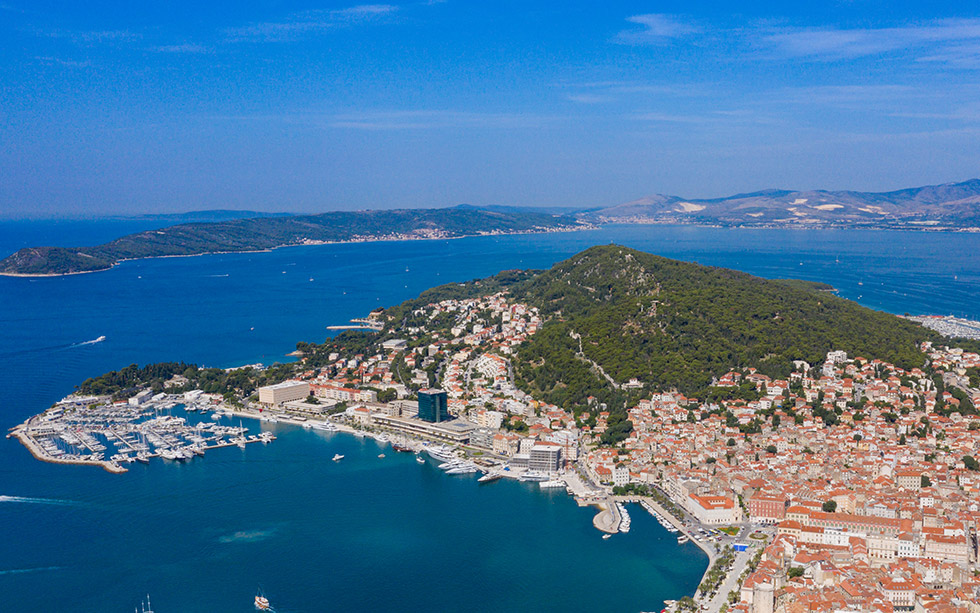
Marjan Forest Park is Split's main outdoor escape, a pine-covered peninsula immediately west of the historic centre with walking and cycling routes, panoramic viewpoints, historic churches, climbing cliffs and beaches, often called "the lungs of Split". Its highest point, Telegrin, reaches 178 metres above sea level and offers views across Split, the Adriatic islands and the nearby Kozjak and Mosor mountains.
Marjan is close enough to explore directly from the Riva promenade, yet large enough for anything from a one-hour viewpoint walk to a half-day hike followed by swimming at Kašjuni Beach.
Is Marjan worth visiting?
Yes. Marjan is one of the best places in Split for panoramic views, walking, running, cycling and combining sightseeing with a beach. It is especially useful when you want a break from the stone streets and crowds around Diocletian's Palace.
You do not need to reach the summit to enjoy Marjan. The lower viewpoints above Varoš already provide excellent views over Split, while visitors with more time can continue through the forest towards Telegrin, Sedlo, historic churches and the beaches on the southern and western sides of the peninsula.
Marjan Forest Park quick overview
- Highest point: Telegrin, 178 m above sea level
- Best for: Walking, viewpoints, cycling, running, climbing, history and beach combinations
- Best quick stop: Marjan stairs and Vidilica viewpoint
- Best high viewpoint: Telegrin or the Sedlo watchtower
- Best beach combination: Kašjuni Beach
- Entry: The forest park itself is free to enter
- Time needed: From about 1 hour for the lower viewpoints to half a day for a longer walk and beach stop
2-hours Split Segway Tour including Marjan Hill
Experience a convenient and efficient way to explore Split's top attractions in just a few hours with this small-group Segway tour.
Meet your guide, gear up with a helmet and safety vest, and familiarise yourself with the Segway. Once you're comfortable, embark on a journey along the scenic Riva promenade, delve into the historic Diocletian's Palace, admire notable landmarks such as the Croatian National Theatre, and ascend to Marjan Park for breathtaking panoramic views of the city.
Best things to do on Marjan
Marjan is not a single viewpoint or hiking trail. The peninsula combines forest paths, paved routes, viewpoints, small historic churches, beaches, recreational areas and cultural attractions.
Walk up to Vidilica viewpoint
The classic first stop is the viewpoint above the western edge of Split, reached by climbing the Marjan stairs from the Varoš side of the city.
This is one of the best options if you only have an hour. You get a wide view across Split's rooftops, harbour and surrounding mountains without needing to hike all the way to the summit.
Reach Telegrin, the highest point of Marjan
Telegrin is Marjan's highest point at 178 metres above sea level. Reaching it involves more walking than the lower viewpoints but rewards you with a broader panorama across the peninsula, city and sea.
The route is not a technical hike, but there are inclines, steps and uneven sections. Comfortable walking shoes are more useful than sandals if you plan to explore the higher parts of the park.
Visit the Sedlo watchtower
The reconstructed Sedlo watchtower stands at approximately 148 metres above sea level and provides another panoramic viewpoint over Split, Marjan and the surrounding coastline.
Unlike many of Marjan's historic paths and stairways, the watchtower has a lift and accessibility adaptations. Entry is free, although the tower has its own opening hours and can close during adverse weather.
Sedlo and Telegrin are different destinations: Telegrin is the natural summit of Marjan, while Sedlo offers an elevated purpose-built viewing platform.
Walk or run through the forest
Marjan is one of Split's main places for everyday walking, running and recreation. Paved roads and forest paths cross the peninsula, allowing visitors to choose anything from a gentle promenade to a longer route through the interior.
In summer, the forest provides welcome shade compared with exposed sightseeing in central Split, although longer climbs are still best tackled in the morning or late afternoon.
Cycle around Marjan
Marjan is also popular with cyclists and mountain bikers. Paved sections work well for recreational cycling, while more demanding forest routes appeal to riders looking for an off-road experience.
Pedestrians and cyclists share many parts of the park, so reduce speed around busy walking areas and viewpoints.
Rock climbing on Marjan
The limestone cliffs on Marjan's southern side have a long climbing tradition and are one of the unusual features of a park located so close to a major city centre.
Climbing routes around the Šantine Stine area range in difficulty. Visitors without suitable experience and equipment should use a qualified guide rather than attempting established climbing routes independently.
Best viewpoints on Marjan
| Viewpoint | Best for | Effort |
|---|---|---|
| Vidilica | Classic view over Split and the harbour | Short but steep climb from Varoš |
| Sedlo watchtower | High panoramic view with lift access | Easier when using park transport or the paved route |
| Telegrin | Reaching Marjan's highest point | Longer uphill walk |
| Southern Marjan viewpoints | Sea, cliffs and island views | Best combined with a longer walk |
Marjan walking routes
There are many possible routes through Marjan, so it is better to choose a walk based on how much time you have rather than trying to follow one compulsory itinerary.
Short Marjan walk: about 1 hour
Riva / Varoš → Marjan stairs → Vidilica → Church of St Nicholas → return.
This is the best route if you mainly want the famous view over Split and do not have time to explore the full peninsula.
Marjan viewpoints walk: about 2–3 hours
Vidilica → St Nicholas → forest paths → Sedlo / Telegrin → return through the park.
This gives a much better sense of Marjan's forest landscape and higher viewpoints without requiring a full-day excursion.
Half-day Marjan and Kašjuni route
Walk from the city through the lower Marjan viewpoints, continue across the peninsula and finish at Kašjuni Beach for a swim.
This is particularly good in warmer months because the beach gives the walk a natural endpoint. You can return towards central Split by bus, taxi or rideshare instead of retracing the whole route.
Historic churches and hermitages on Marjan
Marjan has been connected with Split's religious and cultural life for centuries. Small churches, chapels and hermitages are scattered through the peninsula, particularly along its southern slopes.
Church of St Nicholas
The small Church of St Nicholas dates from 1219 and is one of the easiest historic sites to include in a short Marjan walk. It stands above the city not far beyond the first viewpoints.
Church of Our Lady of Bethlehem
Higher on Marjan, the Church of Our Lady of Bethlehem forms part of the historic religious landscape of the hill and is believed to date from before 1500.
Church of St Jerome and the hermitage
The 15th-century Church of St Jerome is one of Marjan's most interesting historic sites. Nearby, a small hermitage is built directly into the rock face, illustrating how the southern cliffs were once used for secluded religious life.
Karepić Tower
Close to the St Jerome area is Karepić Tower, a defensive refuge dating from the early 16th century. It was built at a time when local inhabitants needed protection from raids and forms an unusual contrast with the surrounding forest and cliffs.
Other historic religious sites are scattered across Marjan, including the Church of St George near the western cape and remains associated with St Benedict around Bene.
Marjan Botanical Garden
The Botanical Garden on Marjan's southern slopes was founded in 1951 and covers roughly 2 hectares. It was originally developed for scientific research and education, with Mediterranean plants alongside species from other warm-climate regions.
After decades of decline, the garden underwent extensive restoration and reopened in 2025. Today it again functions as an educational botanical space connected with the University of Split, with a strong focus on Mediterranean flora.
The Botanical Garden is a useful addition to a longer Marjan visit, particularly for travelers interested in plants, ecology or quieter parts of the peninsula.
Split Zoo on Marjan
Split Zoo is a small zoological facility on Marjan. Its role has changed considerably from the traditional exotic-animal zoo described in older guides.
Today the zoo focuses mainly on domestic and indigenous Croatian animal breeds together with educational activities. It is best treated as an optional family stop rather than one of Marjan's essential attractions.
Museums around Marjan
The southern side of the peninsula also connects Marjan with several important cultural institutions.
The Meštrović Gallery is one of the most important, displaying the work of Croatian sculptor Ivan Meštrović in his former residence and gardens.
The Museum of Croatian Archaeological Monuments is also located beside Marjan, although it is temporarily closed during its current renovation project. Check its latest status before planning a visit.
Beaches around Marjan
One of Marjan's greatest advantages is the ability to combine walking or sightseeing with swimming. Beaches and rocky swimming spots surround much of the peninsula.
Kašjuni Beach
Kašjuni Beach is the best-known beach on Marjan's southern side. Its broad pebble bay, clear water and dramatic backdrop make it one of Split's strongest swimming beaches.
Kašjuni works particularly well as the final stop on a half-day Marjan walk.
Bene
Bene lies on the northwestern side of Marjan and has long served as a recreation and swimming area. Its wooded surroundings provide more natural shade than many exposed Split beaches, making the area particularly attractive during hot weather.
Southern Marjan swimming spots
Additional beaches and rocky swimming areas extend along the southern coast between central Split and Kašjuni. See our complete guide to Split's beaches when choosing where to swim.
Getting to Marjan from central Split
Walking from the Riva
The classic approach begins at the western end of the Riva promenade. Walk through the Varoš neighborhood towards the Marjan stairs and climb towards the first viewpoint.
This is the easiest route for first-time visitors because it connects directly with central Split and requires no transport.
Marjan Visitor Center
The Marjan Visitor Center is located at Trumbićeva obala 18, close to the base of the Marjan stairs. It provides information about the forest park, its natural environment, heritage and current visitor conditions.
The Visitor Center has its own opening hours, so check the current schedule if you specifically want to visit inside rather than simply beginning your walk nearby.
Electric bus through Marjan
An electric park bus provides another way to reach selected locations inside Marjan on operating days. Stops include areas around St Jerome, Sedlo, Telegrin and the Zoo.
The service is particularly useful for visitors who want to reach the higher parts of the park without completing the full uphill walk. Timetables can change, so check current Visitor Center or park information before relying on it.
Bus 12 and the Marjan beaches
City bus 12 is useful for reaching the beach side of Marjan, including Kašjuni. Current routes can be affected by road works and access changes around western Marjan, so check the latest timetable before travelling.
Driving to Marjan
Marjan is better explored on foot, by bicycle or using public transport than as a driving route. Vehicle access within the protected forest park is restricted, and parking close to the most popular beaches and entrances can be difficult during summer.
Accessibility on Marjan
Accessibility varies significantly across Marjan. The classic Marjan stairs, summit paths and many forest trails involve inclines, steps or uneven surfaces and will not suit every visitor with limited mobility.
The Sedlo watchtower is one of the most accessible high-viewpoint options because it has a lift and adapted visitor facilities.
Travelers who require a fully step-free route should plan around individual accessible facilities rather than assume the complete Marjan trail network is accessible.
Current Marjan access information
Road and path access around Marjan has been affected by reconstruction works during 2026. The northern route between Spinut Gate and the Institute of Oceanography and Fisheries reopened in May 2026, but construction has continued in parts of the area.
If you are planning a full loop around the peninsula rather than a simple walk from the city to the viewpoints, follow current signs and check park notices for temporary restrictions.
A short history of Marjan
Marjan has been connected with Split for centuries. Historical records show communal woodland on the peninsula in the medieval period, with documented protection of its vegetation dating back to 1219.
After centuries of human use and periods of deforestation, systematic reforestation during the 19th and early 20th centuries helped create the pine-covered landscape visitors recognize today.
Marjan was officially designated a protected forest park in 1964, while the peninsula later received additional protection as a cultural landscape.
Best time to visit Marjan
Spring and autumn are the best seasons for longer walks, with cooler temperatures and enough daylight to explore several parts of the peninsula comfortably.
During July and August, visit in the early morning or late afternoon if you intend to climb to the higher viewpoints. Forest sections provide shade, but uphill routes can still become very hot around midday.
Summer afternoons work well for combining a shorter Marjan walk with swimming at Kašjuni or another beach.
Winter is suitable for walking on dry days, although individual facilities can have shorter seasonal hours and strong wind or rain can make exposed viewpoints less pleasant.
How long do you need for Marjan?
- 45–90 minutes: Marjan stairs, Vidilica and St Nicholas.
- 2–3 hours: Add forest trails and one of the higher viewpoints such as Sedlo or Telegrin.
- Half day: Explore viewpoints, historic churches and the Botanical Garden.
- Half to full day: Combine a longer Marjan walk with Kašjuni or Bene beach.
You do not need to see the entire peninsula on a first visit. If your main goal is a panoramic photograph of Split, the lower viewpoints provide an excellent return for relatively little time.
Things to know before visiting Marjan
- Entry: Marjan Forest Park itself is free to access.
- Opening hours: The park does not have one universal attraction-style timetable; individual facilities have their own hours.
- Footwear: Comfortable walking shoes are useful if going beyond the lower viewpoints.
- Water: Carry enough during longer summer walks, particularly away from developed areas.
- Heat: Avoid long exposed climbs around midday in peak summer.
- Viewpoints: You do not need to reach Telegrin to get excellent views over Split.
- Accessibility: Many trails involve slopes and uneven terrain, while Sedlo provides a more accessible viewpoint option.
- Beaches: Marjan can easily be combined with Kašjuni Beach or other Split beaches.
- Current works: Check local signs and access notices if planning a complete circuit of the peninsula.
Marjan Forest Park features
Panoramic viewpoints, Walking trails, Cycling, Running, Rock climbing, Historic churches, Botanical Garden, Split Zoo, Kašjuni Beach, Bene recreation area, Sedlo watchtower
Address & contact details
Street: Marjan
Postcode: 21000
City: Split