
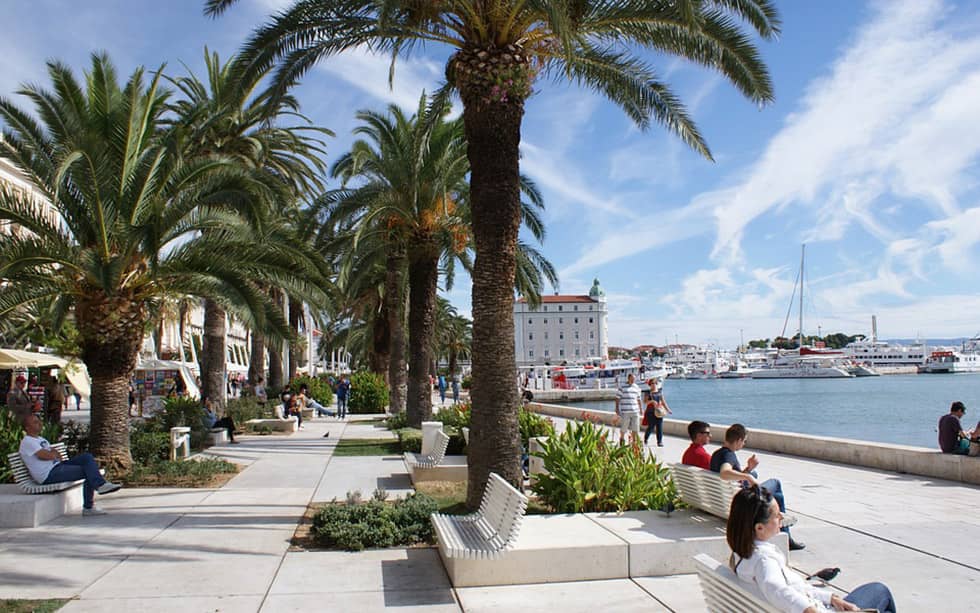
The Riva waterfront is one of the most attractive public places in Split and a huge part of the city’s social life, everyone wants to be seen on the Riva.
Riva in Split: quick facts
- What it is: Split’s main waterfront promenade and "living room", set right in front of Diocletian’s Palace.
- Where: Split Old Town waterfront (street: Obala hrvatskoga narodnog preporoda).
- Size: About 250 m long and 55 m wide (the central promenade space).
- Cost: Free - it’s a public promenade.
- Best for: Coffee culture, people-watching, harbor views, and an easy seaside stroll.
- Best time: Early morning for a calmer walk, or around sunset for the classic Riva atmosphere.
- How long to spend: 15-30 minutes for a simple walk, longer if you stop for a drink.
- Getting there: A short walk from the ferry port and main bus station area along the waterfront.
- Accessibility: Flat, wide, and paved - generally easy with strollers and wheelchairs.
What is Split’s Riva (and why everyone ends up here)
The Riva is Split’s main waterfront promenade, a palm-lined, pedestrian-friendly stretch where the city meets the sea, set right in front of Diocletian’s Palace. Locals often call it Split’s "living room" because it’s the most popular public place in town and the natural meeting point for just about everyone.
In practice, that means one simple thing: if you want to feel the pulse of Split, you come to the Riva. You’ll see locals stopping for a quick espresso, friends meeting before a night out, couples strolling by the harbour, and visitors taking their first "wow" photo of the old town facing the sea.
The Riva vibe: coffee culture, people-watching, and harbour views
The best way to experience the Riva is the simplest one, pick a café terrace, order a coffee (or a drink later in the day), and watch Split go by. The promenade doubles as a daily "korzo" (evening stroll) and also becomes the city’s open-air stage when public celebrations or events take over the waterfront.
Best time to visit the Riva
The Riva works at almost any time of day, but the atmosphere changes a lot depending on when you go. If you want the classic "Split vibe", aim for coffee hours or the evening stroll when the promenade feels like the city’s open-air living room.
Morning vs sunset vs evening atmosphere
Morning is usually calmer and perfect for a relaxed walk along the waterfront before the Old Town gets busy. Late afternoon and sunset are great for harbour views and photos, while evenings are when the Riva is at its liveliest and people meet up, café terraces fill up, and the promenade becomes the natural starting point for the night.
Peak season expectations (crowds, heat, and events)
In the high season, the Riva can feel very busy, especially in the evenings. You may also run into public events and celebrations on the waterfront. If you prefer a quieter experience, come earlier in the day, choose a weekday when possible, and plan your café stop a little outside the main sunset rush.
What to do on the Riva
The best thing about the Riva is that you don’t need a plan, it’s Split’s main promenade where the city naturally gathers. Whether you’re here for a quick espresso, a relaxed stroll, or your first waterfront photos of the Old Town, the Riva is the easiest place to "tap into" Split’s daily rhythm.
Have a coffee like locals do
Pick a terrace, order a coffee, and slow down. Sitting on the Riva is a local habit as much as a tourist activity, it’s all about watching the promenade, catching up with friends, and enjoying the view of the harbor.
Here are some tips to help you order the perfect coffee:
- Mild and milky: try "Bijela kava".
- Creamy with foam: order a "Cappuccino".
- Espresso with just a little milk (bigger drink): go for a "Veliki macchiato".
- Short and strong with a splash of milk: choose a "Macchiato".
If you’re looking for food too, start with our guide to restaurants in Split.
Stroll it as the perfect start point for Split’s Old Town
The Riva is right on the edge of the historic center, so it works perfectly as a "base". From here you can head straight into Diocletian’s Palace, or turn the walk into a simple Old Town loop via the Peristil and out through the Golden Gate to see the Gregory of Nin statue.
If you’d rather experience the Riva and the Old Town with local context (instead of just walking past the highlights), a private tour is one of the best upgrades you can make in Split. In a couple of hours you’ll connect the waterfront "living room" atmosphere with the stories behind Diocletian’s Palace, the Peristil, and the city gates - plus you can tailor the pace, photo stops, and food tips to your interests.
Split - -Private Walking Tour of Old Town & Diocletian's Palace
Private Walking Tour+Cellars Museum
Looking for an authentic deep-dive into Split’s past? This private walking tour is built for history lovers and led by licensed local guides. Because they’re Split natives with first-hand perspective on recent decades, you’ll get the kind of context and local detail you simply won’t pick up on a self-guided stroll.
On the route you’ll explore the medieval old town and the spectacular Palace of Roman Emperor Diocletian, with the option to include a visit to the Palace Cellars museum area - one of the best-preserved parts of the complex. As a private tour, it’s flexible: you can set the pace, ask questions freely, and go "behind the scenes" to experience Split through local eyes.
Harbor views, arrivals, and city events
Because the Riva faces Split’s port, it’s also a great place to watch ferries and boats come and go. Depending on the season, it can also turn into an open-air stage for public celebrations and cultural events, even when nothing special is happening, the “see and be seen” energy is part of the experience.
A short history of Split’s waterfront
Split’s Riva didn’t appear overnight. What you see today is the result of centuries of building, expanding, and redesigning the shoreline in front of Diocletian’s Palace.
The oldest notes of the waterfront date back to the 1st century BC. It consisted of a couple of piers, different dimensions and stone plateaus by the seashore. Afterwards, the first monumental waterfront was built under order of the emperor Diocletian. A large wall with a platform was built from Brač stone. The first serious constructions works started by the Venetian between 1450. and 1600. Those works were the base for further stretching of the waterfront.
-
Late 3rd-early 4th century: Diocletian’s monumental waterfront
Archaeological research describes a Roman-era coastal wall and platform built as part of the palace waterfront, constructed with carved stone from Brač.
-
Early 1800s: French rule and Marshal Marmont
According to Split’s Tourist Board, the Riva began taking its “modern” shape about two centuries ago during the French administration under Marshal Marmont.
-
19th century changes: reshaping the shoreline
Tourism sources note that Marmont removed older Venetian fortifications and used the material to extend the waterfront area, helping form the promenade’s western section.
-
2006-2007: contemporary redesign
The central pedestrian part of the Riva was rebuilt in the mid-2000s, giving the promenade its current clean, open look and reinforcing it as Split’s main public “stage” by the sea.
Want to connect the history on the ground? Walk from the waterfront into Diocletian’s Palace, then loop out via the Golden Gate and back to the Riva.
Where is the Riva promenade
Along the southern façade of Diocletian’s Palace
You’ll find Split’s Riva right on the Old Town waterfront, directly in front of Diocletian’s Palace. It runs along the seafront on Obala hrvatskoga narodnog preporoda (often simply called "Riva"), with palace walls and historic façades behind you and the harbour views in front of you. From here, it’s just a few minutes on foot into the palace area for sights like the Diocletian Palace Cellars, the Peristil, the Vestibule, and the Temple of Jupiter.
If you want to extend the walk, you can also reach Split’s most famous landmarks nearby, including the Golden Gate and the Gregory of Nin statue, as well as Prokurative and Marmont Street to the west.
What you’ll see on the promenade
The Riva is a wide pedestrian zone (around 250 m long and 55 m wide in its central section), lined with café terraces, palm trees, and open views of the port. It’s also directly next to Split’s ferry terminal, so many visitors end up here within minutes of arriving in the city.
Map: Riva promenade in Split
Tip: Zoom out to see how close the Riva is to Diocletian’s Palace and Split’s ferry port.
Easy walking routes from the Riva (nearby sights)
The Riva is the perfect “start point” for exploring Split on foot: the Old Town is directly behind you, and the promenade connects naturally to the port and seaside walks. If you want an easy plan, pick one of these simple routes and follow the links for details.
Old Town essentials loop (palace highlights)
- Diocletian’s Palace - step straight from the waterfront into Split’s historic core.
- Diocletian Palace Cellars - the atmospheric substructures near the waterfront entrance.
- Peristil - the iconic central square inside the palace.
- Vestibule - a dramatic interior space on the way through the palace.
- Temple of Jupiter - a compact but memorable Roman-era highlight.
- Sphinx in Split - a quick “did you know?” stop while you explore the palace area.
Gates and landmarks walk (classic photo spots)
- Golden Gate - the grand northern entrance to the palace.
- Gregory of Nin - one of Split’s most famous landmarks nearby.
- Silver Gate - an easy route back toward the palace’s eastern side.
- Iron Gate - a lively Old Town area and a good “loop” point.
- Brass Gate - brings you back toward the waterfront and the Riva.
West-side stroll (squares, cafés, and shopping street)
- Prokurative - the elegant square just west of the Riva.
- Marmont Street - Split’s main pedestrian street for an easy Old Town walk.
Seaside extension (beaches or greenery)
- Bačvice Beach - a popular sandy beach about 1.2 km from the Riva (great for a quick swim-day add-on).
- Firule Beach - continue a bit further along the coast for a calmer beach vibe.
- Marjan - head toward Split’s green escape for viewpoints and walking trails.
Want more ideas? Browse the full list of attractions in Split and build your own route. If you’d like to turn this simple walking route into a story-driven experience, consider booking a private Old Town tour. It’s an easy way to connect the dots between the Riva, Diocletian’s Palace highlights, and the city gates without missing the "hidden" details. You can set the pace and focus on what interests you most.
Walking Tour of Split and Diocletian's Palace
Want to see Split’s highlights with a guide who can bring the stones to life?
This small-group walking tour is a great way to uncover the stories and hidden details of Diocletian’s Palace while getting a clear, easy-to-follow overview of Split’s historic centre. Along the way you’ll explore key landmarks such as the Peristyle and the Golden Gate, and learn how the palace shaped the city you see today.
The route also includes the palace substructures and finishes with classic waterfront views around the Riva harbour, tying the Old Town to Split’s seaside atmosphere. With several departure times and a small group size, it’s easy to fit into your schedule and you’ll get more personal attention from your guide.
Riva and West Coast: continue the seaside walk
If you like the waterfront atmosphere and want to keep walking without leaving the sea views, continue west from the Riva toward Split’s West Coast promenade (Zapadna obala). It’s often described as the seaside continuation of the Riva, with a slightly calmer feel and great views of yachts and the marina.
West Coast (Zapadna obala) in a nutshell
- Seaside continuation of the Riva, about 623 m long.
- Paved in white Brač stone, with open harbor views.
- A popular stretch for a relaxed stroll, coffee stops, and boat-watching.
Keep going toward nature and beaches
If you want to turn your waterfront walk into a longer, scenic route, continue in the same direction toward Split’s green “escape” and the western beaches.
- Marjan - viewpoints, forest paths, and some of the best walks in Split.
- Kašjuni Beach - a beautiful beach option on the Marjan side.
Prefer to stay in the Old Town instead? From the Riva, it’s also easy to loop inland via Prokurative and Marmont Street.
Practical tips before you go
The Riva is easy to visit and hard to miss, it’s the Old Town waterfront promenade in front of Diocletian’s Palace. These quick tips will help you arrive smoothly and enjoy the walk comfortably.
How to get to the Riva
- From the ferry port: you can reach the Riva in just a few minutes on foot along the waterfront.
- From the main bus station / train station area: it’s a short walk (roughly 5-10 minutes) toward the Old Town and the sea.
- From Split Old Town: head toward the sea and you’ll naturally arrive at the Riva.
Accessibility and comfort
- Easy stroll: the Riva is wide, flat, and paved, so it’s generally comfortable with strollers and wheelchairs.
- Summer heat: bring water and sun protection, especially midday in peak season.
- Crowds: for a calmer experience, go early in the morning; evenings are the liveliest.
Safety (simple common sense)
- Watch valuables in crowds: the Riva and nearby Old Town streets can get busy, which is when pickpockets are most likely to operate.
- Keep it simple: carry your bag in front, don’t flash cash, and keep essentials in separate places.
- Emergency number: 112 works across Croatia.
Parking and taxis
- Old Town is pedestrian-friendly: driving right up to the Riva isn’t practical.
- Best approach: park outside the center (or use a garage) and walk in.
- If you have luggage: get dropped near the port/bus station side, then walk the last stretch along the waterfront.
Where to eat and drink near the Riva
Eating and drinking around the Riva is easy because you’re right on the edge of Split’s Old Town. The waterfront is perfect for a coffee or a drink with harbor views, while the small lanes just behind the promenade are where you’ll find more variety for lunch and dinner.
When we at Absolute Croatia put together our Split recommendations, these are a few places near the Riva we regularly suggest because we have visited them all and they consistently do well in customer reviews (ratings can change, so treat them as a helpful snapshot, not a guarantee).
Konoba Fetivi
A classic Dalmatian-style konoba choice when you want straightforward local cooking.
- Best for: traditional Dalmatian dishes and a more "local tavern" feel.
- Review snapshot: 4.5/5 on Tripadvisor (2,000+ reviews).
Villa Spiza
Small, popular, and known for a menu that changes often, focusing on what’s fresh.
- Best for: a simple meal in the Old Town when you’re okay with a bit of a wait.
- Review snapshot: 4.6/5 on Tripadvisor (1,800+ reviews).
Bokeria Kitchen & Wine
A stylish Old Town pick for a bigger night out (good food-and-wine vibe).
- Best for: a "special dinner" feel and a strong wine focus.
- Review snapshot: 4.5/5 on Tripadvisor (4,500+ reviews).
Uje Restaurant (Uje Oil Bar)
A good Old Town option when you want a quick sit-down meal close to the palace area.
- Best for: a casual lunch/dinner stop between sightseeing.
- Review snapshot: 4.2/5 on Tripadvisor (1,400+ reviews).
Pizzeria Galija
A reliable choice when you just want pizza/pasta without overthinking it.
- Best for: an easy, no-fuss meal close to the center.
- Review snapshot: 4.0/5 on Tripadvisor (800+ reviews).
O&'š Kolač
A strong dessert stop for cakes and pastries when you want something sweet after your Riva walk.
- Best for: dessert + coffee in the Old Town.
- Review snapshot: 4.9/5 on Tripadvisor (130+ reviews).
For more options and styles, see our full guide to restaurants in Split.
Where to stay near the Riva
If you want to be close to Split’s main waterfront promenade, the best strategy is simple: stay in (or just next to) the Old Town. The Riva sits right by Diocletian’s Palace and the port area, so a central base makes sightseeing, restaurant-hopping, and day trips much easier.
Old Town and Diocletian’s Palace (closest to the Riva)
Best if you want to walk everywhere and be minutes from the promenade, sights, and nightlife.
- Best for: first-time visitors, short stays, early ferry trips, and sightseeing-heavy itineraries.
- Good to know: it can be lively at night, and some places have stairs or limited parking access.
- Browse: hotels in Split
Veli Varoš and the Marjan edge (walkable and more local)
A great pick if you want a quieter feel while still being within an easy walk of the Riva and the Old Town.
- Best for: couples, longer stays, and travellers who prefer a calmer base.
- Bonus: you’re well placed for Marjan walks and viewpoints.
- Browse: villas in Split
Bačvice (beach-side, still close to the center)
If you want a beach walk built into your day, Bačvice is a popular option that still keeps you within reach of the Riva.
- Best for: beach time, families, and travelers who want a pool/hotel-style stay.
- Nearby idea: combine with Bačvice Beach.
- Browse: hotels in Split
Budget-friendly base near the center
If you’re visiting Split on a tighter budget, staying in a hostel close to the Old Town is an easy way to keep the Riva walkable.
- Best for: solo travelers, short trips, and social stays.
- Browse: hostels in Split
Recommended picks from our Split hotel list
FAQ: Split Riva promenade
Is the Riva promenade free to visit?
Yes. The Riva is a public waterfront promenade and there’s no entrance fee. You only pay if you stop at cafés, restaurants, or book tours nearby.
Where exactly is the Riva in Split?
The Riva is the Old Town waterfront promenade in front of Diocletian’s Palace, on the street Obala hrvatskoga narodnog preporoda.
How long does it take to walk the Riva?
It’s a short, easy stroll. Most people walk the Riva in about 20-30 minutes (longer if you stop for coffee or photos).
Is the Riva wheelchair and stroller friendly?
Generally yes: it’s wide, flat, and paved. Keep in mind that some Old Town lanes just behind the promenade can be more uneven than the waterfront itself.
What’s the best time to visit the Riva?
Go in the morning for a calmer walk and easy photos, or come later in the day for the classic Riva vibe when café terraces fill up and the promenade feels like Split’s social “living room.”
Which attractions are closest to the Riva?
The closest sights are all in and around the palace area. From the Riva you can quickly reach Diocletian’s Palace Cellars, the Peristil, the Temple of Jupiter, and the Vestibule. For classic landmarks, walk to the Golden Gate and the Gregory of Nin statue.
Can you swim at the Riva?
The Riva is a promenade, not a swimming spot. If you want a beach walk or a swim, head toward Bačvice Beach.
Is the Riva safe at night?
It’s one of the busiest public areas in Split, especially in the evening. Like in any crowded tourist zone, keep an eye on valuables (pickpockets tend to target busy promenades and squares).
Where should I go after the Riva?
For an easy Old Town loop, head inland to Peristil and back out via the gates. For cafés and shopping streets, walk west to Prokurative and Marmont Street. For food ideas nearby, see restaurants in Split.
Do I need a plan to visit the Riva?
Not really. The “classic” Riva experience is simply: stroll the waterfront, grab a coffee, and use it as your starting point for Split’s attractions.