
Split Train Station is the main railway station in Split and the city's practical rail gateway for travellers arriving from Zagreb and other inland connections. Its biggest advantage is not scale but location, the station sits in the central waterfront transport zone, right beside the Main Bus Station and close to the Ferry Port, Riva waterfront and the entrance to the Old Town, which makes onward travel in Split relatively straightforward.
For most visitors, the station is best thought of as a simple, functional hub rather than a major European rail terminal with extensive services. That matters when planning your journey: rail travel to Split can work well if you are coming from Zagreb or connecting through the Croatian rail network, but once you arrive, the real convenience comes from how easily you can continue on foot, by bus, by ferry or by taxi. This guide covers what to expect at Split Train Station, how to buy tickets, where to go next and which details are worth checking before you travel.
Split Train Station short facts
- Official address: Obala kneza Domagoja 9, 21000 Split
- Location: Next to the main bus station and in the same harbour zone as Split ferry port
- Walk to the Old Town: About 650 m, usually around 7-10 minutes on foot
- Ticket office hours: Every day from 6:10 am to 9:40 pm
- Tickets: Domestic tickets can be bought online, at the station, at the ticket vending machine in Split, or on the train - but onboard fares are 10% higher
- Useful contact: HŽPP information line +385 (0)60 333 444
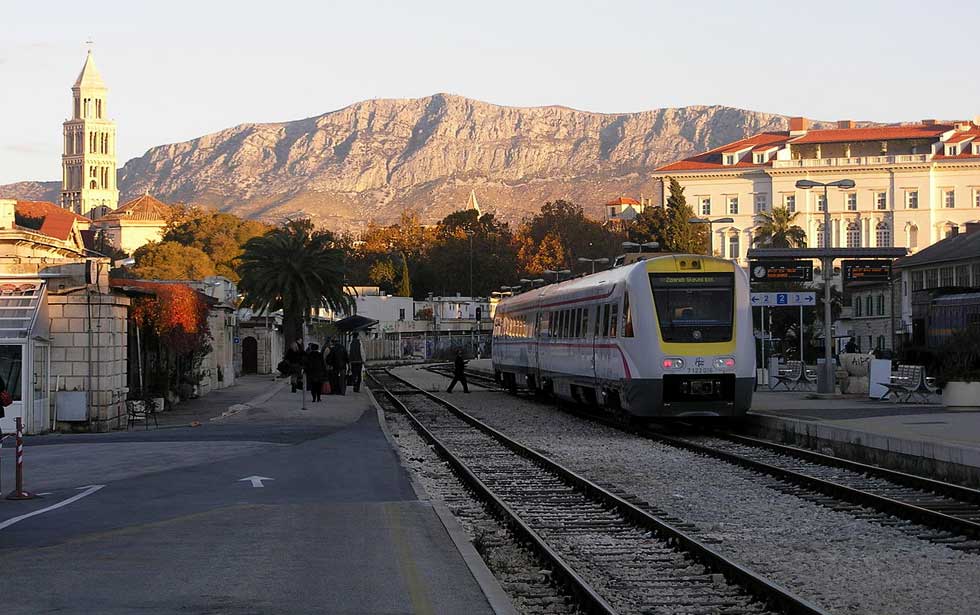
What to expect at the Train Station
Station size, layout and general atmosphere
Split Train Station is relatively small and easy to navigate, which is helpful if you are arriving with luggage or changing quickly to another form of transport. Most travellers use it as a straightforward arrival and departure point rather than as a station where you would want to spend a long wait.
The main advantage here is location, not scale. The station sits in the central port area beside the bus terminal and near the ferry port, so it works best as a practical transfer hub with a short path to onward connections rather than as a large railway complex with extensive in-house services.
Ticket office hours and current contact details
- Ticket office hours: every day from 6:10 am to 9:40 pm
- Station address: Obala kneza Domagoja 9, Split
- Rail information line: +385 (0)60 333 444
- Timetable and ticket inquiries:
This email address is being protected from spambots. You need JavaScript enabled to view it. - Practical tip: check the latest timetable before you travel, especially if you are planning a same-day onward connection
Facilities nearby: toilets, waiting area, food, ATMs and luggage options
Official railway information for Split focuses mainly on ticketing and luggage services, so it is best to expect a basic station setup rather than a full-service terminal. If you need a wider choice of food, coffee or travel errands, the surrounding port area is usually more useful than the station building itself.
- Luggage lockers: HŽPP confirms small, medium and large wardrobe lockers at Split station
- Locker prices: EUR 2 for small or medium and EUR 3 for large, for every 24 hours started
- Ticket vending: domestic tickets can also be bought from the ticket vending machine at Split station
- Nearby services: the wider bus-and-ferry zone around the station is the better place for extra traveller services
Accessibility and travelling with heavy bags
HŽPP provides free assistance to passengers with disabilities and reduced mobility when boarding, leaving the train and travelling, but it asks for notice at least 24 hours before the trip. If you know you will need help at Split Train Station, it is best to arrange it in advance instead of relying on same-day assistance.
For most other travellers, the station is manageable because the key onward links are close together. Even so, the port area can feel crowded in summer, so if you are carrying several suitcases, travelling with children or moving on to the islands, allow a little extra time to walk between the station, the main bus station and Split ferry port.
Tickets, Timetables and Main Train Routes
How to buy tickets online, at the station or from machines
Buying tickets for Split Train Station is straightforward, but the best option depends on how fixed your plans are. If you already know your travel date, booking in advance through HŽPP is usually the simplest choice because domestic e-tickets can be bought online or in the mobile app and shown on your phone.
- Online or app: usually the best choice for domestic tickets and basic journey planning
- Ticket office: useful if you want in-person help or need to sort out a more specific rail journey
- Ticket vending machine: available at Split station for domestic travel tickets
- On the train: possible, but less attractive because onboard fares are higher than ticket office prices
- Good to know: online tickets are cheaper than counter prices, so last-minute station purchases are not always the best-value option
For current departures, always check the official HŽPP timetable before you travel. The rail timetable changes by season and can be amended during the timetable year, so it is better to confirm your exact train than to rely on an older blog post or static route summary.
Split to Zagreb: what travellers usually choose
The main long-distance route most travellers care about from Split is the train to Zagreb. This is the core rail connection from the city, and it is the one that makes the most sense if you want to travel between central Croatia and the Dalmatian coast without driving.
In practical terms, the Split to Zagreb train is best for travellers who want a direct rail journey and are comfortable planning around the timetable rather than expecting frequent departures through the day. HŽPP currently runs daytime services on this corridor, with additional overnight or limited-season options depending on the part of the year, so the exact pattern should always be checked for your travel date.
Other realistic rail connections from Split
Beyond Zagreb, rail travel from Split is possible, but it becomes more specialised and less plug-and-play for most visitors. If you are heading toward Sibenik by rail, the normal pattern is to change at Perkovic rather than expect a simple direct city-to-city service from Split.
Rijeka and Pula are also possible in the Croatian rail network, but these are not usually the first routes international visitors choose from Split unless they specifically want a rail journey. For broader planning, it is better to treat Split as a useful rail gateway to inland Croatia and selected connecting routes, not as a station with a wide menu of fast coastal train services.
No direct train to Dubrovnik: best alternatives
If your real destination is Dubrovnik, Split Train Station works better as a transfer point than as the final rail solution. Dubrovnik is not connected to the active Croatian passenger rail network, so onward travel from Split has to continue by another form of transport.
- By bus: the easiest overland option from the station area, since the main bus station is right beside the railway station
- By ferry: useful only for specific island or seasonal onward routes, starting from Split ferry port
- By air: worth considering if you are combining rail with a flight via Split Airport
- For broader rail planning: see our Split train guide
If you are searching for a rail station in booking tools or route planners, watch the station names carefully. HŽPP lists both Split and Split Predgrađe separately, and for most visitors heading to the port, ferries, Riva or the Old Town, the main Split station is the one that matters.
Trains run between Split and Zagreb, and between Split and Perković for onward connections toward Šibenik, but the exact pattern depends on the timetable period, so it is best to check the current HŽPP schedule before you travel. In the main timetable, Split-Zagreb is usually served by two daytime trains, with additional seasonal or night services on some dates, while Split-Perković is primarily useful as a shorter regional connection rather than a major long-distance route.
Journey times are typically around 7 to 8 hours for Split to Zagreb, depending on the service, and about 1 hour to 1 hour 30 minutes for Split to Perković. As a rough guide, Split-Zagreb tickets are often around EUR 15-28 one way in 2nd class, plus any required reservation, while Split-Perković is usually around EUR 4-5 one way. Prices can change by service and purchase channel, so check the official HŽPP website for the latest timetable and fare before booking.
Split-Zagreb or Zagreb-Split train tickets
The fastest trains from Split to Zagreb take around 6 hours and 8 minutes, covering a distance of approximately 259 kilometres.
See availability and pricesTravel to Split by train from anywhere across Europe
Transfers From Split Train Station
To the main bus station
The easiest transfer from Split Train Station is to the main bus station, because the two sit side by side in the same central port zone. For most travellers, this is less a transfer and more a short walk with luggage, which is one of the main reasons the station is convenient even though rail services themselves are limited.
If you are continuing inland or south along the coast, you can move directly from the train station to the main bus station without needing a taxi. This is the most practical next step for travellers heading onward to places that are not connected by train, including Dubrovnik and many smaller Dalmatian destinations.
To the ferry port
Split ferry port is also in the same waterfront transport zone, so the transfer from the railway station is simple and usually done on foot. If you are continuing to Brač, Hvar, Vis, Šolta or another island, arriving by train into Split is straightforward because you do not need to cross the city to reach the harbour.
The walk is short, but in high season it can feel slower than it looks on a map because the whole area around the port, bus station and waterfront gets busy. If you have a ferry to catch, especially with heavy bags or children, it is worth allowing extra time rather than assuming the transfer will take only a few minutes. For the next leg, see our Split ferry port guide.
To Split Airport
There is no dedicated rail-to-airport transfer directly from the platforms, so the practical approach is to leave the station and continue from the adjacent bus-and-port area. Split Airport confirms that an airport shuttle bus between the airport and Split operates throughout the day, which makes this the simplest option for many travellers who want a direct connection rather than a local bus with more intermediate stops.
- Official airport shuttle: useful if you want the most direct airport transfer from central Split
- Public airport bus: Promet Split lists the Split-Airport trip at about 50 minutes
- Public bus fare: Promet Split currently lists the Split-Airport fare at EUR 3.00
- Planning tip: check the latest airport transfer timetable before travel, especially if you have an early flight or a tight rail connection
For broader flight planning, transfer context and airport options, see our Split Airport guide.
To accommodation in the city centre
If your accommodation is in or near the Old Town, Diocletian's Palace or the Riva area, walking is often the easiest option from Split Train Station. The station is central enough that many first-time visitors do not need a taxi for the final stretch.
If you are staying farther away in neighbourhoods outside the historic core, a local bus, taxi or app-based ride usually makes more sense than walking with luggage through the busy port area. For a broader overview of where different areas sit in relation to the station, use our Split travel guide.
Location of Split Train Station
Address and exact location in the port zone
Split Train Station is at Obala kneza Domagoja 9, in the City Port waterfront zone that most visitors use when arriving in Split by public transport. In practical terms, this puts the station in one of the most convenient arrival areas in the city, because the rail platforms, the Main Bus Station and the Ferry Port all sit in the same central transport cluster rather than in separate parts of town.
This location matters more than the station building itself. If you are continuing to the islands, changing to a long-distance bus or heading into the historic centre, you usually do not need a complicated transfer , you simply arrive in the port area and continue from there.
Walking distance to Riva, Old Town and Diocletian's Palace
For most travellers staying in or near the centre, Split Train Station is within easy walking distance of the main sights. The Riva promenade, the edge of Diocletian's Palace and the Old Town are all close enough to reach on foot with standard luggage, although the route can feel slower in peak summer when the waterfront and palace entrances are crowded.
- Riva promenade: a short, straightforward walk from the station
- Old Town and Diocletian's Palace: roughly 650 m away for most walking routes
- Best use case: ideal if you want to arrive centrally without needing an immediate taxi
How it connects with the bus station and ferry port
One of the biggest advantages of Split Train Station is how easily it connects with other transport. The main bus station is right beside the station, while Split ferry port is in the same harbour zone a short walk away. If you are arriving from Zagreb and continuing to an island, this is one of the easiest intermodal connections in Croatia.
The same central position also helps if you are coming from Split Airport, since airport transfers usually bring passengers into the main bus-station area rather than to a separate rail terminal. For a broader city overview before you travel, see our Split travel guide.
Split train station contact information
Address: Obala Kneza Domagoja br.9, 21000 Split, CROATIA
Arrival and Departure Tips
How early to arrive
For a normal rail departure from Split, you usually do not need to arrive especially early because the station is small and easy to understand. In most cases, arriving around 20 to 30 minutes before departure is enough if you already have your ticket and are not dealing with a complicated connection.
- Already have your ticket: around 20 to 30 minutes is usually comfortable
- Need to buy at the station: give yourself extra time, especially in summer
- Best value: buy online in advance where possible, because online fares are lower than counter fares
- Avoid onboard purchase: tickets bought on the train cost more than tickets bought before boarding
If you are arriving by train and continuing to a ferry, be much more cautious with timing. Jadrolinija recommends being at the port at least 45 minutes before departure, and for some summer sailings it advises arriving even earlier, so do not assume a tight train-to-ferry transfer will always feel comfortable in peak season. See Split ferries.
What to do if you have time before departure
If you have some time before your train leaves, Split is one of the easier Croatian cities to handle because the station is already in the central waterfront zone. You can walk to the Riva, the edge of Diocletian's Palace and the Old Town without needing extra transport, which makes a short wait in Split much more pleasant than waiting inside the station itself.
- For a short wait: stay close to the station and use the waterfront area for coffee or a quick break
- For a longer wait: walk into the centre and explore the area around the Riva and the Palace entrance
- Before heading back: recheck your platform, ticket and timetable rather than relying on memory
- Useful planning pages: Split travel guide and Split ferry port guide
Peak-season crowd and luggage strategy
The station itself is manageable, but the wider port area can become slow and crowded in summer because trains, buses, ferries, airport transfers and city arrivals all feed into the same waterfront zone. That does not make the station difficult to use, but it does mean that walking times with luggage often feel longer than they look on a map.
- Travel light if possible: the whole station-to-port area is easier with compact luggage
- Build in buffer time: especially if you are changing from train to ferry or airport transfer
- Use station lockers if needed: helpful if you want to spend time in the centre before departure
- Do not cut it too fine: summer crowds around the bus station and ferry port can slow you down
If you are travelling onward the same day, think of Split Train Station as a good central hub, but not one where you should gamble on very tight connections. A little extra buffer makes the whole journey much less stressful.
Split Main Station vs Split Predgrađe (Kopilica)
Which station most travellers actually need
If you are booking a train to Split as a visitor, the station you usually want is the main Split station at Obala kneza Domagoja 9. This is the central waterfront station beside the bus terminal and close to the ferry port, Riva and the Old Town, so it is the most practical arrival point for almost anyone staying in the city centre or continuing onward by bus or ferry.
By contrast, Split Predgrađe is a separate station in another part of the city. It is still part of the Split rail network, but for most tourists it is not the default choice because it does not place you directly in the port-and-historic-centre zone that makes the main station so convenient.
When Split Predgrađe matters
Split Predgrađe can matter if your accommodation or onward plans are better aligned with that side of the city, or if your journey planner specifically offers it as a useful stop on a regional or suburban connection. In practical travel terms, though, it is more of a secondary station than the main arrival point most first-time visitors are looking for.
- Choose Split main station if: you want the easiest access to the centre, ferries, buses and the waterfront
- Consider Split Predgrađe if: your destination is outside the port area or a rail connection specifically uses that station
- Main station advantage: daily ticket-office hours and the strongest onward transport connections
- Predgrađe difference: a separate station with more limited office hours and a less central location
If you are unsure which station to use, keep it simple: for most travellers heading into the city, the harbour, or the islands, the main Split station is the right choice. For broader arrival planning once you get off the train, see our Split travel guide and Split ferry port guide.
Useful Internal Links for Planning the Next Step
One of the strengths of this page is that Split Train Station sits inside a wider transport cluster, so readers often need one more practical page after this one rather than a longer station explanation. Linking clearly to the next likely step helps both users and SEO by turning this page into a stronger hub for rail arrivals, onward transfers and city planning.
- Train travel in Split - broader rail planning, routes and connections
- Split main bus station - best next step if you are continuing by coach
- Split ferry port - essential for island departures from the same waterfront zone
- Split Airport - useful if you are combining rail and air travel
- Split travel guide - city overview, local context and practical planning
- Parking in Split - relevant if someone is meeting you by car or switching transport modes
FAQ About Split Train Station
Where is Split Train Station?
Split Train Station is at Obala kneza Domagoja 9, in the central port area beside the main bus station and close to the ferry port, Riva and the Old Town. For most visitors, it is the most practical rail arrival point in the city because the main onward transport links are all grouped in the same waterfront zone.
Can you buy train tickets at Split Train Station?
Yes. HŽPP lists a staffed ticket office at Split station, and domestic tickets can also be bought online, in the HŽPP mobile app, at the ticket vending machine in Split, and on the train. Buying before boarding is usually the better option because online tickets are cheaper than ticket-office fares and onboard fares are higher.
Is there a ticket machine at Split Train Station?
Yes. HŽPP confirms that Split is one of the stations with a ticket vending machine for domestic travel tickets. That makes it a useful backup if you prefer not to queue at the counter, although online booking is still the simplest option for many travellers.
How early should I arrive at Split Train Station?
Because the station is small and easy to use, around 20 to 30 minutes before departure is usually enough if you already have your ticket. Give yourself more time if you need to buy tickets at the station, store luggage, or connect onward to a ferry during the busy summer season.
Are there daily trains between Split and Zagreb?
Yes, but the exact pattern depends on the timetable period. The core route is Split to Zagreb, with daytime services in the main pattern and additional seasonal or overnight options on some dates, so it is best to check the official HŽPP timetable for your exact travel day.
Can you travel from Split to Šibenik by train?
Yes, but not usually as a simple direct city-to-city train from Split. HŽPP notes that passengers travelling to or from Šibenik normally change trains at Perković, so it is better to think of this as a connecting rail journey rather than a straightforward direct service.
Is there a train from Split to Dubrovnik?
No. Dubrovnik is not connected to the active Croatian passenger rail network, so you cannot continue there by train from Split. If Dubrovnik is your next stop, the practical alternatives are bus, ferry on relevant routes, or a flight via Split Airport.
Is Split or Split Predgrađe the right station for most travellers?
For most visitors, the correct station is the main Split station, not Split Predgrađe. The main station is central, beside the bus station and close to the ferry port, while Split Predgrađe is a separate station with a less central location and more limited ticket-office hours.
Are there luggage lockers at Split Train Station?
Yes. HŽPP confirms wardrobe lockers at Split station in small, medium and large sizes. They are useful if you want to spend a few hours in the centre before departure instead of carrying luggage through the port area.