
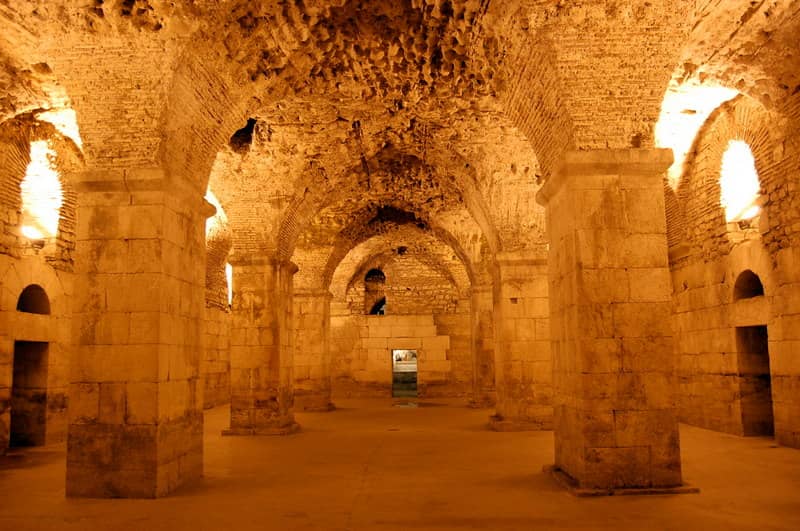
The Cellars of Diocletian’s Palace, also known as the Basement Halls or Substructures, are the vast vaulted rooms beneath the Emperor’s apartments in the southern part of the palace. They are one of Split’s top historical attractions because the underground layout mirrors the rooms above, making it easier to understand how the Roman palace was designed.
In the early Middle Ages, part of the substructures was used as a residential area, and in one of the halls parts of an ancient oil and wine press were found.
Today the cellars are accessible through the Bronze (Brass) Gate from the Riva, or via a staircase down from the Peristyle. The western halls were opened to visitors earlier, while the eastern halls were cleared and opened later after extensive restoration, and a large part is now accessible.
Important planning note: you can freely walk the streets and squares of Diocletian's Palace, but entry rules for the cellars and the full sightseeing route depend on the managed visitor area. Always check the official ticket and opening-hours listing before you go.
Cellars of Diocletian's Palace quick overview
- What it is: Roman-era substructures (cellars) built to support the Emperor’s chambers above and used for storage.
- Where it is: Inside Diocletian’s Palace in Split’s Old Town, directly between the Riva waterfront and the Peristyle.
- Main entrance: From the Riva through the Bronze (Brass) Gate (Porta Aenea, also called the Brass Gate) or via stairs down from the Peristyle.
- Tickets: Check current ticketing and entry rules on the official listing (prices and hours can change).
- Time needed: 20-30 minutes for a quick look, 45-60 minutes for an unhurried visit.
- Best time to visit: Early morning or later in the afternoon for fewer crowds, especially in peak summer.
- Good to know: It is usually cooler underground than outside, so comfortable shoes are a good idea.
If you want to get the most out of your time in Split, consider joining a guided tour that includes the Palace Cellars and continues through the Peristyle, Vestibule, and key palace streets, often adding highlights like the Cathedral of Saint Domnius area, the Golden Gate, and a short walk along the Riva. A good local guide can quickly explain what you are seeing, point out details you would otherwise miss, and help you follow a logical route so you cover more of the Old Town without backtracking.
Split - Private Walking Tour of Diocletian's Palace & Old Town
Want to cover the highlights of Split fast, with real historical context?
This private walking tour focuses on Diocletian’s Palace and the Old Town, led by a licensed local guide who brings the Roman and medieval layers to life while keeping the route efficient. In around 2 hours you’ll hit key spots like the Peristyle, Riva, Golden Gate, and the main squares, so you get your bearings and understand what you’re looking at instead of wandering without a plan.
The itinerary also includes a stop at the Diocletian’s Palace Substructures (cellars), making it a great "all-in-one" option if you want the underground halls plus the best of the palace above in a single walk.
Where are the cellars and how to enter
The Diocletian’s Palace Cellars (Substructures) sit under the southern part of the palace, right between the Riva waterfront promenade and the Peristyle. The easiest way to find them is to start on the Riva and enter through the southern gate, then walk through the main vaulted hall toward the Peristyle.
Main entrance from the Riva (Bronze/Brass Gate)
From the Riva, look for the gate in the palace’s southern wall and enter through the Brass (Bronze) Gate (Porta Aenea). This route leads you directly into the cellars and is the most common way visitors begin a palace walk.
Alternative access from the Peristyle
If you are already inside the palace, you can also reach the cellars via a staircase down from the Peristyle. This is a convenient option if you are doing a loop through the palace highlights and want to add the underground halls as part of your route.
Quick navigation tip
The main hall of the substructures forms a straight, easy-to-follow passage between the Riva and the Peristyle, so it works well as a practical shortcut as well as a sightseeing stop.
Diocletian’s Palace (Split) location map
What are the Diocletian Palace substructures?
The Diocletian’s Palace substructures (often called the cellars or basement halls) are the large vaulted rooms beneath the Emperor’s apartments on the palace’s southern side. They originally served as structural supports and helped level the terrain, while also protecting the upper rooms from moisture coming from the sea-facing side of the complex.
Why they matter
They are one of the most impressive spaces you can enter inside Diocletian’s Palace because their preserved layout closely mirrors the rooms above. This makes the underground halls one of the easiest places to visualize how the Roman imperial residence was organized within today’s Split Old Town, a protected UNESCO World Heritage area.
What they were used for
In Roman times, the substructures supported the upper apartments and were used for practical functions such as storage and service access. Over the centuries, parts of the space were reused and gradually altered, until conservation and restoration work cleared major sections and opened them for visitors as a key heritage site.
The simple way to understand the layout
Think of the cellars as a “blueprint” under the palace: as you walk through the main vaulted halls, you are effectively walking under the former imperial chambers above. With even a short explanation from a guide, this mirror-like plan helps you connect what you see underground with the palace squares, corridors, and rooms you explore on the surface.
What you’ll see inside (highlights)
The Palace Cellars are a sequence of atmospheric Roman stone halls and corridors under the southern half of Diocletian’s Palace. The main vaulted hall runs directly between the Riva and the Peristyle and is often lined with souvenir stalls, while the side rooms and deeper sections feel quieter and more "museum-like".
- Massive vaulted halls: the scale and preserved late-Roman masonry are the main wow factor.
- The central passage (Riva - Peristyle): an easy straight route through the complex and the busiest area for stalls and browsing.
- Side chambers with more detail: explore beyond the main corridor for a calmer look at the architecture and layout beneath the imperial apartments.
- West and east sections: the western halls were opened earlier, and the eastern halls were cleared and opened later after major conservation work, so you can now see a much larger portion of the substructures.
- Temporary exhibitions and cultural events: the museum periodically uses the cellars as an exhibition venue, so what you see can vary by season.
Game of Thrones connection
If you are a Game of Thrones fan, the Diocletian’s Palace Cellars may look familiar - the underground halls were used as a filming location for Daenerys Targaryen’s scenes in Meereen, which is why many Split walking tours include a quick stop here alongside the main palace highlights.
To make the most of it, pair the cellars with a themed walking tour that points out the exact spots inside Diocletian’s Palace and explains how Split was transformed into Meereen on screen (local guides often combine this with other nearby filming locations too). If you want a fun, time-efficient way to see the Palace Cellars and the most famous Diocletian’s Palace sights in one walk, join a tour that combines filming locations with real Split history and includes stops at the Golden Gate, the Vestibule, the Peristyle, and Diocletian’s Cellars.
Split: Game of Thrones Small group Tour with Diocletian's Cellar
A 2-hour walking tour that takes you through the streets and courtyards of Diocletian’s Palace that were transformed into Meereen.
Along the way, your licensed local guide blends behind-the-scenes GoT context with the essential history of Split, so it works well even if you are traveling with both fans and non-fans.
One of the biggest perks is that entrance to Diocletian’s Cellars is included, so you can step into the underground halls where key scenes were filmed without extra planning. The tour starts on the Riva promenad (tour is stroller accessible).
How to visit well (self-guided vs guided tour)
The easiest self-guided route is to start on the Riva, enter via the Brass (Bronze) Gate, walk through the main vaulted hall of the cellars, then continue up to the Peristyle and explore the palace streets above. The central hall is a direct connection between the Riva and the Peristyle, so you can fit the cellars into your Old Town walk without backtracking.
Best simple route (quick and logical)
- Start on the Riva promenade and enter through the Brass (Bronze) Gate.
- Walk the main corridor of the cellars and take a few minutes to explore the side chambers for a quieter feel.
- Exit toward the Peristyle and continue your palace loop above ground.
- Finish with the broader highlights around Diocletian’s Palace (gates, squares, viewpoints) depending on your time.
How long to spend
- Quick visit: 20-30 minutes (main hall + a few side rooms)
- Standard visit: 45-60 minutes (slower pace + more side chambers)
- With context: add a guided tour if you want the story, details, and a smarter overall route through the palace
Photography and etiquette
Lighting is dimmer underground, so phone night mode or a steady hand helps. For professional photography or filming, the museum lists a separate fee, so ask staff on-site if you plan any commercial shooting or tripods.
Practical tips before you go
- Go early or late: the cellars are a popular stop, so aim for the first part of the day or later afternoon to avoid the biggest crowds (and remember last entry is typically 30 minutes before closing).
- Start from the Riva for the simplest navigation: entering via the Brass (Bronze) Gate is the easiest way to find the main hall and connect directly toward the Peristyle.
- Wear comfortable shoes: the floors can be uneven in places and the lighting is dimmer than outside, so stable footwear helps.
- Expect a "market" feel in the main corridor: the central passage can have souvenir stalls, while side chambers are usually calmer for a slower look and photos.
- Mobility note: access from the Peristyle involves stairs, so if you have limited mobility, start from the Riva side and ask on-site staff for the easiest route through the accessible sections.
- Combine it with nearby highlights: for a smooth palace loop, pair the cellars with the Peristyle and a walk through Diocletian’s Palace above ground.
Nearby things to see inside Diocletian’s Palace
The cellars work best as part of a short palace loop: start on the Riva, enter the substructures, then continue up to the Peristyle and explore the main palace sights above ground. If you have extra time, these nearby stops are the easiest add-ons within a few minutes on foot.
- Peristil (Peristyle) - the palace’s main ceremonial square and your best “centre point” for exploring nearby lanes.
- Vestibule - the impressive circular antechamber that once marked the entrance to the imperial residential area.
- Temple of Jupiter - a quick, high-impact stop right in the palace core.
- The Sphinx - one of the palace’s most surprising details, next to the Peristyle steps.
- Golden Gate - the grand northern entrance and a great orientation point for first photos.
- Riva promenade - ideal for a post-visit coffee break right outside the palace walls.
To build a simple itinerary around this visit, start here: Best attractions in Split.
If you want a deeper, story-first walk through Split that goes beyond quick photo stops, a guided walking tour is a great choice: you’ll explore Diocletian’s Palace with an expert guide who explains the Roman foundations, medieval layers, and everyday life inside the living UNESCO Old Town, helping you understand the cellars and the palace above as one connected complex.
Walking Tour of Split with a "Magister" of History
Enjoy Split from a local, history-first perspective on a guided walking tour.
As you explore on foot, you’ll cover Split’s key landmarks in a smart, time-saving route, including the Grgur Ninski (Gregory of Nin) Statue, Diocletian’s Palace, the Cathedral of Saint Domnius, and the Temple of Jupiter, with clear context and stories that are easy to miss when you wander on your own. It’s a strong choice if you have limited time in Split but still want more than the basics, with richer historical insight and the chance to notice the small details that make the Old Town feel like a living museum.
FAQ
Do you need a ticket for Diocletian’s Palace Cellars?
Yes - while you can freely walk the streets and squares inside Diocletian’s Palace, the Palace Cellars (substructures) are managed as a visitor site with official opening hours and ticketing. For the latest prices and entry rules, use the official tickets and opening hours listing.
Where is the entrance to the cellars?
The easiest entrance is from the Riva through the Brass (Bronze) Gate. You can also access the cellars via a staircase down from the Peristyle if you are already exploring the palace above.
How long does it take to visit the cellars?
Plan 20-30 minutes for a quick look along the main hall, or 45-60 minutes if you want to explore side chambers, take photos, and move at an unhurried pace.
Are the cellars worth visiting - what will you see?
Yes - the highlight is the scale of the Roman vaulted halls beneath the imperial apartments, plus the “mirror layout” that helps you understand the palace above. Expect an atmospheric underground walk, with the busiest central corridor often lined with stalls and calmer side areas for a quieter look.
Is it accessible with a stroller or wheelchair?
Access from the Peristyle involves stairs and some surfaces can be uneven, so mobility can be limited in parts. If accessibility matters, start from the Riva side via the Brass (Bronze) Gate and ask on-site staff for the easiest route through the most accessible sections.