
The Sphinx in Split is one of the city's most unusual ancient monuments: an Egyptian sphinx standing on the Peristyle, the ceremonial heart of Diocletian's Palace. Thought to date back around 3,500 to 3,600 years and commonly linked to Pharaoh Thutmose III, it is the best-preserved sphinx in Split and one of the most memorable details inside the old Roman palace complex.
For most visitors, it is a short stop that adds a remarkable extra layer to a walk through the Old Town. In just a few moments, you are looking at a monument that connects ancient Egypt, the Roman emperor Diocletian, and present-day Split in one small corner of the palace.
Key details about the Sphinx in Split
- Location: Peristyle, in the heart of Diocletian's Palace in Split Old Town, near the former imperial mausoleum and today's cathedral
- Why it matters: It is one of Split's most remarkable ancient monuments, an original Egyptian sphinx displayed inside a Roman imperial complex
- Age: Commonly described as around 3,500 years old and usually linked to the reign of Pharaoh Thutmose III in the 15th century BC
- Material: Carved from black granite, which makes it stand out even more against the stone architecture of the Peristyle
- Best for: History lovers, first-time visitors, and anyone exploring Split's top attractions
- Time needed: Around 5 to 10 minutes as part of a palace walk
- Entry: Free to view while walking through the Peristyle
What is the Sphinx in Split?
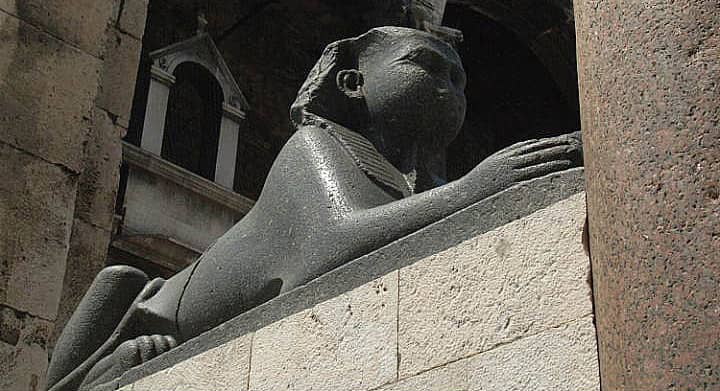
The Sphinx in Split is an ancient Egyptian monument with a human head and a lion's body, set on the Peristyle, the main ceremonial square of Diocletian's Palace. Made of black granite and commonly linked to the period of Pharaoh Thutmose III, it is far older than the palace itself and is usually described as one of the oldest objects in Split.
It was brought from Egypt in the Roman period, when Diocletian decorated his palace complex with sphinxes, and today it is the best-preserved and most famous example in the city. One of the details worth noticing is the vessel for offerings held in its hands, a small feature that makes this monument even more distinctive among Split's historic sights.
Why is the Sphinx in Split famous?
The Sphinx in Split is famous because it is not just another Roman-era detail, it is an original Egyptian monument standing in the middle of Diocletian's Palace. Few places in Croatia bring together ancient Egypt, imperial Rome, and a living historic city so clearly in one small space, which is why the sphinx leaves such a strong impression on visitors.
Its setting also adds to its appeal. The sphinx sits on the Peristyle, the ceremonial heart of the palace, near the former imperial mausoleum and today's cathedral, so it is surrounded by some of the most important architecture in Split. For many visitors, that combination of age, rarity, and location makes it one of the most striking details in the Old Town.
Where is the Sphinx in Split?
The Sphinx in Split stands on the Peristyle, the central ceremonial square of Diocletian's Palace in Split Old Town. You will find it near the former imperial mausoleum, today the Cathedral of Saint Domnius, which places it right in one of the most historically important parts of the palace complex.
The Sphinx is easy to see while walking through the palace without making a separate detour. If you are already visiting the Vestibule, the Temple of Jupiter, or simply exploring Split's main attractions, you are only moments away from it.
If you would rather explore this part of Split with expert local context, this is also a great point to join a private walking tour that covers the Peristyle, Diocletian's Palace, and other nearby highlights in one route.
Walking Tour of Split and Diocletian's Palace
Discover the story of Split on a small-group walking tour through Diocletian's Palace and the city's historic center.
With a knowledgeable guide leading the way, you will learn more about Emperor Diocletian, the rise of the palace complex, and key landmarks such as the Peristyle and the Golden Gate.
The tour also includes the palace substructures and the Riva, giving you a broader sense of how Split developed from a Roman imperial residence into the lively coastal city visitors see today. With several departure times available and a small-group format, it is an easy and more personal way to explore a UNESCO World Heritage Site.
History of the Sphinx in Split
How Egyptian sphinxes reached Diocletian's Palace
The sphinx on the Peristyle is part of a much larger story that connects Split with Roman Egypt. When Emperor Diocletian built his retirement palace on the Adriatic at the end of the 3rd century AD, he had Egyptian sphinxes brought to the complex as symbols of imperial prestige and power. Their presence helped turn Diocletian's Palace into a setting that felt both monumental and cosmopolitan, combining Roman architecture with prestigious objects from one of the empire's most famous provinces.
Which pharaoh is linked to the Peristyle sphinx?
The best-known sphinx in Split is usually linked to Pharaoh Thutmose III and is commonly dated to the 15th century BC, which makes it far older than the palace itself. It is often described as being around 3,500 years old and carved from black granite. This extraordinary age is one of the reasons the monument stands out so strongly on the Peristyle, where visitors can see an original Egyptian sculpture placed in the ceremonial heart of Roman Split.
How many sphinxes were brought to Split?
Many sources state that twelve sphinxes were originally brought to Split for Diocletian's palace complex, and that tradition is still widely repeated. However, heritage and academic sources are less uniform, showing that several sphinxes or sphinx fragments were associated with the palace over time. Today, it remains one of the most distinctive ancient monuments among Split's top attractions.
What to notice when you see the Sphinx
- The black granite: The sphinx is carved from dark granite, which makes it stand out immediately against the pale stone of the Peristyle and the surrounding Roman architecture.
- The classic sphinx form: It has the traditional combination of a human head and a lion's body, a form associated with protection, power, and royal symbolism in ancient Egypt. More specifically, it is an androsphinx (a mythical creature, typically portrayed with the body of a lion and the head of a human male, often with falcon wings).
- The offering vessel: One of the easiest details to miss is the vessel held in its hands, a small but distinctive feature that adds character and helps set this sphinx apart from a quick background glance.
- The setting: The monument stands in front of the former imperial mausoleum, today's cathedral, which gives it a dramatic position in one of the most important spaces inside Diocletian's Palace.
- Its age in context: The more you look at it, the more striking the contrast becomes, this Egyptian sculpture is far older than the Roman palace around it, which is one reason it feels so memorable in Split Old Town.
Visiting the Sphinx in Split
Best time to visit
The Sphinx in Split is easy to see at any time while exploring the Old Town, but the experience is usually better early in the morning or later in the afternoon. The Peristyle is one of the busiest parts of the palace complex, so visiting outside the peak midday hours usually means fewer crowds and a better chance to appreciate the setting.
How long you need
You only need around 5 to 10 minutes to stop and look at the sphinx itself, but most visitors see it as part of a wider walk through Diocletian's Palace. It works especially well as a short pause between nearby highlights such as the Vestibule and the Temple of Jupiter.
Practical tips
- Look closely at the black granite, the human head and lion's body, and the offering vessel in its hands, these are some of the most distinctive details.
- Expect a lively atmosphere around the Peristyle, especially in high season, since this is one of the focal points of Split Old Town.
- Treat it as part of a wider palace route rather than a separate attraction.
- Please show respect for the monument, it has stood here for centuries and is one of the most remarkable ancient details in the city.
If you want more context than a quick self-guided stop can offer, a private walking tour can be a great way to explore the Peristyle, Diocletian's Palace, and other nearby highlights with a guide who can bring the history to life. It is an especially good option for first-time visitors who want to connect the Sphinx with the wider story of Roman Split and see the main attractions in this part of the Old Town without missing the details.
Split Private Walking Tour of Old Town & Diocletian's Palace
Award-winning private walking tour in Split combining history, local insight, and a more personal way to experience the city.
Led by licensed resident guides with backgrounds in history, archaeology, economics, politics, and related fields, this tour are especially well suited to history lovers who want more than a standard overview.
You will explore Split's medieval Old Town and the remarkable Palace of Emperor Diocletian, built in AD 305 and listed as a UNESCO World Heritage Site since 1979. This tour also includes Museum of Cellars, one of the best-preserved parts of the palace complex. Because it is a private tour, the experience feels more flexible and personal, with more opportunities to go beyond the basics and see Split through the eyes of locals.
What to see nearby
One of the best things about visiting the Sphinx in Split is that it sits in the middle of the city's most important historic area. In just a short walk, you can continue exploring some of the key sights inside and around Diocletian's Palace, which makes this a very easy stop to combine with a wider Old Town route.
- Peristyle - the ceremonial square where the sphinx stands and one of the most iconic spaces in Split
- Diocletian's Palace - the wider Roman complex that gives the sphinx its full historical setting
- Temple of Jupiter - one of the most interesting surviving Roman sites near the Peristyle
- Vestibule - a striking circular space that is often part of the same walking route
- Diocletian's Palace Cellars - one of the best-preserved parts of the palace and a great addition if you want more historical context
- More attractions in Split - useful if you want to keep building your sightseeing route through the city
Is the Sphinx in Split worth seeing?
Yes! The Sphinx in Split is well worth seeing, especially if you are already exploring Diocletian's Palace and the Old Town. It only takes a few minutes to stop by, but it adds something genuinely unusual to the experience: an original Egyptian monument set in the middle of a Roman imperial complex.
It is not a standalone attraction that requires a long visit, but that is exactly why it works so well. The sphinx is one of those small details that makes Split more memorable, especially for visitors who enjoy history, architecture, and finding the layers that make the city different from a standard seaside destination.
Sphinx in Split map
The Sphinx in Split is located on the Peristyle, one of the most important squares inside Diocletian's Palace in the heart of the Old Town. Use the map below to find its exact location and plan your walk to nearby highlights such as the Cathedral of Saint Domnius, the Vestibule, and the Temple of Jupiter.
FAQ about the Sphinx in Split
How old is the Sphinx in Split?
The Sphinx in Split is commonly described as around 3,500 years old and is usually linked to the reign of Pharaoh Thutmose III in the 15th century BC.
Is the Sphinx in Split free to see?
Yes - you can see it for free while walking through the Peristyle in Diocletian's Palace.
Can you see the Sphinx without entering a museum?
Yes - the sphinx stands in the open palace area, so most visitors see it as part of a walk through Split Old Town rather than as a separate museum visit.
Are there other sphinxes in Split?
Yes - sources indicate that several sphinxes or sphinx fragments were associated with Diocletian's Palace, but the Peristyle sphinx is the best-preserved and most famous example in Split.
Is the Sphinx part of Diocletian's Palace?
Yes - the sphinx stands on the Peristyle and forms part of the wider historical setting of Diocletian's Palace.