
Grgur Ninski (Gregory of Nin) was a Croatian bishop in the Middle Ages, traditionally linked with defending the use of the national language and the Glagolitic tradition in religious services. A popular attraction in Split, with thousands of people stopping to rub the statue's toe each year.
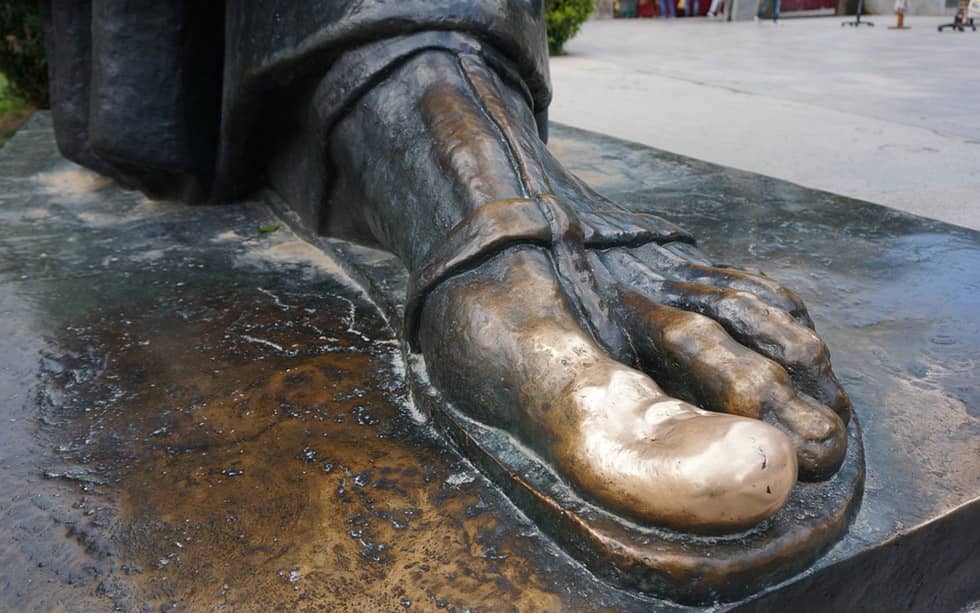
According to local tradition, rubbing Grgur Ninski’s big toe is meant to bring good luck and help your wish come true, so it has become a must-do ritual for first-time visitors to Split. After years of people stopping for a quick "toe rub" on the way into Diocletian’s Palace, the bronze toe has been worn smooth and shiny, making it the easiest detail to spot in photos and the reason the legend keeps spreading from one traveller to the next.
Gregory of Nin quick overview
- Name: Gregory of Nin (Grgur Ninski)
- What it is: Bronze public monument and one of Split’s best-known landmarks
- Artist: Ivan Meštrović
- Height: 7.58 m
- Location: Beside Diocletian’s Palace at the Golden Gate (Zlatna vrata)
- Cost: Free
- Opening hours: Open-air monument (visit anytime)
- Time needed: 5-15 minutes (30-60 minutes with nearby palace sights)
- Why it’s famous: Meštrović’s monumental work in Split and the tradition of rubbing the statue’s toe for good luck
Today, the larger-than-life bronze monument stands right beside Diocletian’s Palace at the Golden Gate, making it one of the easiest quick photo stops in the Old Town.
It was of big importance for Croatian culture but also for keeping religion strong within the Croatian kingdom. As there were not many priests speaking Latin, church ceremonies for the local population continued to be performed in the Slavic language tradition, written in Glagolitic.
The famous sculptor and architect Ivan Meštrović created the monument and it was originally placed on the Peristyle of Diocletian's Palace in 1929. During World War II it was dismantled and removed, and in 1954 it was set in its current position outside the city gates, in front of the palace's Golden Gate. Other casts by Meštrović can be seen in Varaždin and Nin.
Private Walking Tour of Diocletian's Palace & Old Town
Walking tour in Split designed for history lovers who want an authentic, fun, and story-rich experience.
Guided tour of Old Town Split, including the famous Diocletian's Palace (UNESCO World Heritage Site), Peristyle and the basement cellars. Because it’s a private tour, you can move at your own pace, go a little "behind the scenes", and see the city through local eyes.
Where is the Gregory of Nin statue in Split?
The Gregory of Nin statue (Grgur Ninski) stands right beside Split’s Golden Gate (Zlatna vrata), the main north entrance to Diocletian’s Palace and one of the easiest landmarks to find in the Old Town.
You will see it immediately as you approach the Golden Gate from the north, next to the open green space of Đardin park, so most visitors stop here naturally on their first walk into the palace area.
Address and coordinates
- Address: Kralja Tomislava 10A, 21000 Split
- GPS: 43.50940, 16.44079
Fast directions (walk)
- From the Peristyle (Peristil): walk north through the palace streets toward the Golden Gate and exit - the statue is right outside.
- From Split Riva: enter the palace area from the seafront side, then follow signs for the Golden Gate - you will reach the statue as you approach the north wall.
Map
The toe-rub legend: should you touch it?
The most famous tradition here is simple: visitors rub Grgur Ninski’s big toe for good luck and to make a wish. Over time, thousands of hands have polished the bronze toe to a bright shine, so you can literally see where the "luck ritual" happens.
Should you do it? If you want to join in, go for it - it’s a light-hearted local custom and part of the fun of walking into the Old Town. Just be respectful in crowds: don’t climb on the statue, let people take turns for photos, and keep an eye on your belongings when tour groups arrive.
Best time for photos (and fewer crowds)
- Early morning: the easiest time to get a clear photo without tour groups.
- Late afternoon: softer light and a nicer atmosphere around the Golden Gate area.
- Quick photo tip: step back toward the gate to frame both the statue and the palace entrance in one shot.
Who was Gregory of Nin (Grgur Ninski)?
Grgur Ninski (Gregory of Nin) was a medieval Croatian bishop (episcopus Chroatorum) whose seat was in Nin in the early 10th century. He is directly mentioned in the records of the Split church synods of 925 and 928, which is why he remains one of the best-documented church figures of early Croatian history.
Historically, those synods show him in a dispute connected to church jurisdiction and the relationship between the Croatian bishopric and Split’s metropolitan authority. After the decisions of the synods, the Nin bishopric was abolished and Gregory was reassigned, but his name stayed alive in Croatian cultural memory far beyond these official records.
In Croatian tradition, Grgur Ninski is most often remembered as a defender of worship in the people’s language and the Glagolitic heritage, which is why he later became a symbol of identity, culture, and “standing up for locals” in Dalmatia. That symbolic role is exactly what makes the monument in Split feel more than just a photo stop.
- Known from primary-era records: mentioned at the Split synods (925, 928)
- Linked in tradition: Old Church Slavonic and Glagolitic church heritage
- Modern meaning: a cultural symbol closely tied to Croatian identity and language
Why the statue is famous
A popular attraction in central Split, with thousands of people stopping to rub the statue's toe each year, Grgur Ninski has become one of the city’s most recognizable “first stop” landmarks on the way into Diocletian’s Palace.
- It is a true Split icon: the statue stands right beside the Golden Gate (Zlatna vrata), so almost every Old Town walk passes it.
- It is Meštrović’s monumental work: at 7.58 m tall, it is widely described as the most famous public monument in Split and one of Ivan Meštrović’s greatest public monuments.
- The toe-rub legend is part of the experience: visitors rub the shiny big toe for good luck and wishes, and the polished bronze is a visible sign of how popular the tradition is.
Statue history
As visible on old postcards, Gregory of Nin was first located on the Peristyle. During WWII he was moved outside the city gates by Italian occupiers. It stands in front of the palace's Golden Gate.
The monument was originally installed on the Peristyle in 1929, removed in 1941, and then re-erected in its current Golden Gate location in 1954. After a condition analysis in 2013 highlighted damage and corrosion, the statue underwent major conservation and restoration work between 2013 and 2015.
Ivan Meštrović and the monument
The Gregory of Nin statue in Split is a monumental bronze work by Ivan Meštrović, one of Croatia’s most celebrated sculptors. It is often described as the most famous public monument in Split and the greatest public monument in Meštrović’s opus, which is why it has become a must-see stop even for visitors who only have a short time in the city.
Meštrović conceived the statue specifically for Diocletian’s Palace: it was installed on the Peristyle in 1929 as a site-specific placement, designed to feel like part of the palace setting rather than "just another statue" in a random square. That original palace connection is also why the monument still feels perfectly at home today beside the Golden Gate at the entrance to the Old Town.
Meštrović also created other versions of Gregory of Nin, which is why you can see related statues in Varaždin and Nin as well. The Split statue remains the most iconic because of its scale, its palace setting, and the famous toe-rub tradition that turned a serious historical figure into a playful local ritual.
- Material: bronze
- Scale: 7.58 m tall
- Original concept: made for the Peristyle of Diocletian’s Palace
- Other statues: Gregory of Nin can also be seen in Varaždin and Nin
How to fit Gregory of Nin into your Split walk
The easiest way to visit Grgur Ninski is to treat it as your "start point" for Diocletian’s Palace. You are already at the Golden Gate, so you can do a quick photo stop, rub the toe if you want, and then walk straight into the palace core without backtracking.
Below are two simple routes that work for most visitors, whether you have 15 minutes or a full hour for the palace highlights.
Quick 10-15 minute loop (best if you are short on time)
- Start at Gregory of Nin and the Golden Gate (photo + toe-rub tradition).
- Walk through the Golden Gate into Diocletian’s Palace and follow the main lanes to the Peristil (the palace’s main square).
- Continue a minute to the Vestibule (quick look up inside the imperial antechamber).
- Return the same way or continue into the Old Town lanes for coffee.
Classic 45-60 minute palace highlights loop (best first-time walk)
- Start at Gregory of Nin by the Golden Gate.
- Walk into the palace and visit the Peristil (main square).
- Step into the Vestibule (one of the most memorable interiors in the palace).
- Add the Temple of Jupiter nearby for one more major palace landmark.
- Go down to the Cellars of Diocletian’s Palace (a top highlight if you want the "underground" side of the palace).
- Exit toward the seafront side via the Brass Gate and finish on the Riva promenade.
If you want the full story behind Grgur Ninski and the palace landmarks around it, consider joining a Split walking tour led by a licensed local guide with a Magister (Master’s) degree in History. It’s one of the best ways to see the statue, Diocletian’s Palace, and the Old Town highlights in the right order, with the context and "hidden details" you would otherwise walk past on a self-guided route.
Walking Tour of Split with a "Magister" of History
Enjoy Split from a local, history-first perspective on a guided walking tour.
As you explore on foot, you’ll tick off the essential landmarks in a logical route, including Grgur Ninski Statue, Diocletian’s Palace, the Cathedral of Saint Domnius, and the Temple of Jupiter, with plenty of context that’s easy to miss when sightseeing on your own. This tour is ideal if you have limited time in Split but still want to go beyond the basics, with richer historical insights and time to notice the small details that make the Old Town special.
Nearby attractions (2-10 minutes away)
Because the Gregory of Nin statue is right by the Golden Gate, you are only a few minutes from Split’s biggest Old Town highlights. These are the easiest nearby stops to combine in the same short walk.
- Diocletian’s Palace - the UNESCO-listed heart of Split and the main area you will explore on foot.
- Golden Gate (Zlatna vrata) - the north entrance and the perfect “start point” for a palace walk.
- Peristil (Peristyle) - the palace’s central square and one of the most photogenic spots in Split.
- Vestibule - a quick but memorable interior, famous for its circular opening above.
- Temple of Jupiter - a standout palace landmark near the Peristil, with an Egyptian sphinx outside.
- The Sphinx - an ancient detail most visitors walk past unless they know to look for it.
- Diocletian’s Palace Cellars - the best-preserved underground spaces and a great shade stop in summer.
- Riva promenade - the classic waterfront for coffee, people-watching, and an easy finish to your Old Town walk.
- Silver Gate and Brass Gate - two more palace gates you can add if you want to “complete the loop”.
Practical tips for visiting
Accessibility
The statue is outdoors on the edge of the Old Town by the Golden Gate, so it is easy to reach on foot. If you are visiting with a wheelchair or stroller, the simplest approach is along the flatter walkway on Ulica Kralja Tomislava, but note that some angles near the statue have steps, so choose your route based on the surface in front of you.
Inside Diocletian’s Palace and the surrounding streets you will often walk on stone paving, so wear shoes with good grip, especially if the ground is wet.
Safety and respect
- Expect crowds: this is one of Split’s busiest photo stops, especially when tour groups arrive.
- Keep valuables secure: like any crowded Old Town area, stay aware of pickpockets and keep phones and wallets out of open pockets.
- Be respectful: avoid climbing on the statue, and let others take turns for photos and the toe-rub tradition.
Good to know
- Free and always open: it is an open-air monument you can visit any time of day.
- Best light: early morning and late afternoon are usually the easiest times for photos with fewer people.
- Easy to combine: you are steps from the Golden Gate and a short walk to the palace highlights like the Peristil and Vestibule.
- Summer tip: the nearby Đardin park is a handy spot for a short shaded break before heading into the palace lanes.
FAQ
Where is the Gregory of Nin statue in Split?
It stands right beside Diocletian’s Palace at the Golden Gate (Zlatna vrata), the main north entrance to the Old Town.
Is it free to visit?
Yes - it is an outdoor public monument, so it is completely free and you can see it any time.
Why do people rub the statue’s toe?
Rubbing the big toe is a popular local visitor tradition for good luck and making a wish. The toe looks shiny because thousands of people touch it every year.
How long do you need at Gregory of Nin?
Most visitors spend 5-15 minutes for photos. If you combine it with nearby palace highlights, plan 30-60 minutes.
Can you visit Gregory of Nin at night?
Yes - it is outdoors and always accessible. For the best atmosphere, visit in the evening when the Old Town is lively and well-lit.
What is the best time for photos?
Early morning is best for fewer crowds, while late afternoon usually gives softer light near the Golden Gate.