
Prokurative in Split, officially Republic Square, is one of the city's best-known public spaces and an easy stop on any walk through the historic centre. Just west of the Riva promenade and a short walk from Diocletian's Palace, this elegant square stands out for its neo-Renaissance arcades, open southern side, and long role as a stage for concerts and city events.
If you are exploring the main attractions in Split, Prokurative is worth visiting not because it is a museum-style sight with a long checklist, but because it gives you a different feel for the city. The square reflects Split's 19th-century ambitions, draws clear comparisons with Venice's St Mark's Square, and still works as both a local meeting point and one of the most recognisable landmarks in central Split.
This guide covers what Prokurative is, why it matters, what to look for, and how to fit it into a wider walk that also includes the Diocletian's Palace, the Riva, and other key sights in the old town.
Prokurative quick facts
- Official name: Republic Square - Trg Republike
- Local name: Prokurative, the name most people still use
- Location: West of the Riva in central Split
- Known for: Neo-Renaissance arcades and a strong Venetian feel
- What stands out: The square opens to the south with views toward the harbour and waterfront
- Access: Free public square, best visited on foot as part of a central Split walk
- Best for: Architecture, photos, short breaks, and event atmosphere
What is Prokurative and why visit?
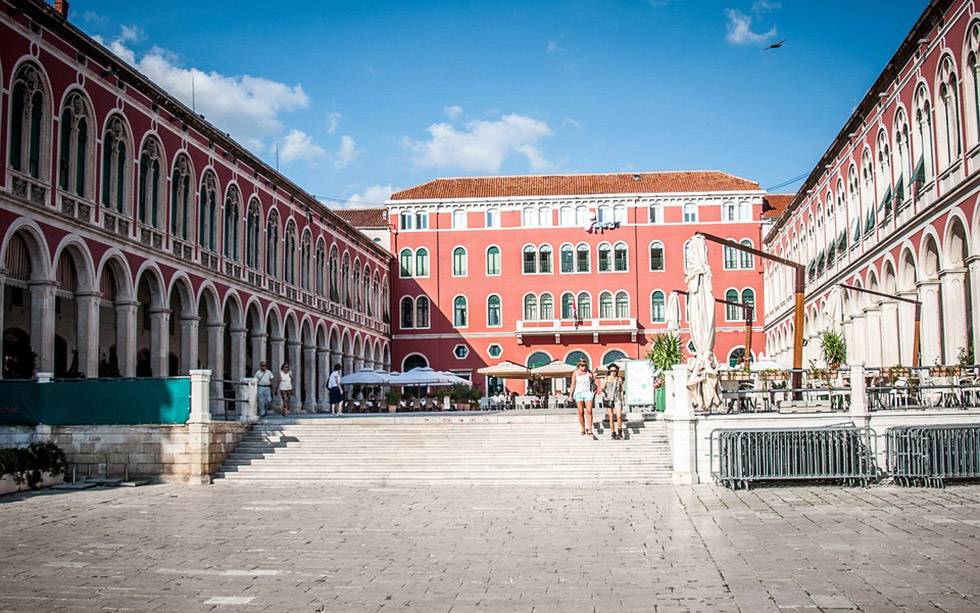
Prokurative in Split, officially Republic Square, is one of the city's most distinctive public squares. Set just west of the Riva, it is framed on three sides by elegant neo-Renaissance buildings and arches, while the southern side opens toward the harbour, giving it a very different atmosphere from the tighter stone streets around Diocletian's Palace.
It is worth visiting because it adds another layer to a walk through central Split. Prokurative is not a major ticketed sight, but a free, easy stop that combines architecture, city history, waterfront views, and everyday local life.
What to see at Prokurative
Prokurative is best appreciated as a complete urban space rather than a single monument. What makes it memorable is the contrast between its elegant arcades, its open harbour-facing edge, and the way it shifts from a calm architectural stop during the day to a much livelier square when concerts, festivals, or evening crowds fill the area.
The neo-Renaissance façades and arches
The first thing most visitors notice is how different Prokurative feels from the older stone streets around the palace core. The square is framed on three sides by red-toned neo-Renaissance buildings and arcades whose style is often compared to Venice, which gives this part of Split a more formal 19th-century character than the Roman and medieval streets nearby.
The harbour-facing southern side
Unlike a fully enclosed square, Prokurative opens to the south, which gives it a lighter, more open feel and creates a clear visual connection with the harbour and the Riva. That open side is one of the reasons the square works so well for photos, a short pause on a walking route, or simply stepping back to take in the full scale of the architecture.
The event space and local atmosphere
Prokurative is also worth seeing as a living city square, not just an architectural backdrop. It is one of the better-known event spaces in Split and is closely associated with concerts, festivals, and public gatherings, so the atmosphere can range from quiet and spacious in the morning to much more animated later in the day or during summer events.
Prokurative works best when you see it as part of a wider walk through central Split rather than as a stand-alone stop. On your own, it is easy to admire the arcades, take a few photos, and move on without fully understanding how this square fits into the city's shift from the Roman core around Diocletian's Palace to the more formal 19th-century waterfront centre.
That is exactly where a guided walk can add value. If you want the square to make more sense in the wider story of Split a guided tour is an easy fit, giving you expert context for the palace, the old streets, and the central landmarks around them, including places like Prokurative that are often more interesting once someone explains why they matter.
Private Walking Tour of Split Old Town & Diocletian's Palace
A strong choice for travellers who want more than a standard overview of Split, Private Walking Tour+Cellars Museum
Led by a licensed resident guide, it combines the main highlights of the Old Town with deeper local context, including Diocletian's Palace, the Peristyle, and the palace cellars, often considered one of the best-preserved parts of the complex.
Because the tour is private, it also gives you a more personal way to experience the city through local insight rather than a fixed group script.
The history behind Prokurative
Prokurative reflects a later chapter in Split's development, when the city expanded beyond its Roman and medieval core and began shaping a more formal 19th-century urban identity. The square was initiated in the mid-19th century under Mayor Antonio Bajamonti and was designed to project a more elegant, outward-looking image of Split, with clear architectural references to Italy and especially Venice. The square's neo-Renaissance arcades and Venetian character are why it is often compared to St. Mark's Square in Venice.
Antonio Bajamonti and 19th-century Split
Antonio Bajamonti is one of the central names linked to modern Split, and Prokurative is one of the best-known results of that period. Official local sources credit him with initiating the square's construction in the mid-19th century as part of a broader vision for the city, and the area became associated not only with new architecture but also with public and cultural life, including a large theatre that once stood on the square.
Marmont, Venice, and the Republic Square name
The square is often described as Split's most Venetian-looking urban space, and that comparison is easy to understand once you see the arcades and long façades surrounding it. Its official name is Republic Square - Trg Republike - but most locals and visitors still call it Prokurative, the traditional name that remains far more widely used in everyday speech. That combination of official naming, Venetian visual influence, and strong local identity is part of what makes the square more interesting than a quick photo stop suggests.
Best time to visit Prokurative
Prokurative is easy to visit at almost any time of day, but the experience changes depending on what you want from the stop. Morning and late afternoon are best if you want cleaner photos and a calmer feel, while evening is usually better for atmosphere, especially when the square is busier and the surrounding cafés and waterfront area are more active.
If you want to see Prokurative at its most memorable, check whether there is a concert, festival, or public event taking place during your stay. The square is one of Split's established cultural venues, so an event night can make it feel far more dynamic than a quick daytime pass-through. On the other hand, if you are mainly interested in the architecture and the harbour-facing layout, earlier in the day is usually the better choice.
- Best for photos: Morning or late afternoon, when the square feels more open and less crowded.
- Best for a quieter stop: Earlier in the day, before the central waterfront area gets busier.
- Best for atmosphere: Evening, especially during concerts, festivals, or other public events at Prokurative.
How to fit Prokurative into a Split walking route
Prokurative is easiest to visit as part of a central Split walking loop rather than as a separate destination. Because it sits between the waterfront and the western side of the old centre, it fits naturally into a short city walk that also includes the palace area, a few major squares, and one or two nearby landmarks.
A simple route is to start on the Riva, step up to Prokurative for the square and arcades, continue through Marmont Street, and then loop back toward the palace core. That gives you a good balance of waterfront atmosphere, 19th-century urban Split, and the older Roman heart of the city without turning the stop into a detour.
- Short central loop: Start at the Riva, visit Prokurative, then continue into the old centre.
- Best architectural contrast: Pair Prokurative with Diocletian's Palace to see how different 19th-century Split feels from the Roman core.
- Easy shopping and café add-on: Walk through Marmont Street before or after the square.
- For a stronger historic sequence: Continue from the palace area to Peristil and the Diocletian's Palace Cellars.
- Best timing: Visit Prokurative earlier in the walk if you want quieter photos, or later if you want to pause for atmosphere before returning to the waterfront.
Practical tips before you go
- No ticket needed: Prokurative is a public square, so you can visit it freely at any time as part of a walk through central Split.
- Best as part of a route: It works better as a short stop between the Riva, Marmont Street, and Diocletian's Palace than as a stand-alone attraction.
- Check the atmosphere on event days: Concerts, festivals, and public events can make the square much livelier and busier than usual.
- Good for a short pause: This is one of the easier places in the centre to stop for photos, take in the architecture, or sit down nearby before continuing.
- Wear comfortable shoes: The square itself is easy to walk through, but it is usually combined with older streets in the historic centre where stone paving can be uneven or slippery.
- Plan around your timing: Come earlier for cleaner views and easier photos, or later if you want more atmosphere around the waterfront side of the centre.
Where is Prokurative in Split?
Prokurative, officially Republic Square, is in central Split just west of the Riva promenade. It sits on the edge of the historic centre, so it is easy to reach on foot from the waterfront, Diocletian's Palace, and Marmont Street.
For most visitors, Prokurative is not a destination you travel to separately - it is a natural stop within a wider Old Town walk.
- From the Riva: Walk west from the waterfront and you will reach Prokurative almost immediately.
- From Diocletian's Palace: Exit toward the waterfront side of the old core, then continue west for an easy add-on stop.
- From Marmont Street: The square sits right by one of Split's best-known central walking routes, so it fits naturally into a city-centre stroll.
FAQ about Prokurative in Split
Is Prokurative the same as Republic Square?
Yes. Prokurative is the traditional name most locals still use, while the official name is Republic Square - Trg Republike. On maps, tourist material, and event listings, you may see either version.
Is Prokurative worth visiting in Split?
Yes, especially if you are already exploring central Split on foot. It is not a major ticketed attraction, but it is one of the city's most distinctive squares, with elegant arcades, a harbour-facing open side, and an atmosphere that feels very different from the tighter streets around Diocletian's Palace.
Do you need a ticket for Prokurative?
No. Prokurative is a public square and there is no admission fee to walk through it. Only specific concerts or event setups held on the square may have separate ticketing.
How far is Prokurative from the Riva?
Very close. Prokurative is just west of the Riva, so it is usually reached within a few minutes on foot from the waterfront. For most visitors, it feels like a natural extension of a walk through the centre rather than a separate trip.
What is the best time of day to visit Prokurative?
Morning and late afternoon are best if you want cleaner photos and a quieter feel. Evening is better if you want more atmosphere, and event nights can make the square feel much livelier than a standard daytime visit.
What can you see near Prokurative?
Prokurative is close to the Riva, the wider historic centre of Split, and the route toward Diocletian's Palace. That makes it easy to combine with other central sights, cafés, and short walking stops in the Old Town.