
The Temple of Jupiter in Split, Croatia, is a remarkably well-preserved Roman monument built between 295 and 305 AD within Diocletian's Palace. Originally dedicated to Jupiter, the supreme god of ancient Roman religion, it was later converted into a Christian baptistery in the 6th century. Located just west of the Peristyle, the temple is best known for its impressive barrel-vaulted ceiling, Roman reliefs, a headless Egyptian Sphinx at the entrance, and a 20th-century sculpture of St John the Baptist inside.
Key details about the Temple of Jupiter
- Purpose: Originally built to honour Jupiter, the chief god of ancient Roman religion and a deity closely tied to Emperor Diocletian's imperial image, the temple was later converted into the Baptistery of St John the Baptist.
- Location: The Temple of Jupiter stands in the western part of Diocletian's Palace, just west of the Peristyle in Split's UNESCO-listed old town.
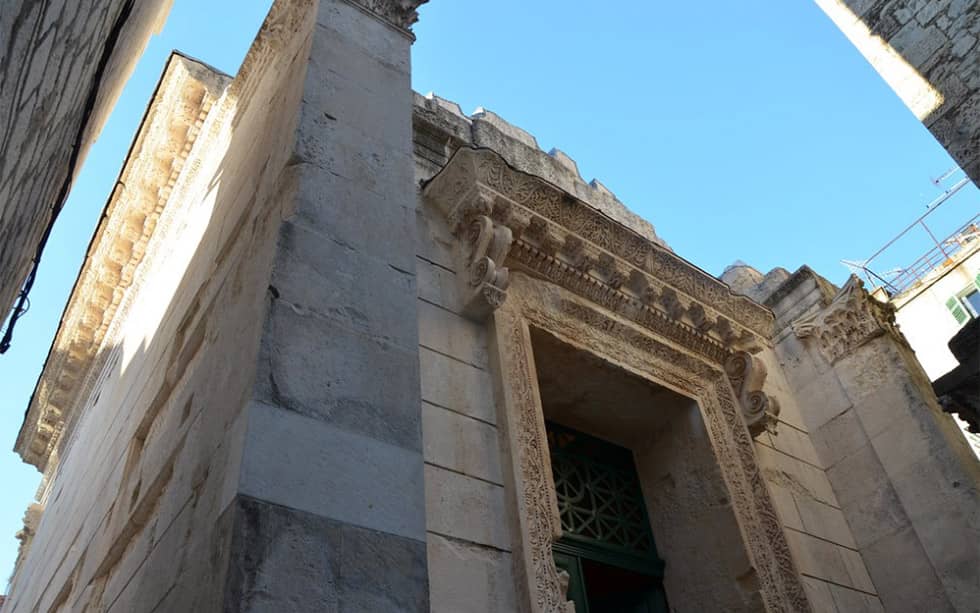
- Architecture: The building is known for its remarkably preserved barrel-vaulted coffered ceiling, raised podium and compact stone interior, making it one of the most distinctive Roman structures in the palace complex.
- Features: At the entrance stands a damaged black granite Egyptian Sphinx brought to Split in antiquity, while inside visitors can see the large bronze statue of St John the Baptist created by the renowned Croatian sculptor Ivan Meštrović.
- Significance: The temple forms part of Diocletian's Palace, a UNESCO World Heritage Site and one of the most important Roman monuments in Croatia.
- Nearby curiosity: Right next to the temple is the famously narrow passage called Pusti me proć, usually translated as “Let me pass”, one of Split's best-known small curiosities.
Where is the Temple of Jupiter?
The Temple of Jupiter is located in the western part of Diocletian's Palace in the heart of Split's old town, just a short walk from the Peristyle, the palace's main ceremonial square. This central location makes it easy to include in any self-guided walk through the UNESCO-listed palace complex.
If you are exploring the historic core on foot, the temple is tucked just west of the Peristyle near Ul. Kraj Svetog Ivana 2. Because the monument is small and surrounded by other major Roman landmarks, many visitors see it as part of a compact route that also includes the Peristyle, the Cathedral of St Domnius, the Vestibule and the Diocletian's Palace Cellars. The famous narrow passage called "Pusti me proć" - usually translated as "Let me pass" - is also right next to the temple, which makes the area even easier to identify once you are nearby.
- Area: western part of Diocletian's Palace
- Nearest landmark: the Peristyle
- Setting: inside Split's UNESCO-listed old town
- Address: Ul. Kraj Svetog Ivana 2, 21000 Split
- Best way to reach it: on foot while exploring the palace complex
Why visit the Temple of Jupiter?
The Temple of Jupiter is worth visiting because it offers a rare chance to step into one of the best-preserved Roman monuments in Diocletian's Palace without needing much time. Even though it is a small attraction, it stands out for the quality of its surviving architecture, its layered Roman and Christian history, and its location right next to some of Split's most important palace landmarks.
For many visitors, the appeal is in the details rather than the size. The coffered barrel-vaulted ceiling, the carved entrance, the headless Egyptian sphinx outside, and Ivan Mestrovic's bronze statue of St John the Baptist inside make the monument feel distinctive and easy to remember. It also works especially well as a short stop between the Peristyle, the Cathedral of St Domnius, the Vestibule, and the palace cellars.
- Short but rewarding: ideal if you want a meaningful historical stop without adding much time to your walk
- Roman heritage: one of the most atmospheric surviving Roman spaces inside Diocletian's Palace
- Unique details: the sphinx, vaulted ceiling, stone carvings, and baptistery conversion make it more memorable than a quick exterior glance suggests
- Easy to combine: it fits naturally into the main Old Town route near the Peristyle and other palace highlights
- Best for: visitors interested in history, architecture, photography, and hidden details inside Split's UNESCO-listed core
If you want to experience the Temple of Jupiter in context rather than just pass by it, it makes sense to visit it as part of a wider walk through Diocletian's Palace and Split's Old Town. That way you can connect the temple with nearby landmarks such as the Peristyle, the Cathedral of St Domnius, the Vestibule and the palace cellars, while also getting a better feel for the history behind one of Split's most fascinating Roman monuments.
Walking Tour of Split and Diocletian's Palace
Explore the Temple of Jupiter and the rest of Diocletian's Palace with a guided walking tour that adds real context to what you see.
As you move through Split's old town, your guide explains how the palace was built, why the Temple of Jupiter was dedicated to one of ancient Rome's most important gods and how nearby landmarks such as the Peristyle, the Cathedral of St Domnius, the Vestibule and the substructures fit into the wider story of the city.
It is a convenient way to see more in less time while gaining a clearer understanding of Split's Roman heritage, later Christian layers and everyday atmosphere.
What to see at the Temple of Jupiter
Although the Temple of Jupiter is a relatively small monument, it contains several details that make it one of the most interesting stops inside Diocletian's Palace. The appeal is not only in its Roman origins, but also in the way ancient architecture, later Christian use and unusual surviving objects come together in one compact space.
- The barrel-vaulted ceiling: One of the temple's most impressive features is its richly carved coffered barrel vault, often described as one of the finest surviving Roman interiors in Split.
- The elevated Roman structure: The temple stands on a raised podium, which adds to its monumental feel and helps explain its original ceremonial importance within Diocletian's Palace.
- The carved entrance and reliefs: Look closely at the portal and stone decoration, where Roman craftsmanship is still visible despite centuries of change.
- The black granite sphinx: Near the entrance stands a damaged Egyptian Sphinx brought to Split in antiquity, one of the most memorable details linked to Diocletian's fascination with Egypt.
- The baptistery interior: After the temple was converted into the Baptistery of St John the Baptist, the space gained a new Christian function that still shapes how visitors experience it today.
- The statue of St John the Baptist: Inside, the most striking later addition is the bronze sculpture of St John the Baptist by Ivan Meštrović, one of Croatia's best-known sculptors.
- The medieval baptismal font: The baptistery also preserves important early medieval stonework, including a font made from parts of an older altar screen associated with the historic Croatian kingdom.
For most visitors, this is a place to slow down and notice the details rather than rush through. The temple may not take long to visit, but its ceiling, sphinx, sculpture and layered history make it one of the most distinctive small monuments in Split's old town.
History of the Temple of Jupiter
The Temple of Jupiter was built between 295 and 305 AD as part of Diocletian's Palace, the vast imperial complex created for the Roman emperor Diocletian in what is now the historic centre of Split. It was dedicated to Jupiter, the supreme god of Roman religion and a deity closely linked to Diocletian's imperial identity, which gave the temple both religious and political importance within the palace complex.
Historians generally place the temple in the western, religious part of the palace near the Peristyle. Some sources also note that parts of the structure may have remained unfinished after Diocletian's abdication in 305, when work on the palace complex appears to have stopped earlier than planned. What survives today is still one of the best-preserved Roman monuments in Split, especially because of its richly decorated entrance and remarkable coffered barrel-vaulted ceiling.
In late antiquity or the early medieval period, the temple was converted into the Baptistery of St John the Baptist, giving the building a new Christian role that reshaped how it was used and understood. Later additions and layers, including the famous bronze statue of St John the Baptist by Ivan Mestrovic and important medieval stonework, reflect how the monument evolved over centuries rather than remaining frozen as a purely Roman site.
Today, the Temple of Jupiter matters not only as an ancient Roman building, but as part of the larger story of Diocletian's Palace, a UNESCO World Heritage Site whose history connects Roman, medieval and modern Split. That layered identity is one of the main reasons the temple remains such a rewarding stop for visitors exploring the old town.
Tickets, opening hours and how long to plan
The Temple of Jupiter is usually visited as part of the cathedral and baptistery complex rather than as a major standalone attraction, so it is best to think of it as a short but worthwhile stop within a wider walk through Diocletian's Palace. Entrance is paid, and current visitor information is typically managed through the cathedral ticketing system in the Peristyle area rather than presented as a large separate attraction setup.
- Tickets: The Temple of Jupiter, today functioning as the Baptistery of St John, generally has an entrance fee and is often included in combined cathedral complex tickets.
- Where to buy: Tickets for the cathedral complex are commonly sold at the treasury opposite the Cathedral in Peristyle Square.
- Opening hours: Hours can vary by season, day and church use, so it is best to check the latest official information locally before visiting.
- How long to plan: Most visitors only need around 10 to 20 minutes at the temple itself, or a little longer if visiting as part of the wider cathedral complex.
- Best approach: Visit it together with the Peristyle, Cathedral of St Domnius, Vestibule and palace cellars for a more complete experience of Split's Roman core.
Because ticket options and opening times can change, especially between seasons, it is smart to confirm the latest details on site or through current official visitor information before planning your visit around a specific entry time.
How to visit the Temple of Jupiter
The easiest way to visit the Temple of Jupiter is as part of a walking route through Diocletian's Palace rather than as a standalone stop. Because the monument is small and sits close to the Peristyle, Cathedral of St Domnius, Vestibule and palace cellars, most visitors naturally see it while exploring Split's old town on foot. That makes it a simple addition to both self-guided sightseeing and organised palace tours.
- Self-guided visit: If you prefer to explore at your own pace, the temple is easy to include in a short Old Town route centred on Diocletian's Palace and the Peristyle.
- Guided walking tour: A walking tour is often the best option if you want more historical context, especially because the temple makes more sense when explained together with the wider palace complex.
- Best visiting order: Many visitors start around the Peristyle and Cathedral area, then continue to the Temple of Jupiter, Vestibule, palace substructures and nearby lanes of the old town.
- Time needed: The temple itself does not take long to visit, so it works best as one stop within a broader palace itinerary.
- Who benefits most from a tour: First-time visitors, history lovers and anyone who wants to understand how the palace functioned beyond just seeing the buildings.
If you want to see more than just the exterior and understand how the Temple of Jupiter fits into the wider story of Diocletian's Palace, joining a guided walking tour can make the visit much more rewarding.
Split Private Walking Tour of Old Town & Diocletian's Palace
Discover the Temple of Jupiter, Diocletian's Palace and Split's Old Town on an award-winning private walking tour that combines history with local insight.
Led by licensed local guides with backgrounds in history, archaeology, economics, politics and related fields, this tour is especially well suited to visitors who want more than a standard overview and prefer deeper context as they explore Split's Roman and medieval heritage.
You will walk through Split's historic centre and the extraordinary Palace of Emperor Diocletian, built around AD 305 and listed as a UNESCO World Heritage Site since 1979. The tour also includes the palace cellars, one of the best-preserved parts of the complex, and because it is private, the experience feels more flexible, more personal and better suited to travellers who want to see Split beyond the basics.
What to see nearby
One of the best things about visiting the Temple of Jupiter is that it sits in the heart of Diocletian's Palace, so you can easily combine it with several of Split's most important historic sights in one short walk. Because everything is close together, this part of the old town works especially well for visitors who want to see more without spending much time moving between attractions.
- Peristyle The ceremonial heart of Diocletian's Palace and the main square closest to the temple.
- Cathedral of St Domnius: One of Split's best-known landmarks, located right beside the Peristyle in the former imperial mausoleum.
- Vestibule A striking domed hall that once formed part of the emperor's private apartments and is only a short walk away.
- Diocletian's Palace Cellars One of the most atmospheric and best-preserved parts of the palace complex, often included in guided visits.
- Egyptian sphinxes: The Temple of Jupiter is linked to Split's wider story of ancient sphinxes brought from Egypt during Diocletian's time.
- "Pusti me proć": The famously narrow passage next to the temple, known in English as "Let me pass", is a small but memorable local curiosity.
Practical tips before you go
The Temple of Jupiter is best visited as part of a wider walk through Diocletian's Palace, since it is a short stop rather than a large standalone attraction. Split's official tourism material recommends starting with the main palace sights in the historic core, and this monument fits naturally into that route near the Peristyle.
- Best time to visit: Go earlier in the day or outside the busiest midday period if you want a calmer look inside the palace area, especially around the Peristyle. The historic core is easy to explore on foot, but it can become lively and crowded around the main sights.
- Combine it with nearby landmarks: The temple works best together with the Peristyle, Cathedral of St Domnius, Vestibule and palace substructures rather than as a separate detour.
- Allow a short visit: Most visitors only need a brief stop at the temple itself, so plan to spend more time on the surrounding palace complex than on this single monument. Jupiter's Temple is one of the core sights within the larger palace visit.
- Watch your footing: The old town is historic and uneven in places, so comfortable shoes are a good idea when exploring the palace lanes and stone surfaces around the temple. This is practical advice based on the character of Split's old core as a maze of ancient streets.
- Look for the details: This is a place where the ceiling, carvings, sphinx and baptistery layers matter more than the building's size, so it is worth slowing down rather than treating it as just a quick photo stop. These details as the temple's main appeal.
- Who will enjoy it most: The Temple of Jupiter is especially rewarding for visitors interested in Roman history, architecture and the hidden details of Diocletian's Palace.
If you only have a short time in Split, focus on the main palace area and treat the Temple of Jupiter as one of the small but memorable details that make the old town experience richer.
Temple of Jupiter map and location
The Temple of Jupiter is located in the heart of Diocletian's Palace, just a short walk from the Peristyle in Split's UNESCO-listed old town. Use the map below to find the exact location and plan your visit more easily while exploring the historic centre on foot.
Address
- Address: Ul. Kraj Svetog Ivana 2, 21000 Split
- Area: Diocletian's Palace, Split Old Town
- Best access: On foot from the Peristyle and surrounding palace streets
FAQ about the Temple of Jupiter in Split
Is the Temple of Jupiter worth visiting?
Yes - especially if you are already exploring Diocletian's Palace. It is a small monument, but its Roman architecture, baptistery history, sphinx and vaulted interior make it one of the most memorable short stops in Split's old town.
Is there an entrance fee?
Yes - the baptistery is open to visitors with an entrance fee. In practice, access is often handled as part of the wider cathedral complex, so it is best to check the latest ticket details locally before your visit.
How long does a visit take?
Most visitors only need around 10 to 20 minutes at the temple itself. It works best as one stop within a wider walk through Diocletian's Palace, the Peristyle and the surrounding old town.
Is the Temple of Jupiter part of Diocletian's Palace?
Yes - the temple is one of the historic monuments inside Diocletian's Palace and stands near the Peristyle in the western part of the palace complex.
Can you visit it without a guided tour?
Yes - it is easy to visit on your own while walking through Split's old town. A guided tour is helpful if you want more context about the palace and the temple's Roman and Christian history.