
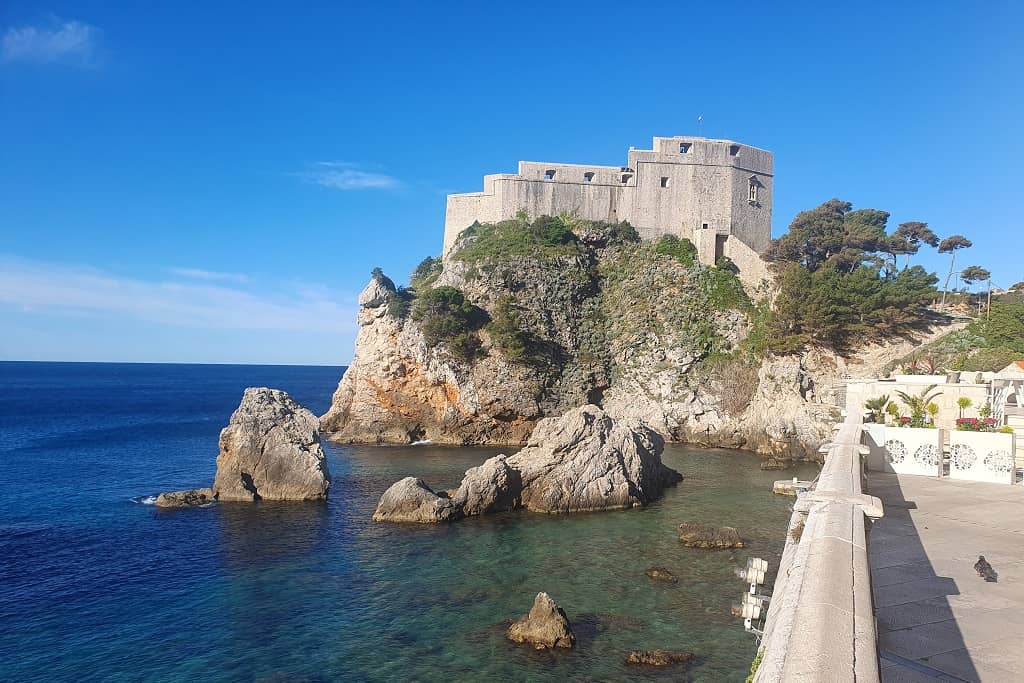
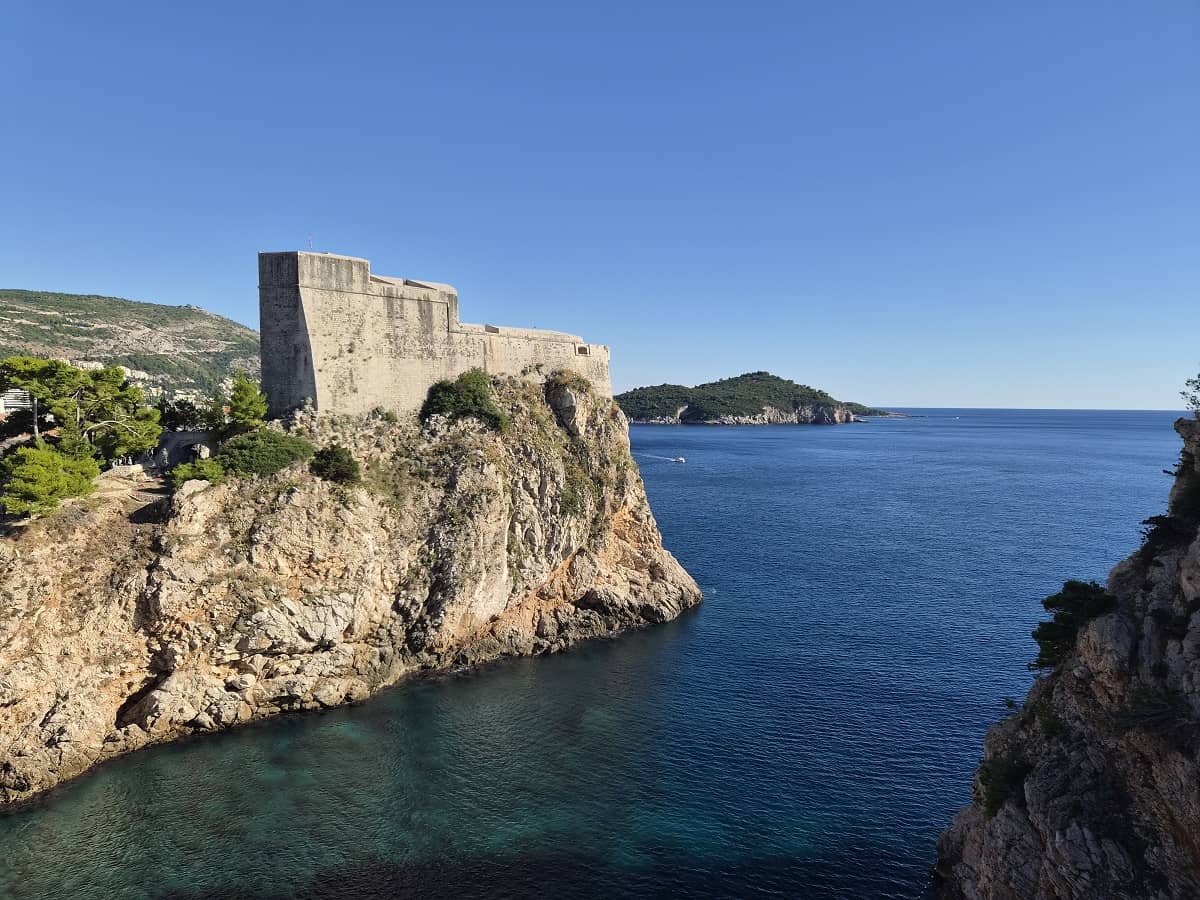
Fort Lovrijenac (Lovrjenac), also known as St Lawrence Fortress, rises dramatically on a 37-metre-high rock just outside Dubrovnik’s western city walls. Built to defend the approaches to the old Republic, it is now one of the best places in Dubrovnik for views back toward the City Walls, Fort Bokar, the Old Town and the Adriatic.
Lovrijenac combines military history, Dubrovnik’s fierce tradition of independence and one of the city’s most atmospheric settings. The fortress also hosts performances during the Dubrovnik Summer Festival and became internationally recognizable as the Red Keep in Game of Thrones.
The climb involves a substantial number of steep stone steps, but the views from the terraces are worth the effort. Allow around 45-60 minutes for the fortress itself, or longer if you enjoy photography and want to explore at a slower pace.
Fort Lovrijenac: quick overview
- Also called: Lovrjenac Fortress, St Lawrence Fortress and sometimes “Dubrovnik’s Gibraltar”
- Location: outside Dubrovnik Old Town, immediately west of Pile Gate
- Height: approximately 37 metres above the sea
- Historic role: defended Dubrovnik’s western land and sea approaches
- First written record: 1301, although Dubrovnik tradition places its origins much earlier
- Famous legend: Dubrovnik built Lovrijenac rapidly to prevent Venice from fortifying the same strategically important rock
- Famous inscription: “NON BENE PRO TOTO LIBERTAS VENDITUR AURO”
- Best for: Old Town views, fortress history, photography, theatre and Game of Thrones locations
- Time needed: approximately 45-60 minutes; allow longer for a relaxed visit
- Ticket: included with a valid Dubrovnik City Walls ticket; a Lovrijenac-only ticket is also available
- Access: steep stone staircases; not suitable for wheelchair access
- Best time: early morning or later afternoon, particularly in summer
Dubrovnik Super Saver:
Cable Car Ride and Old Town Walking Tour plus City Walls
Embark on an unforgettable journey through the stunning city of Dubrovnik, renowned for its breathtaking architecture and rich history. Stroll along the narrow and winding streets of the UNESCO World Heritage Site of Dubrovnik Old Town. Be awe-inspired by the mesmerising views from the 16th-century city walls, and take your experience to the next level by taking a cable car ride to Mt. Srd for panoramic views of the city.
Book your tour now and discover Dubrovnik with a knowledgeable tour expert.
Is Fort Lovrijenac worth visiting?
Yes, particularly if you are already visiting Dubrovnik’s City Walls. Lovrijenac gives you something the wall circuit cannot: a view back toward Dubrovnik from outside its fortifications.
From the upper terraces you can see Fort Bokar, the western walls, Pile, the small harbour below and the dense roofs and towers of the Old Town. It is one of the strongest photography locations close to the historic centre.
The fortress is also worthwhile for travellers interested in Dubrovnik’s political history. Its position, unusually thick seaward walls and famous inscription about liberty make it one of the clearest physical expressions of how seriously the Republic of Ragusa took the defence of its independence.
Game of Thrones fans will recognize the fortress immediately, while theatre lovers may know Lovrijenac as one of the best-known performance spaces of the Dubrovnik Summer Festival.
Where is Fort Lovrijenac?
Fort Lovrijenac stands on its own rocky outcrop immediately outside the western side of Dubrovnik Old Town. It is physically separate from the Dubrovnik City Walls, even though the two attractions are closely connected historically and through the current ticket system.
The fortress overlooks the small western harbour below Pile and faces Fort Bokar across the water. Together, these fortifications protected the vulnerable western approach to the city.
Walking from Pile Gate
- Start outside Pile Gate.
- Follow the signs toward Fort Lovrijenac and the western harbour.
- Continue to the staircase climbing the rocky outcrop.
- Follow the stone steps to the fortress entrance.
The distance is short, but the climb is steep. Allow roughly 10-15 minutes from the Pile area if you are taking the stairs at a comfortable pace.
From Gruž, Lapad or Babin Kuk
If you are staying elsewhere in Dubrovnik, take a local bus or taxi toward Pile and continue to the fortress on foot. See our Dubrovnik city bus guide for current public-transport information.
The famous Venice legend
One of the best-known stories associated with Lovrijenac concerns the rivalry between Dubrovnik and the powerful Republic of Venice.
According to Dubrovnik tradition, the Venetians planned to build a fortress on this strategically vital rock overlooking the western entrance to the city. When the people of Dubrovnik learned of the plan, they acted first and constructed their own fortress with extraordinary speed, traditionally said to have taken only around three months.
When the Venetian ships later arrived carrying stone and materials for their proposed stronghold, they found Lovrijenac already standing above the sea and were forced to abandon the project.
Whether every detail of the story can be documented exactly as later generations told it, the legend has endured because it perfectly captures Dubrovnik’s historic relationship with Venice: commercially connected, frequently competing and fiercely protective of its political independence.
History of Fort Lovrijenac
Dubrovnik tradition places the beginnings of Lovrijenac in the early 11th century, often around the period between 1018 and 1038. The first preserved written reference to the fortress dates from 1301.
Its location was strategically exceptional. Whoever controlled the rock above Pile could threaten Dubrovnik’s western harbour, the nearby road approaches and the fortifications protecting the city itself.
For the Republic of Ragusa, preventing a rival power from holding this position was therefore essential.
The fortress was repeatedly strengthened and adapted as military technology changed. What survives today reflects several periods of construction rather than one single building campaign.
After the Dubrovnik Republic
Following the fall of the Republic in the early 19th century, Lovrijenac was used by the Austrian authorities as a military barracks. Alterations were made to parts of the fortress, including changes to some cannon openings and internal spaces.
The army eventually left the fortress in the early 20th century. Lovrijenac later became increasingly important as a cultural monument and performance venue.
“Freedom is not sold for all the gold in the world”
Above the entrance to Lovrijenac is one of Dubrovnik’s most famous inscriptions:
NON BENE PRO TOTO LIBERTAS VENDITUR AURO
It is usually translated as:
“Freedom is not sold for all the gold in the world.”
The phrase has become closely associated with the ideals of the former Republic of Ragusa, which maintained a strong political identity centred on its independence and freedom.
The inscription is particularly appropriate at Lovrijenac: the fortress existed specifically to prevent an enemy from controlling one of the most strategically important positions outside the city walls.
Architecture and defensive design
Lovrijenac was shaped by the rock beneath it rather than imposed on a flat site. Its roughly triangular plan follows the contours of the outcrop and rises through several levels and terraces.
Walls facing the sea
The outer walls exposed to a potential enemy are extraordinarily substantial, reaching up to roughly 12 metres thick in places.
These massive defences protected the fortress from naval attack and bombardment from outside Dubrovnik.
The thin wall facing Dubrovnik
The wall facing the city is dramatically thinner, traditionally given as approximately 60 centimetres.
This was an ingenious security measure. The Republic wanted Lovrijenac strong enough to resist an external enemy, but not so strong that a rebellious commander or occupying force could use it against Dubrovnik itself.
If the fortress were captured, Dubrovnik’s own defenders could attack the relatively weak city-facing side.
Terraces and artillery
The fortress contains several levels connected by stone stairs, passages and open terraces. Artillery positions faced the sea and surrounding approaches, while the elevated site provided excellent visibility over the waters west of Dubrovnik.
What to see inside Fort Lovrijenac
Entrance and inscription
Pause at the main entrance to see the famous Latin inscription before continuing into the fortress.
Stone passages and courtyards
The interior is relatively austere compared with Dubrovnik’s palaces and churches. That is part of its appeal: Lovrijenac feels unmistakably like a defensive structure rather than a ceremonial building.
Fortress terraces
The upper levels provide the best views toward Dubrovnik. Give yourself time to walk around rather than heading immediately back down after reaching the top.
Chapel of St Lawrence
The fortress takes its name from St Lawrence, and a small chapel dedicated to the saint is incorporated into the complex.
Historic artillery
Cannons and defensive features help illustrate how the fortress controlled the approaches below.
Best views from Fort Lovrijenac
The views are one of the main reasons to make the climb.
Fort Bokar and the City Walls
The classic view looks across the narrow bay toward Fort Bokar and Dubrovnik’s western walls. This is one of the best places to photograph the fortifications from outside the Old Town.
Old Town rooftops
From the upper terraces you can see the dense historic centre rising behind the walls, including church towers and the terracotta rooftops that define Dubrovnik’s skyline.
West Harbour and Pile
Directly below is the small western harbour, today familiar as a departure area for kayak trips and as another well-known Game of Thrones filming location.
The Adriatic
Look west and south for uninterrupted views across the sea. On clear days, the contrast between the fortress stone, deep blue water and Old Town walls is particularly striking.
Fort Lovrijenac tickets
Lovrijenac is managed alongside Dubrovnik’s historic fortifications by the Society of Friends of Dubrovnik Antiquities.
If you have a Dubrovnik City Walls ticket
A valid Dubrovnik City Walls ticket includes admission to Fort Lovrijenac. You do not need to buy a separate Lovrijenac ticket when using the City Walls ticket according to the current official rules.
If you only want to visit Lovrijenac
A separate Lovrijenac ticket is available for visitors who do not initially plan to walk the City Walls.
What if you buy Lovrijenac first and then decide to walk the walls?
Current official rules allow visitors with a Lovrijenac ticket to visit the City Walls by paying the additional difference at the City Walls entrance.
Ticket prices can change, so use the official City Walls and Lovrijenac ticket shop for current prices.
Opening hours
Fort Lovrijenac has seasonal visitor hours. Summer opening is significantly longer than winter opening, and access can occasionally change because of maintenance, special events or performances.
The official heritage site currently publishes the day’s operating hours for Lovrijenac, so check before visiting if you are planning an early-morning or late-afternoon entry.
Check current Fort Lovrijenac opening hours.
Best time to visit Fort Lovrijenac
Early morning
Early morning is the best overall choice in summer. The climb is cooler, the fortress is usually quieter and there are fewer people in photographs looking back toward the Old Town.
Late afternoon
Later afternoon brings softer light and can be particularly attractive for views toward Dubrovnik’s western walls.
If you are also walking the City Walls, separating the two attractions can make the day more comfortable rather than doing both stair-heavy visits consecutively.
Midday in July and August
The approach and upper terraces are exposed to the sun, so midday can be tiring in peak summer heat. Bring water and sun protection.
For seasonal conditions, see our Dubrovnik weather guide.
Rain and strong wind
Stone stairs and exposed terraces can become less comfortable in rain or strong wind. Wear shoes with good grip and take extra care on wet surfaces.
Fort Lovrijenac and the Dubrovnik City Walls
The two attractions are best understood together.
The City Walls put you on top of Dubrovnik’s fortifications, with views inward across rooftops and outward toward the Adriatic.
Lovrijenac puts you outside the fortifications looking back at them.
If you have enough time, visit both rather than choosing between them.
A comfortable summer plan
- Walk the City Walls early in the morning.
- Explore Stradun and the Old Town during the middle part of the day.
- Return toward Pile later in the afternoon.
- Climb to Lovrijenac when the heat and light are softer.
Fort Lovrijenac and Game of Thrones
Lovrijenac is one of Dubrovnik’s most recognizable Game of Thrones filming locations. The fortress represented parts of the Red Keep in King’s Landing.
Its terraces and courtyards appear in several scenes, including sequences connected with the tournament held in honour of King Joffrey.
The small harbour beneath Lovrijenac and the nearby western walls were also used extensively in filming, making the Pile area particularly rich in recognizable locations.
See our Game of Thrones in Dubrovnik guide for a wider filming-location route.
Dubrovnik Summer Festival and theatre at Lovrijenac
Lovrijenac has become one of Dubrovnik’s most atmospheric performance spaces and is closely associated with the Dubrovnik Summer Festival.
The fortress is particularly famous for theatrical productions, including performances of Shakespeare. Stone walls, open sky and the sea surrounding the stage give performances here a setting that would be difficult to reproduce in a conventional theatre.
Watching Romeo and Juliet at Lovrijenac during the Summer Festival is a very different experience from visiting during normal sightseeing hours. As the daylight disappears behind the fortress and the Old Town begins to glow across the water, the building itself becomes part of the performance rather than simply its backdrop.
If a performance is scheduled during your stay, check the current Dubrovnik events listings. Events can occasionally affect normal visitor access.
Accessibility, stairs and practical advice
Lovrijenac is one of Dubrovnik’s more physically demanding central attractions because reaching the entrance requires climbing a long series of stone steps.
- Wheelchair access: the fortress is not practically wheelchair accessible
- Reduced mobility: the climb can be difficult for anyone with significant knee, balance or mobility problems
- Footwear: wear supportive shoes with good grip
- Rain: stone steps can become slippery
- Heat: the approach and upper terraces can be exposed to strong summer sun
- Children: supervise children carefully around stairways, terraces and historic parapets
- Water: bring drinking water in hot weather
The official heritage organization also notes that its historic sites can be difficult to access for people with disabilities because of their physical characteristics.
Facilities
Lovrijenac is a historic fortress rather than a modern visitor centre, so facilities are limited compared with those available around Pile and inside the Old Town.
Use toilets, buy drinks or refill your water before climbing if needed. The Pile area and nearby Stradun offer far more services.
Parking near Fort Lovrijenac
Driving directly to the fortress is not practical. Parking around Pile and the Old Town is limited and can be expensive, particularly during summer.
If arriving by car, consider parking away from the immediate Old Town entrance and continuing on foot or by local transport.
Useful options include the Public Garage Dubrovnik and Gradac Parking. Check the dedicated parking pages for current prices and access details.
How long do you need at Fort Lovrijenac?
30 minutes
Enough for a quick visit if you mainly want to climb to the upper terrace and take photographs.
45-60 minutes
A comfortable amount of time for most visitors. You can explore the terraces, passages, chapel and viewpoints without rushing.
60-90 minutes
Better for photographers, history enthusiasts or anyone who wants to spend longer enjoying the views.
Remember to add roughly 10-15 minutes for the approach and stair climb from the Pile area.
Nearby attractions
- Pile Gate - the main western entrance to Dubrovnik Old Town
- Dubrovnik City Walls - naturally paired with Lovrijenac and included in the same main ticket
- Stradun - Dubrovnik’s main Old Town promenade
- Big Onofrio’s Fountain - immediately inside Pile Gate
- Sponza Palace - at the eastern end of Stradun
- Dubrovnik Cathedral - one of the Old Town’s principal religious landmarks
FAQ - Fort Lovrijenac
Is Fort Lovrijenac worth visiting?
Yes. It offers some of the best external views of Dubrovnik’s City Walls and combines military history, excellent photography and a quieter atmosphere than many central Old Town attractions.
Is Fort Lovrijenac included with the Dubrovnik City Walls ticket?
Yes. Under the current official rules, a Dubrovnik City Walls ticket also allows you to visit Lovrijenac Fortress.
Can you visit Lovrijenac without walking the City Walls?
Yes. A separate Lovrijenac ticket is available if you only want to visit the fortress.
What if I buy a Lovrijenac ticket and later want to visit the City Walls?
You can pay the additional difference at a City Walls entrance according to the current official ticket rules. Keep your Lovrijenac ticket.
How long do you need at Fort Lovrijenac?
Most visitors need around 45-60 minutes inside the fortress. Allow additional time for the climb from Pile and longer if you enjoy photography.
Is Fort Lovrijenac outside Dubrovnik City Walls?
Yes. Lovrijenac stands on a separate rocky outcrop immediately west of the walled Old Town.
How high is Fort Lovrijenac?
The fortress stands on a rock approximately 37 metres above the sea.
Why was Fort Lovrijenac built?
It protected Dubrovnik’s vulnerable western land and sea approaches and prevented an enemy from occupying a strategically commanding rock beside the city.
What is the Venice legend about Fort Lovrijenac?
According to Dubrovnik tradition, Venice planned to build a fortress on the rock. Dubrovnik learned of the plan and rapidly built Lovrijenac first, so when Venetian ships arrived with construction materials they found the strategic position already occupied.
What does the inscription at Fort Lovrijenac mean?
The Latin inscription “Non bene pro toto libertas venditur auro” is usually translated as “Freedom is not sold for all the gold in the world.”
Is Fort Lovrijenac wheelchair accessible?
No. Reaching and exploring the fortress requires steep stone staircases and there is no practical step-free route.
What is the best time to visit Fort Lovrijenac?
Early morning is best for cooler temperatures and fewer people. Late afternoon can provide attractive light for views toward the Old Town.
Was Game of Thrones filmed at Fort Lovrijenac?
Yes. Lovrijenac represented parts of the Red Keep in King’s Landing and appears in several scenes from the series.
Can you see Dubrovnik Old Town from Lovrijenac?
Yes. The fortress has excellent views across to Fort Bokar, the western City Walls and Dubrovnik Old Town.
Are performances held at Fort Lovrijenac?
Yes. Lovrijenac is an important performance venue during the Dubrovnik Summer Festival and is particularly associated with theatrical productions.